
XWA Power & Cable | Rubber Cable Models
SHD-GC for shielded trailing power for mobile mining plant
Voltage class shown: 5 kV AC (5,000 V)
SHD-GC cable is a shielded mining trailing cable with flexible power cores, grounding conductors and a ground-check conductor. Its screened power-core construction suits equipment connections where voltage control and ground monitoring must work together.
The reference design on this page is a three-power-core, 5 kV construction. Each phase includes the appropriate conductor screen, EPR insulation and flexible metallic shielding arrangement. Different SHD-GC voltage classes have different insulation and dimensional schedules.
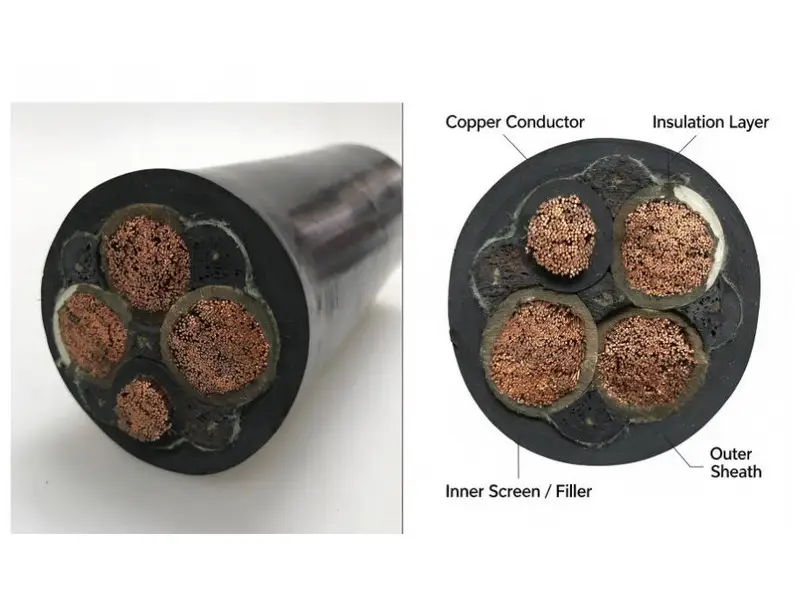
5 kV reference construction
SHD-GC conductor and layer arrangement

| Component | Construction |
|---|---|
| Phase conductor | Three flexible rope-lay copper conductors. |
| Conductor screen and insulation | Semiconductive conductor screen followed by EPR insulation. |
| Insulation shielding | Flexible copper/textile braid shielding around each insulated phase in the reference design. |
| Grounding and check | Two grounding conductors plus a separately insulated ground-check core. |
| Outer protection | Reinforced heavy-duty jacket enclosing the complete assembly. |
ICEA S-75-381 / NEMA WC 58 provides the mining-cable construction and test framework. The cited dimensional group is specifically 5 kV, 100% insulation level, grounded service. Other voltage groups require their own design tables.
SHD-GC reference sizes and technical data
| Power cores | Ground (AWG) | Check (AWG) | Insulation (mm) | Jacket (mm) | OD (mm) | Mass (kg/km) | Current (A) |
|---|---|---|---|---|---|---|---|
| 3 × 1/0 AWG | 4 | 8 | 2.8 | 5.6 | 52.3 | 4530 | 211 |
| 3 × 2/0 AWG | 3 | 8 | 2.8 | 5.6 | 55.1 | 5315 | 243 |
| 3 × 4/0 AWG | 1 | 8 | 2.8 | 6.0 | 68.8 | 7380 | 321 |
Selected 5 kV reference construction: three power cores, two grounding conductors and one check core; 100% insulation level, grounded. Reference current values use 90°C conductor and 40°C ambient air under ICEA S-75-381/NEMA WC 58; reel layers and installation conditions require correction.
Shield termination belongs in the machine connection design
Power shovels, draglines and other relocatable mining plant place combined electrical and mechanical demands on their supply cable. The power-core shields, grounding conductors, monitor loop and coupler must remain coordinated when cable is extended, repaired or replaced.
We would treat the coupling arrangement as part of the cable requirement from the outset. A heavier jacket can improve mechanical protection, but it does not address a mismatched shield connection or an unsuitable ground-check termination.
SHD-GC and related rubber cable types
| Cable family | Relevant distinction |
|---|---|
| Type G-GC | Ground-check cable with a different power-core screening arrangement; the selected reference is 2 kV. |
| SHD-GC 5 kV | Screened power cores and monitoring conductors for the defined 5 kV duty. |
| SHD-GC at other voltages | Separate insulation, screen, diameter and coupling requirements; retain the exact voltage class. |
For the wider context of SHD-GC applications, explore the rubber cable range, NSSHÖU heavy-duty cable and our XWA factory information.
SHD-GC cable questions
What distinguishes SHD-GC from G-GC?
SHD-GC adds a shielded power-core construction. Both the shield system and the required voltage class affect dimensions, grounding and termination design.
Does a 5 kV table apply to 8 kV or 15 kV cable?
No. Each voltage class requires the corresponding insulation and screen design. The reference dimensions on this page describe only the stated 5 kV construction.
Is the ground-check conductor the same as a grounding conductor?
The check core is used in the monitoring loop. The grounding conductors and the shield-grounding arrangement carry their specified protective duties.
Discuss a SHD-GC cable project with XWA
Send your SHD-GC cable schedule or equipment specification, required length and destination to info@xwacable.com. A drawing or an existing designation is a practical starting point for a product and quotation discussion.
For standards context, see the official technical reference.