
Bare Overhead Conductor
AAC Conductor for Overhead Distribution Lines
AAC conductor, also called all aluminum conductor or AAC cable, is a bare concentric-stranded conductor made from aluminum wires without a steel core. It combines high conductivity with low conductor mass for overhead circuits where the required mechanical loading is moderate.
MaterialAluminum 1350-H19
ConstructionConcentric stranded
StandardsASTM B231 / IEC 61089
Primary useOverhead line systems
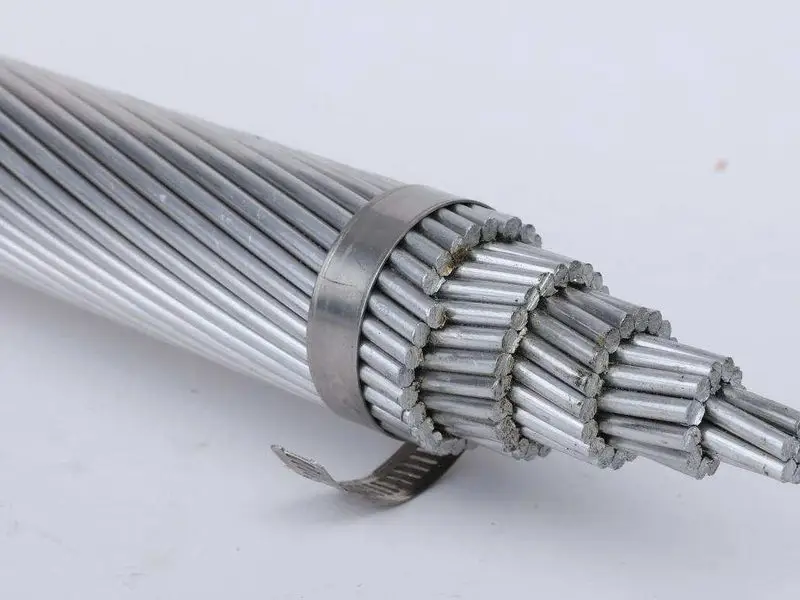
XWA AAC Conductor
AAC combines high electrical conductivity with low conductor mass. It is primarily used where span and mechanical loading remain within the capability of an all-aluminum construction.
The finished conductor is configured by governing standard, code word or nominal area, strand count, resistance, rated strength, total length and drum schedule. AAC is bare conductor; it does not include insulation or a steel-reinforcement core.
AAC Conductor Construction
A typical AAC design uses hard-drawn 1350-H19 aluminum wires arranged in concentric layers. ASTM B230 covers the aluminum wire, while ASTM B231 covers concentric-lay-stranded AAC. IEC 61089 provides another specification framework for round-wire concentric-lay overhead conductors. A project specification must identify the governing edition and any utility-specific requirements.

| Construction item | Typical AAC arrangement | Why it matters |
|---|---|---|
| Conductor material | Aluminum 1350-H19 under common ASTM designs | Defines conductivity and wire mechanical properties |
| Stranding | Concentric layers, commonly 7, 19, 37 or more wires depending on size | Controls finished diameter, flexibility and mechanical behavior |
| Core | No steel or alloy-reinforcement core | Distinguishes AAC from ACSR and ACAR |
| Insulation | None | Line clearances and insulation coordination belong to the overhead system |
| Surface | Bare metallic finish | Wire damage, sharp edges and surface defects require inspection |
Where AAC Fits in an Overhead Line
AAC is commonly considered for short-span distribution, substation connections and other overhead circuits where conductivity and low conductor mass are useful and the required tensile performance is moderate. It is not automatically the correct choice for long crossings, high wind or ice loading, large ruling spans, or routes that demand a reinforced core.
The line engineer determines suitability from the conductor tension limit, support spacing, sag-temperature behavior, wind and ice cases, clearance requirements, fittings and local loading rules. An attractive resistance value does not compensate for inadequate mechanical performance.
Electrical and Mechanical Data Must Be Read Together
The following values are reference examples derived from a published ASTM B231 manufacturer table. They illustrate the relationship between size, diameter, mass, resistance and rated strength; they are not an XWA guaranteed datasheet. Final values must come from the approved technical schedule and referenced standard.
| Code word | Size | Stranding | Approx. diameter | Approx. mass | DC resistance at 20°C | Rated strength |
|---|---|---|---|---|---|---|
| Rose | 4 AWG | 7 wires | 5.89 mm | 58 kg/km | 1.358 Ω/km | 3.92 kN |
| Iris | 2 AWG | 7 wires | 7.42 mm | 92 kg/km | 0.853 Ω/km | 6.00 kN |
| Poppy | 1/0 AWG | 7 wires | 9.35 mm | 147 kg/km | 0.538 Ω/km | 8.85 kN |
| Aster | 2/0 AWG | 7 wires | 10.52 mm | 186 kg/km | 0.427 Ω/km | 11.16 kN |
| Phlox | 3/0 AWG | 7 wires | 11.79 mm | 234 kg/km | 0.338 Ω/km | 13.52 kN |
Ampacity is deliberately excluded from this reference table. Current-carrying capacity changes with ambient temperature, solar radiation, wind speed and direction, conductor temperature and surface condition. IEC TR 61597 describes calculation considerations for overhead conductors; a single ampacity figure without its environmental assumptions is incomplete.
AAC, AAAC and ACSR Are Not Interchangeable
| Conductor | Core construction | Relative design emphasis | Typical selection boundary |
|---|---|---|---|
| AAC | All aluminum | Conductivity and low mass | Shorter spans and moderate mechanical duty |
| AAAC conductor | All aluminum alloy | Higher strength and corrosion performance than AAC | Routes needing an alloy conductor without steel reinforcement |
| ACSR conductor | Aluminum strands over steel core | High tensile capability | Longer spans or greater mechanical loading |
This comparison is directional, not a substitution rule. Conductor area, material grade, stranding and loading assumptions must be compared on the same basis. The aluminum conductor range provides the broader product-family context.
Manufacturing and Inspection Controls
AAC quality depends on both the incoming aluminum wire and the completed strand. Inspection normally confirms wire diameter and condition, strand count, lay direction and lay length, overall diameter, conductor mass, DC resistance and mechanical values required by the purchase specification. Test scope must be agreed against the applicable standard; a standard reference alone is not evidence of third-party certification.
- Confirm the exact standard, edition, code word or nominal cross-sectional area.
- Define stranding, conductor class and required dimensional tolerances.
- State resistance and rated-strength requirements using the same unit system as the standard.
- Include routine tests, inspection hold points and required document format in the technical schedule.
- Coordinate conductor data with fittings, clamps and stringing equipment before production release.
Drum Packing and Identification
Drum planning is part of the technical delivery. Required cut lengths should follow the line stringing plan so that avoidable joints are not introduced. Drum flange diameter, barrel diameter, gross weight and lifting arrangement must remain compatible with transport and site handling limits.
Typical drum identification includes product description, standard, conductor size or code word, strand count, net length, net and gross mass, drum number, production reference and direction of rolling. Exact markings follow the contract and destination requirements.
Standards and Engineering References
IEC 61089 defines electrical and mechanical characteristics for covered conductor families, while ASTM B230 and ASTM B231 are common references for 1350-H19 wire and completed AAC. The official IEC 61089 publication page is linked for scope verification. The standard named in a quotation must match the requested conductor system; mixing IEC and ASTM code words or tables without a declared basis can create dimensional and acceptance conflicts.
Related Overhead Conductor Pages
AAC Conductor FAQ
Is AAC conductor insulated?
No. AAC is normally a bare overhead conductor. ABC cable is an insulated aerial bundled product and should not be specified as AAC.
Does AAC conductor have a voltage rating?
AAC itself is not selected by a fixed cable voltage rating. System voltage, conductor clearances, insulators and insulation coordination are determined by the complete overhead line design.
When is AAAC or ACSR more suitable?
AAAC or ACSR may be more suitable when the route requires greater tensile strength, longer spans, or a different balance of sag, corrosion resistance and conductivity. See the engineering comparison of ACSR and AAAC conductor selection.
What information defines an AAC conductor quotation?
A usable configuration identifies the standard and edition, code word or conductor area, strand count, required length, drum schedule, resistance and rated-strength limits, test documentation, marking and destination handling constraints.
Contact XWA for AAC Conductor
XWA prepares the conductor construction and technical schedule around the applicable standard, code word or nominal area, stranding, required length and inspection documents.
Material: Aluminum 1350-H19
Construction: Bare concentric-stranded conductor
Standards: ASTM B231 / IEC 61089 project specifications