
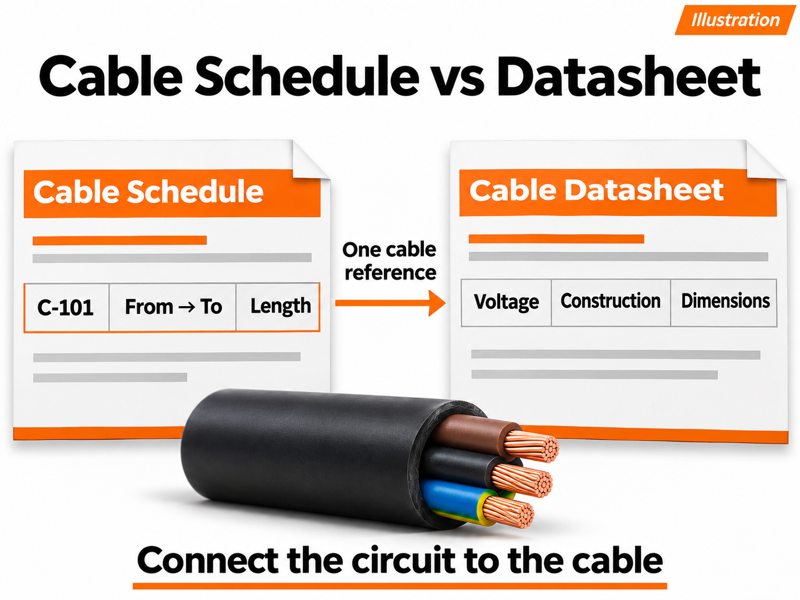
A cable schedule identifies the cable runs in a project; a cable datasheet defines the technical construction used for those runs. The schedule connects a cable reference to its endpoints, route and required length. The datasheet describes voltage rating, مواد, dimensions and declared characteristics. Keeping the two linked helps the factory, installation team and project engineer work from the same cable definition.

Follow one feeder from the drawing to the supply length
Consider an illustrative feeder between switchgear and an industrial distribution point. The circuit needs an identity even before its final route is measured. As the design develops, the cable construction, route and cut length become clearer. A shared reference keeps those decisions connected.
In this example, C-101 identifies the circuit and D-01 identifies the selected cable datasheet. Those labels are simple examples, not a prescribed international numbering system. The project’s reference convention should remain consistent across its drawings, schedules, labels and records.
| سؤال | Cable schedule | Cable datasheet |
|---|---|---|
| Which connection is this? | Cable tag, from/to equipment and route reference | Construction or type reference shared with the schedule |
| What is being supplied? | الترتيب الأساسي, conductor size and datasheet reference | الجهد االكهربى, موصل, العزل, شاشة, armour and sheath details as applicable |
| How much cable is needed? | Number of runs, length basis and required cut lengths | أبعاد, mass and handling characteristics used for delivery planning |
| Which version applies? | Issued revision and circuit changes | Matching construction revision and stated technical conditions |
The distinction is useful because one cable construction may serve several circuits, while a single circuit may contain several cable runs. Repeating the complete datasheet in every schedule row can make revisions harder to control. A concise, unambiguous link is usually more effective.
Make the construction reference specific enough to survive a revision
A note such as “copper XLPE cable” describes a material combination, but leaves several construction decisions open. A useful datasheet adds the rated voltage, ترتيب الموصل, نظام العزل, outer protection and the dimensions relevant to installation.
For a fixed LV feeder, طعام كابل الطاقة N2XY provides one construction context. For a screened MV connection, كابل N2XSY adds a distinct insulation-screen system and metallic-screen requirement. The circuit’s actual voltage and installation conditions determine which construction belongs in its schedule.
Keep operating system voltage and cable rated voltage in separate fields where the project uses both. على نفس المنوال, distinguish phase-conductor area from metallic-screen area. A notation such as 1×240/25 identifies different components rather than a single combined conductor size.
اللجنة الانتخابية المستقلة 60502-1 واللجنة الانتخابية المستقلة 60502-2 address construction and testing within their respective voltage and application scopes. اللجنة الانتخابية المستقلة 60228 addresses conductor characteristics. These references help define the product, while the schedule records where the selected product is used. The applicable edition and project requirements should be explicit.
Separate route length from the quantity of cable
Imagine a circuit using three separate single-core phase cables, each with an agreed cut length of 125 م. The required phase-cable quantity is 3 × 125 m = 375 م, supplied as the specified cuts. The route is not 375 m long merely because three cables follow it.
ال 125 m figure in this example is an assumed final cut length. Real cut lengths may need to account for the measured route, المقاطع العمودية, termination positions, installation arrangement and agreed reserve. A universal percentage allowance is less useful than documenting what has already been included.
This also keeps a quotation clearer. “375 m total” و “three continuous cuts of 125 م” describe the same aggregate quantity but different information for production and drum planning. Any separate protective conductor, bonding lead or auxiliary cable needs its own quantity where required by the design.
Our related MV cable drum-length explanation connects the cut-length decision to access, pulling sections and delivery constraints.
Let performance values carry their conditions
A datasheet current rating needs an installation basis. Cable arrangement, ambient or soil conditions, circuit grouping and screen bonding can change the result. The schedule can reference the relevant route or calculation rather than treating one catalogue ampere figure as valid for every circuit.
Short-circuit duty needs current and duration; bending requirements need the relevant installation or service condition. Dimensions matter at glands, cleats and accessories. These are useful interfaces between the product definition and the route, rather than extra columns added simply to make the schedule longer.
Our preference is to keep the schedule compact and retain the detailed conditions in the referenced technical document. That makes the information easier to read without separating a headline value from the basis that gives it meaning.
A route change should reach the documents that depend on it
Suppose C-101 moves from an open tray into an underground duct. The endpoints may remain unchanged, but length, الظروف الحرارية, pulling requirements and environmental protection may need review. Updating only the route description would leave the product and installation records out of step.
Identify which decisions the change affects, then revise the schedule, relevant datasheet or installation calculation accordingly. A change to conductor size can also affect cable diameter, mass and accessory fit. The revision reference makes that consequence traceable through the project.
اللجنة الانتخابية المستقلة 81346-1 provides principles for unambiguous reference designations, while IEC documentation work addresses the presentation and organisation of electrotechnical information. Neither should be treated as proof that one generic spreadsheet column set is mandatory for every project.
Use language support without changing the technical identity
Projects may use English datasheets alongside Spanish-language discussions or installation documents. Keep model names, تدوين الجهد, units and document references consistent when translating; a translated description should still identify the same cable construction.
For Spanish-language cable information, يرى XWA Energia. The circuit-specific schedule and agreed datasheet remain the technical references for the actual supply.
Give XWA a coherent project starting point
For a quotation discussion, share the cable schedule with its referenced datasheets, required cuts and current issue status. Where a construction is still being defined, identify the circuit voltage, conductor preference, route and key performance requirements so the open points can be addressed together.
A clear connection between circuit, construction and quantity is more useful than a long list of cable names. It helps focus the supply discussion on the cables the project will actually install. Send the available documents to info@xwacable.com.