
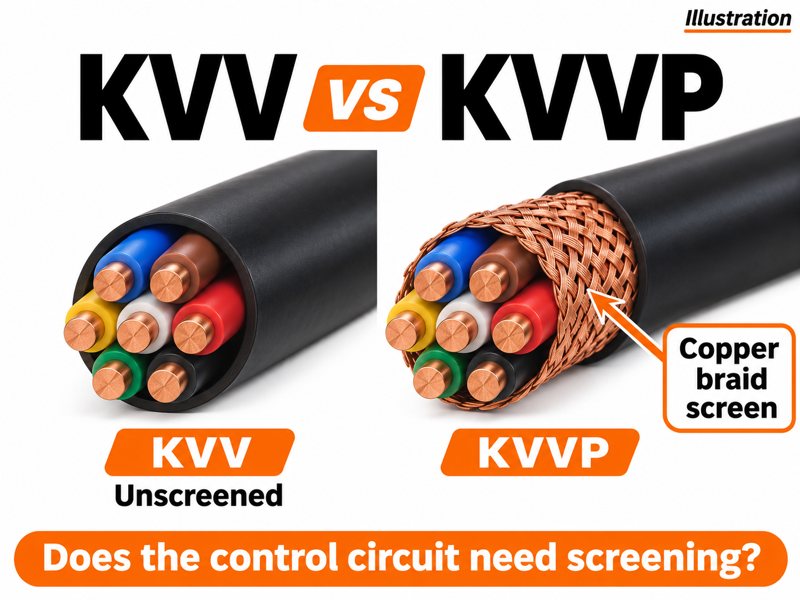
The difference between KVV and KVVP cable is the screen: KVV is unscreened, while KVVP adds an overall copper-wire braid around the insulated core assembly. The XWA constructions compared here both use copper conductors, PVC insulation and a PVC sheath, تصنيف 450/750 الخامس التيار المتردد. KVVP is relevant where the control circuit requires screening against electromagnetic interference. KVV remains a practical option for fixed control and auxiliary routes where the circuit design does not require a screen. The decision starts with the circuit and its surroundings, rather than treating the screened version as automatically better.

What is the control circuit actually carrying?
A relay command, an equipment-status contact and a sensitive analogue measurement can travel between the same two cabinets while presenting different demands. Their signal levels, input characteristics and acceptable disturbance determine how much attention the cable route needs. The word “control” alone does not describe that sensitivity.
For a fixed auxiliary connection on a protected route, an unscreened multicore cable may provide the straightforward construction the drawing calls for. A route close to switching equipment or drive power cables deserves a closer look at interference coupling and the receiving equipment. هنا, an overall copper screen can become a useful part of the installation design.
Our preference is to classify the circuit before adding layers to the cable. That keeps a simple auxiliary connection simple, while giving noise-sensitive functions the construction and installation attention they need.
| ميزة | KVV | KVVP |
|---|---|---|
| Conductor and polymers | نحاس, العزل PVC, غمد PVC | نحاس, العزل PVC, غمد PVC |
| Overall screen | لا أحد | Copper-wire braid around the multicore assembly |
| Rated voltage in this comparison | 450/750 الخامس التيار المتردد | 450/750 الخامس التيار المتردد |
| Primary selection reason | Fixed control or auxiliary circuit without a screening requirement | Fixed control circuit requiring an overall metallic screen |
| Equipment interface | Core identification, cable support and entry sealing | The same interfaces, plus the specified screen connection |
See the XWA construction pages for KVV unscreened control cable و KVVP copper-braid-screened cable. The comparison here addresses the choice between them, rather than replacing their product data.
Trace the noise source, the route and the receiver
Consider an illustrative control route between a cabinet and a field device near a motor installation. Start by locating the likely disturbance source: على سبيل المثال, a drive output, switched load or switching contact. Then trace where the control cable runs alongside that source or its power wiring. Finally, examine the input that receives the signal.
This source-path-receiver approach helps separate different remedies. Route separation addresses the coupling path. Screening addresses part of the electromagnetic exposure. The receiving equipment and its connection instructions determine the interface. A well-chosen cable supports that system; it does not replace the rest of it.
For a sensitive measurement or a communication circuit, the next decision may extend beyond KVV versus KVVP. Pairing, السعة, characteristic impedance or individual pair screening can matter to the specific signal. An overall-screened multicore control cable and a purpose-designed data or instrumentation cable solve different requirements.
الأوسع control-cable screen and core-arrangement explanation covers how the signal functions and conductor allocation influence the cable specification.
The braid needs a defined connection at the equipment
The copper braid in KVVP creates an overall screen around the core bundle. Its effectiveness depends on the complete installed arrangement, including the continuity of that screen and the way it meets the equipment enclosure or designated bonding point. For high-frequency interference, the geometry of that connection matters as well as electrical continuity.
Follow the equipment EMC instructions when specifying screen termination. A suitable screen clamp or EMC gland may form part of that interface. The decision between bonding arrangements belongs to the system design, taking account of frequency, equipment configuration and potential differences between connection points. A universal instruction to connect every control screen at only one end would oversimplify that decision.
Keep the protective conductor function explicit in the circuit drawing. The screen connection and protective earthing have different design duties. That distinction makes installation and inspection clearer, particularly where several control cables enter the same enclosure.
For the underlying installation context, the IEC describes an earthing and cabling guidance framework covering electromagnetic compatibility. It is an installation-level technical report, separate from the control cable’s construction standard.
Keep the core arrangement and installation duty visible
KVV and KVVP are associated with the GB/T 9330 plastic-insulated control-cable family. The agreed product specification should identify the applicable edition and construction. اللجنة الانتخابية المستقلة 60228 addresses conductor characteristics, بينما اللجنة الانتخابية المستقلة 60204-1 addresses electrical equipment of machinery; those references describe different parts of the engineering task.
The rated voltage is also distinct from the operating signal. أ 24 V control circuit can use cable with a higher insulation rating when the installation specification calls for it. ال 450/750 V designation describes the cable’s rated insulation duty, not a claim that every connected device operates at that voltage or that every core can carry the same current.
For the fixed constructions discussed here, select the conductor arrangement to suit the route and termination. Equipment that moves repeatedly needs a cable construction designed for that motion. Adding a braid to a fixed-installation cable does not by itself turn it into a continuous-flex machine lead.
Three ways the comparison ends in a useful specification
- A protected auxiliary route with no screening requirement: KVV may keep the installation economical and straightforward. Confirm core count, موصل المنطقة, voltage rating and the equipment connection.
- A fixed control route with a specified overall screen: KVVP adds the copper braid. Include the termination and bonding arrangement with the cable description so the screen has a clear role in the installed circuit.
- A sensitive signal or demanding movement duty: define those requirements first. The right solution may need a paired instrumentation, communication or motion-cable construction rather than a choice based only on the letter P.
للاستفسارات حول مشروع XWA, a circuit schedule or equipment drawing is a useful starting point. Send the required core count, موصل المنطقة, route length and quantities, together with any screening or movement requirements. We can discuss the relevant control-cable construction and quotation at info@xwacable.com.