
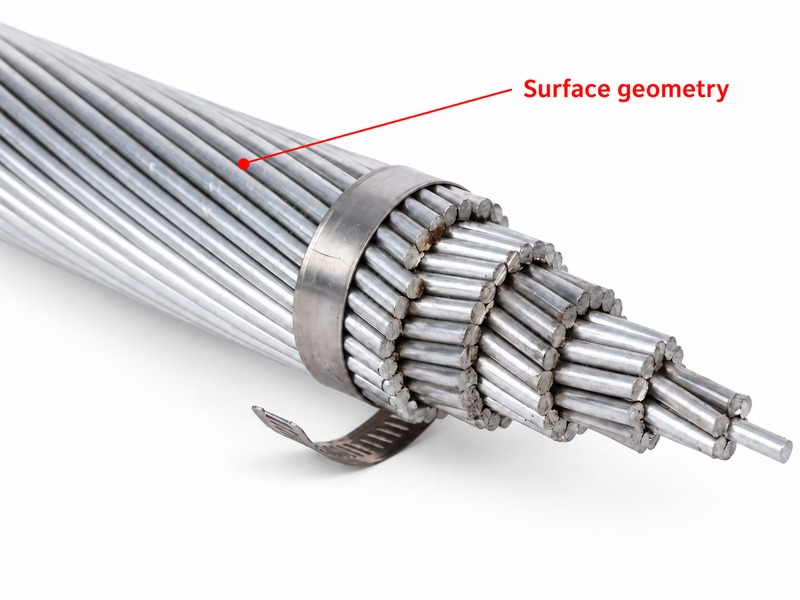
The corona effect in transmission lines is the localized ionization of air around an energized conductor or fitting when the local electric field becomes sufficiently intense. It can produce audible noise, radio interference and power loss without a flashover across the complete insulation gap. For an AC overhead line, its behavior depends on conductor surface geometry, the surrounding line arrangement and weather, not simply on load current or conductor area. The practical design question is therefore not just whether the conductor carries the required current, but how the complete energized geometry behaves under the relevant surface and environmental conditions.
This explanation concerns bare overhead conductors, principally on AC transmission lines. It is not a description of partial discharge within an insulated power cable, and it is not a field diagnosis based on sound alone.
Start with electric stress, not with conductor temperature
Current produces resistive heating. Voltage and the geometry around an energized surface determine electric stress. The two phenomena can interact with an operating line, but they are not the same problem. Raising the current rating of a conductor does not by itself establish acceptable corona performance.
The electric field is not uniformly distributed over every strand and accessory. A local projection or a change in geometry can create a higher-stress region than the average description of the conductor suggests. The outer surface and nearby fittings therefore matter alongside the conductor’s nominal diameter. A product name such as ACSR conductor identifies a construction family, not the complete electric-field environment of the installed line.
The useful distinction is between corona onset, the appearance of localized discharge under stated conditions, and the resulting noise or interference at a specified observation point. They are related, but a prediction of one is not automatically a measurement of the other. Neither can be reduced to a universal voltage threshold applicable to every overhead line.

A light wetting event can change the sound more than expected
Water droplets can enhance the local field at parts of an energized conductor surface. A line that behaves quietly in dry conditions can therefore become more noticeable when wet. However, rainfall intensity alone does not describe the conductor’s actual wetting state.
A 2024 CIGRE Science & Engineering study of AC overhead-line noise found that very low rain rates deserved particular attention and were not adequately represented by some existing predictions. The finding is not a rule that drizzle is always louder than heavy rain. It establishes that light rain, mist and a persistently wet surface must not be dismissed simply because the recorded rainfall rate is small.
There are two separate questions: how much sound the line generates, and how noticeable that sound is against the surrounding environment. Rain itself adds background sound. A quiet location with light wetting is a different observation condition from the same location during a noisy downpour.
An engineering comparison needs comparable surface and weather conditions. A dry sample, a freshly wetted sample and a sample that remains wet after rainfall do not automatically represent equivalent states. An unexplained difference between two noise readings is therefore insufficient grounds to attribute the change solely to conductor type.
The same metal area does not mean the same electric-field geometry
Cross-sectional metal area primarily describes how much conducting material is present. It does not fully describe the outside shape of a stranded assembly or the positions of neighboring energized members. Different constructions can have different overall diameters and outer-wire arrangements, even when a headline area appears similar.
For a transmission-line phase, several sub-conductors can be arranged as a bundle. Those separated members belong to the same phase; they are not the phases of an insulated ABC assembly. The number of sub-conductors, their individual diameter and their separation all enter the line’s electric-field geometry. Bundling is a recognized corona-control design option, but its benefit depends on the complete arrangement.
CIGRE’s public overview of Technical Brochure 792, Compact AC overhead lines, highlights a competing constraint: reducing phase spacing can increase conductor surface gradients and the risk of exceeding audible-noise criteria. A layout change made to fit a narrower corridor can therefore alter the electrical environment even when the conductor itself is unchanged.
| Quantity | What it describes | What it does not establish alone |
|---|---|---|
| Metal area, mm2 | The stated area of conductor material, with the area convention identified. | The finished external shape or the installed surface field. |
| Overall diameter, mm | The external dimension of a specified conductor. | Bundle spacing, phase arrangement or accessory stress. |
| Surface gradient, kV/cm or kV/m | Electric field at the surface under a stated model and operating condition. | A universal noise level at a residence or corridor boundary. |
| Sound pressure level, dB(A) | A weighted acoustic level at a stated observation point and measurement condition. | A conductor property independent of distance, surroundings and background sound. |
The product information and line model must use the same offered construction. Substituting nominal area for verified diameter, or treating bundle spacing as an interchangeable accessory detail, removes information that the corona assessment needs.
Surface treatment is a conditional measure, not a noise guarantee
Conductor surface condition can affect how water collects. Hydrophilic treatments are among the approaches studied for controlling wet-weather noise. The 2024 CIGRE research also showed that their benefit depended on surface gradient. A treatment result cannot be separated from the geometry and test conditions under which it was obtained.
For a manufacturer-facing specification, the useful requirement is an identified surface condition and evidence relevant to the proposed line configuration, rather than an unsupported description such as “low-noise conductor.” A visually smooth conductor is not a measured acoustic result. Similarly, a surface treatment that is technically possible elsewhere must not be presented as an XWA supply capability without verified product documentation.
CIGRE’s B2.83 research scope considers conductor and fitting shape, weather, surface treatments, phase arrangement and bundle configuration together. That multi-variable approach is more defensible than changing one material label and assuming that a noise problem has been solved.
The overhead conductor range provides construction context. The line-level assessment still needs the actual geometry and environment; the product page is not a substitute for that assessment.
Identify the mechanism before choosing a remedy
A crackle, hum or whistle reported near a line is an observation, not a complete technical diagnosis. Wet-weather electrical discharge, wind interaction and a localized equipment problem can require different investigations. Sound alone does not establish that a line is safe, nor does it prove a conductor defect.
- Wet-weather crackle or hiss: investigate the weather correlation and the location of discharge through the operator’s approved assessment methods. Do not assume that all noise comes from the conductor spans rather than fittings.
- Wind-related movement or sound: consider aerodynamic excitation separately. The distinction between aeolian vibration and galloping concerns mechanical motion and fatigue, not an acoustic acceptance test for corona.
- A newly localized or changing symptom: retain the location, time and conditions for the network operator’s review. An electrical investigation must not be replaced with a general claim that transmission-line noise is normal.
A noise comparison also needs a stated measurement method: observation position, weather, relevant acoustic metric, instrument setup, background treatment and uncertainty. The National Physical Laboratory’s measurement uncertainty guidance explains why sound-level-meter operation and calibration contribute to the uncertainty of the result. Its historical report is methodological context, not a current transmission-line acceptance limit.
AC and DC conclusions must also remain separate. EPRI’s HVDC research overview identifies space-charge effects that distinguish DC electric-field behavior from AC operation. An AC wet-weather noise relationship cannot simply be transferred to an HVDC line.
For a noise-sensitive route, specify the operating line, not just the conductor. Conductor dimensions and surface condition, phase and bundle geometry, relevant weather states and the assessment location form the technical basis of a meaningful evaluation. That approach identifies whether the missing information lies in the product definition, the line design or the measurement, instead of treating larger area as the automatic answer.