
Project power distribution
Dry type transformers use solid insulation and air cooling rather than an oil-filled tank. XWA offers cast-resin transformer configurations for building substations, industrial distribution and project power systems where equipment location, ventilation and service access shape the design.
The SC(B) cast-resin family combines resin-insulated windings with an air-cooled assembly. O 10/10.5 kV to 0.4 kV series presented here covers 30 para 2,500 kVA. The product programme also includes separate 35 kV cast-resin designs.
XWA works with a specialist transformer manufacturing partner to coordinate product selection, technical schedules and quotations for international projects. Send your required rating and voltage ratio to start a transformer enquiry.
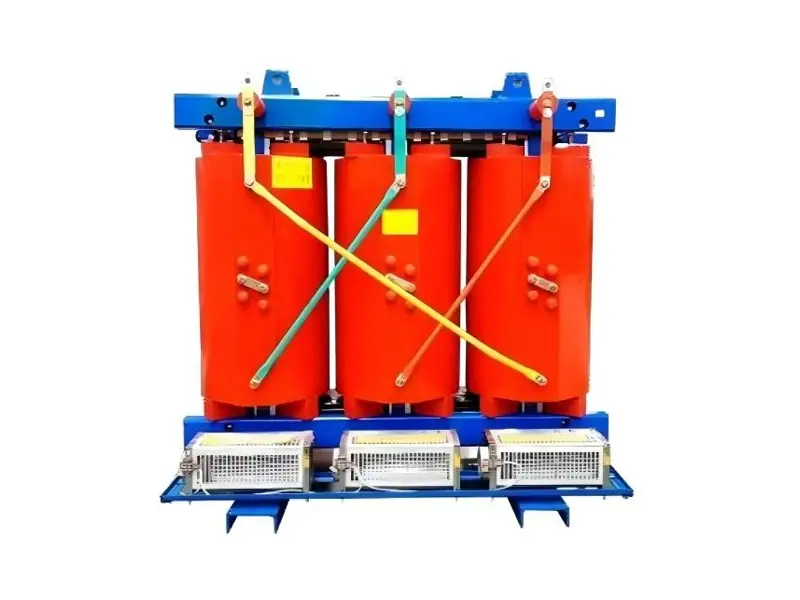
Cast-resin windings and a clear airflow path
The cast-resin construction encapsulates the winding insulation system and leaves air passages around the active assembly. This arrangement suits indoor electrical rooms where an oil containment system would add installation complexity.
Cooling and enclosure work together
Natural-air cooling relies on free air movement through the winding assembly. Fan-assisted cooling is a separately specified operating condition, with its own permissible output and control arrangement. An enclosure changes the airflow path, so its protection rating and ventilation openings belong in the same thermal assessment.
Our recommendation for an indoor project is to settle the room arrangement early: intake and exhaust locations, folgas, ambient temperature and service access affect the installation as much as the transformer footprint.

SC(B)18 cast-resin technical data
| Parâmetro | Configuração |
|---|---|
| Família de produtos | SC(B)18 cast-resin, trifásico |
| Capacity series | 30–2,500 kVA at the stated voltage combination |
| Primary / secondary | 10 ou 10.5 kV / 0.4 kV |
| Vector group options | Dyn11 or Yyn0, selected for the system |
| HV tapping options | ±2 × 2.5% or ±5%, conforme especificado |
| Frequency and cooling rating | Project-specific frequency; natural-air or fan-assisted configuration |
| Thermal system and enclosure | Insulation class, winding temperature rise and enclosure selected together |
Selected SC(B)18 classificações: 10/0.4 kV
| Rated capacity (kVA) | No-load loss (C) | Short-circuit impedance (%) |
|---|---|---|
| 100 | 230 | 4.0 |
| 250 | 415 | 4.0 |
| 500 | 670 | 4.0 |
| 800 | 875 | 4.5 |
| 1,000 | 1,020 | 4.5 |
| 1,600 | 1,415 | 4.5 |
| 2,500 | 2,080 | 5.0 |
Catalogue values for the stated product family and voltage ratio. Dimensões finais, load losses at the specified reference temperature and guaranteed performance are recorded in the project datasheet.
No 0.4 kV, a three-phase 1,000 kVA transformer has a rated line current of approximately 1,443 UM, calculated as 1,000,000 / (√3 × 400). Switchgear connections, terminals and busbar arrangements therefore need to be considered alongside the kVA rating.
Compare losses at the same rating
Para o 1,000 kVA, 10/0.4 kV configurations below, catalogue no-load losses are 1,415 W for SC(B)12, 1,205 W for SC(B)14 e 1,020 W for SC(B)18. The comparison isolates core losses; winding losses and the actual load profile determine the rest of the operating loss.
A lower core-loss value is particularly useful when a transformer remains energised for long periods at modest load. At high loading, the winding-loss schedule becomes more influential. Comparing both at the agreed reference conditions gives a more useful picture than an isolated efficiency percentage.
Temperature class is part of the thermal design
Class F and Class H identify insulation-system thermal classes. The permitted winding temperature rise, condições ambientais, cooling mode and enclosure remain separate design inputs. Temperature sensing and fan control, where fitted, should be coordinated with the selected rating and protection settings.
Where cast-resin transformers fit
| Project setting | Design focus |
|---|---|
| Commercial and public buildings | Indoor distribution rooms, rising-main supply and accessible maintenance routes. |
| Instalações industriais | Process-load distribution with attention to motor starting, harmonics and expansion duty. |
| Urban substations | Electrical-room layouts with ventilation and acoustic requirements established. |
| Renewable-energy auxiliaries | Site distribution duties matched to the voltage ratio and load characteristics. |
For an indoor room with restricted ventilation, the enclosure and air path deserve attention before the footprint is fixed. For an outdoor installation, an oil-immersed alternative may offer a different balance of cooling, space and site works. Explorar o XWA power transformer range for the wider programme.
Standards and project inspection
CEI 60076-11 addresses dry-type power transformers within its defined scope. CEI 60076-1 covers general requirements and IEC 60076-3 addresses winding insulation and dielectric tests.
The specification establishes applicable standards and editions, testes, reference temperatures, acceptance values and inspection responsibilities. Winding resistance, relação de tensão, phase displacement, losses and dielectric performance are key items in a transformer test schedule; temperature-rise and additional tests follow the contract requirements.
Technical review aligns the electrical schedule with the installation drawing: arranjo terminal, lifting points, dimensões, earthing provisions and transport configuration. This makes documentation useful to the installation team as well as the project reviewer.
Referência: IEC dry-type transformer standard scope.
Dry Type Transformer FAQs
Is a cast-resin transformer a dry type transformer?
Sim. Cast resin is a dry-type construction in which resin forms part of the winding insulation system. Other dry-type constructions use different insulation processes.
Can a dry type transformer be installed outdoors?
An outdoor installation needs a suitable enclosure, weather protection, ventilation and environmental design. The complete assembly and site conditions determine suitability.
Which voltage and capacity does this range cover?
The detailed SC(B)18 examples on this page cover the 10/10.5 kV to 0.4 kV, 30–2,500 kVA family. Separate technical schedules apply to 35 kV designs and other voltage ratios.
What starts a project quotation?
The required kVA rating, primary and secondary voltages, freqüência, quantity and installation location start the discussion. A single-line diagram or transformer schedule helps align the remaining details.
Discuss your transformer requirement with XWA
Send capacity, primary and secondary voltages, freqüência, quantity and project destination. Include a single-line diagram or transformer schedule if available. XWA can coordinate the configuration and quotation with our transformer manufacturing partner.
Use o XWA contact page or the enquiry form below.