
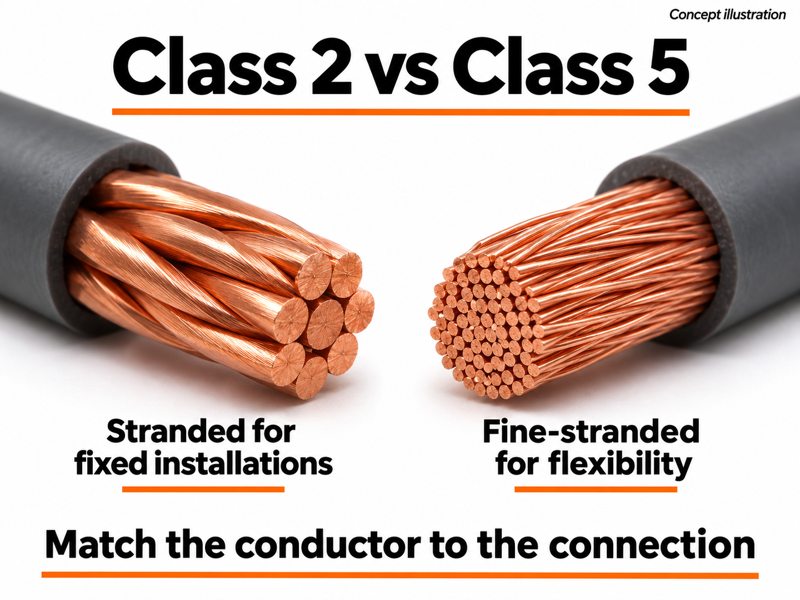
Klasse 2 and Class 5 are both stranded conductor constructions, but they suit different handling requirements. Klasse 2 is associated with fixed-installation cables; Klasse 5 uses finer copper wires to provide greater flexibility. The practical decision is whether the complete cable suits its duty and whether the conductor is compatible with the lug, connector or terminal.

Resolve handling and connection together
A fixed feeder positioned during installation, a flexible lead handled between tasks and a continuously moving machine connection experience different conditions. Start with that movement description, then consider the conductor construction.
At the equipment, nominal conductor area is only part of connection compatibility. Material, Dirigentenklasse, preparation and the terminal’s accepted constructions also matter. Our preference is to resolve the handling and connection questions together, so improved flexibility remains useful at the final equipment inlet.
Klasse 2 vs Class 5: the practical distinction
IEC 60228 distinguishes Class 2 stranded constructions from flexible copper conductors in Classes 5 Und 6. It addresses conductor construction and resistance; the applicable cable standard determines its use in the finished cable.
| Auswahlpunkt | Klasse 2 | Klasse 5 |
|---|---|---|
| Konstruktion | Stranded; circular, compacted or shaped designs according to the construction | Fine-stranded flexible copper |
| Typische Rolle | Fixed power-cable installations | Flexible equipment connections and handling applications suited to the complete cable |
| Verbindungsüberprüfung | Check acceptance of the actual conductor construction | Check fine-strand acceptance and required preparation |
| Properties specified separately | Stromspannung, Isolierung, Mantel, dimensions and installation conditions | The same properties, plus the required movement duty where applicable |
Klasse 1 is the solid-conductor category. Klasse 2 is not another name for solid wire, and Class 5 is not a complete cable type. The insulation, sheath and other layers remain part of the product specification.
A 70 mm² substitution reaches the equipment inlet
Consider an illustrative request to replace a fixed 70 mm² feeder construction with a more flexible 70 mm² cable because space near equipment is restricted. The nominal area stays the same, but the conductor class changes.
Compare the actual conductor diameter and shape, finished cable diameter and connection hardware. A different bundle can require a different connector variant or preparation even when the stated area matches. Cable-entry seals and support also need to suit the proposed finished construction.
For a compression connection, follow the connector manufacturer’s conductor range, Vorbereitung, die system and crimping instructions. For a mechanical connector, follow its accepted conductor constructions and installation requirements. A lug’s area marking is useful, but it belongs with that compatibility information.
IEC 61238-1-1 provides a test framework for its covered LV power-cable connectors. That scope supports a construction-specific approach rather than choosing connection hardware by area alone.
Keep fine strands controlled at the terminal
Some terminals accept fine-stranded conductors directly; others specify an approved ferrule or other preparation. A ferrule is one option, not an automatic requirement for every Class 5 Leiter.
Where a ferrule is specified, its size and form must suit both conductor and terminal. Crimp it using the appropriate tool before insertion; terminal-screw pressure is not a substitute for correct preparation. Small terminal-block ferrules and large power-cable lugs serve different connection arrangements.
Support the cable so handling loads stay away from the terminations. Die HSEs equipment suitability guidance places robust cables, fittings and maintenance within the wider operating environment.
Flexibility is not a repetitive-movement rating
Finer strands can improve handling, but repeated bending, Torsion, tension and travel require a complete cable designed for that duty. Isolierung, Mantel, core assembly and support arrangements contribute alongside the conductor.
A connection repositioned between tasks and a powered reel need different movement descriptions. Use the selected cable’s declared fixed or moving conditions rather than infer a cycle life from Class 5 alone. IEC 60204-1 addresses machine electrical equipment within its scope; it does not turn every flexible cable into a continuous-motion design.
ESSEN N2XY power cable provides a fixed-feeder context, während H07RN-F Gummikabel provides a flexible equipment-connection context. These are different complete constructions, with separate voltage, material and service characteristics.
Preserve the electrical basis when changing class
The circuit still needs the specified voltage rating, aktuelle Kapazität, voltage-drop performance and fault withstand. Changing conductor class does not justify an automatic ampacity increase or a reduction in nominal area.
Use the resistance requirements and design data applicable to the selected conductor. The complete cable arrangement, installation temperature, protective devices and terminal limits remain relevant. For AC power cables, assess the applicable losses rather than treating wire fineness as a current-rating formula.
A clear schedule identifies nominal area and conductor class, then references the full construction. Unser cable-marking explanation distinguishes conductor size, core arrangement and voltage information without treating one field as the entire specification.
Define the useful change, not just the softer conductor
Klasse 2 is often the straightforward construction for a fixed route. A suitable Class 5 cable can be worth considering where handling flexibility matters, with the connection and operating duty kept in view. Neither class is universally better.
For an XWA project discussion, send the voltage class, Dirigentenbereich und Klasse, Kernanordnung, lengths and connection details. If replacing an existing cable, include its description and the handling problem to be addressed. These details give us a focused basis for a construction and quotation discussion at info@xwacable.com.