
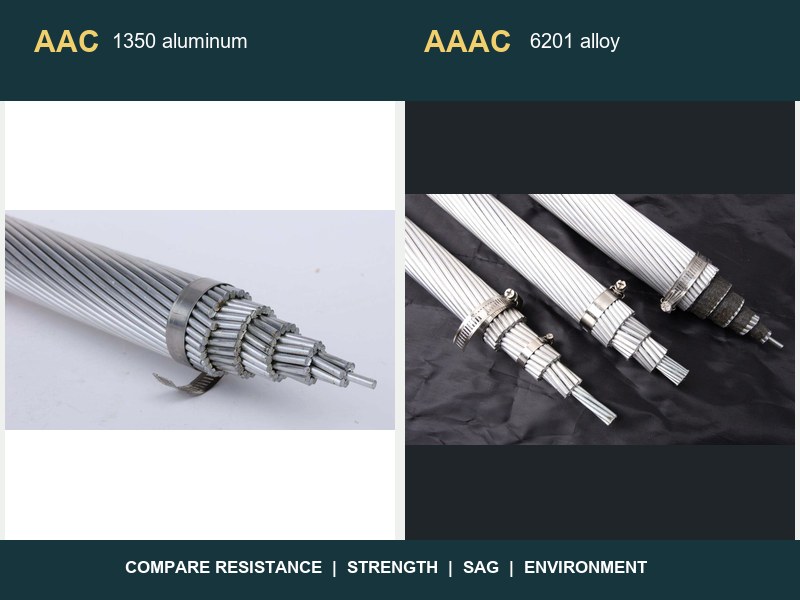
AAC and AAAC are both all-aluminum overhead conductors, لكنها ليست قابلة للتبديل. AAC normally uses high-conductivity 1350 aluminum and is strongest where electrical efficiency and low conductor mass matter more than high tensile demand. AAAC normally uses a heat-treated aluminum alloy such as 6201, giving greater mechanical strength at the cost of higher electrical resistance for the same nominal aluminum area. The correct choice comes from one coordinated comparison of resistance, قوة الشد المقدرة, sag-tension behavior, التعرض البيئي, التجهيزات, and the governing conductor standard.
The most important distinction is not visible in a product photograph. Bare AAC and AAAC can have similar concentric-lay geometry and a similar metallic appearance. Alloy designation, temper, strand schedule, مقاومة, and tensile data must remain traceable through the specification and test records.
One material change moves four engineering boundaries.
The usual shorthand says that AAC has better conductivity and AAAC has better strength. That is directionally useful, but incomplete. A line is not designed from material names alone: changing the wire material changes the area required for a resistance target, the conductor mass and diameter, the rated tensile strength, the sag-tension result, and potentially the hardware selected for the line.
| Decision boundary | AAC design tendency | AAAC design tendency | What must be compared |
|---|---|---|---|
| Electrical | Lower resistance for the same nominal aluminum area. | Higher resistance for the same nominal aluminum area. | DC resistance at the stated reference temperature, then AC resistance and thermal rating for the installed line. |
| ميكانيكية | Lower tensile capability where conductor area and construction are otherwise comparable. | Higher tensile capability from the alloy wire system. | Rated tensile strength, everyday tension, maximum load case, creep, and safety factors. |
| Geometry | A smaller area may meet an electrical target, but not a mechanical target. | A mechanically efficient choice may need more area to meet the same resistance target. | Actual stranding, القطر الكلي, الكتلة لكل وحدة الطول, and wind or ice loading. |
| بيئة | All-aluminum construction avoids a dissimilar steel core. | Also avoids a steel core; the alloy name alone does not settle corrosion life. | Atmosphere, deposits, moisture retention, التجهيزات, واجهات, and maintenance practice. |
Electrical comparison starts with equal resistance, not equal code words.
Comparing AAC and AAAC at the same nominal cross-sectional area isolates the material effect, but it does not represent an equal electrical design. ال 1350 aluminum commonly used for AAC has higher conductivity than the 6201 alloy commonly used for AAAC. At equal area and temperature, the AAAC option therefore generally has higher DC resistance.
An equal-resistance comparison may require a larger AAAC area. That change can increase diameter, كتلة, حمل الرياح, hardware size, and drum logistics, while also changing tensile capability. It is therefore misleading to compare ampacity, كتلة, or price before stating whether the alternatives have equal area, equal diameter, equal rated strength, or equal resistance.
Current carrying capacity also cannot be read from material conductivity alone. Heat produced by electrical loss must balance heat rejected by convection and radiation, with solar heating included where applicable. قطر الموصل, حالة السطح, درجة الحرارة المحيطة, رياح, sun, ارتفاع, maximum conductor temperature, and frequency all affect the result. إيك تر 61597 provides methods for current carrying capacity, مقاومة التيار المتردد, مفاعلة, thermal elongation, creep, and high-temperature strength effects; its scope also makes clear that a calculation requires declared conditions.
Mechanical advantage matters only after the line loads are known.
AAAC’s principal advantage is the greater tensile capability of the alloy wire system. That can be valuable where ruling spans, رياح, الجليد, elevation differences, clearance limits, or support loads demand more mechanical margin than an AAC design can provide. It does not mean that AAAC automatically permits any long span, because the installed behavior depends on the complete conductor geometry and the line’s loading cases.
Sag is controlled by tension, conductor weight, درجة حرارة, elastic behavior, and long-term creep. A lighter conductor is not automatically the lowest-sag conductor, and a stronger conductor is not automatically installed at a higher everyday tension. Structure capability, vibration performance, التجهيزات, safety factors, and the utility’s tension limits constrain the usable mechanical advantage.
The practical comparison is a sag-tension study using the offered conductor data, not a generic statement that one acronym sags less. Initial and final conditions should be separated. High-temperature operation can increase sag immediately through thermal elongation, while creep changes the final condition over time. The line design must also retain the required clearances under the governing load and temperature cases.
Corrosion is a system question, not a simple AAC-versus-AAAC ranking.
Both AAC and AAAC are all-aluminum families and contain no steel core. That removes the steel/aluminum core interface found in conventional ACSR, but it does not make either conductor immune to corrosion. Alloy chemistry, حالة السطح, atmospheric contaminants, wet deposits, crevices at fittings, trapped moisture, and contact with dissimilar metals can still control degradation.
For coastal or industrial exposure, the useful questions concern the complete line: which aluminum wire designation is proposed, which fittings and joint compounds are compatible, whether water or deposits can remain at interfaces, how installation avoids strand damage, and how the inspection plan detects fretting, pitting, or broken strands. Selecting AAAC only because it is called an alloy is not a corrosion assessment; selecting AAC only because it is purer aluminum is not one either.
CIGRE’s conductor condition guidance treats corrosion, تعب, اهتزاز, التجهيزات, تقتيش, and ageing as connected mechanisms. This is the correct boundary for an environmental decision. The conductor and its fittings age as one mechanical and electrical system.
The comparison basis can reverse the apparent winner.
| Comparison basis | What it reveals | What it can hide |
|---|---|---|
| Equal nominal area | Direct material difference in resistance and wire strength. | The alternatives do not carry the same electrical duty at the same temperature. |
| Equal DC resistance | Closer electrical-loss comparison. | القطر, كتلة, حمل الرياح, الأجهزة, and tensile capability may differ. |
| Equal rated tensile strength | Closer mechanical-capacity comparison. | مقاومة, درجة حرارة الموصل, energy loss, and diameter may differ. |
| Equal overall diameter | Useful for wind loading and some hardware interfaces. | منطقة, مقاومة, كتلة, and rated strength can still be different. |
| Equal code word | Only useful within the same recognized table and revision. | A code word is not a universal cross-standard equivalence. |
A technically fair tender comparison should therefore identify the fixed design targets first. If electrical loss and clearance govern, resistance and sag at the declared operating condition may be the leading constraints. If span or weather loading governs, tensile and sag-tension limits may lead. In either case, all other consequences must remain visible.

The standard defines the conductor identity before calculations begin.
Under the ASTM route, ASTM B231/B231M covers concentric-lay-stranded aluminum 1350 الموصلات, while ASTM B399/B399M covers concentric-lay-stranded 6201-T81 and 6201-T83 aluminum-alloy conductors. Their wire requirements, بناء حبلا, lay, أبعاد, كتلة, مقاومة, and rated-strength provisions are not interchangeable line items.
اللجنة الانتخابية المستقلة 61089 defines electrical and mechanical characteristics for round-wire concentric-lay overhead stranded conductors and uses its own material designations and conductor tables. ال النطاق القياسي الرسمي is a useful neutral reference, but a project specification still needs to name the required edition, conductor designation, and project-specific performance data.
Mixing an ASTM conductor name with IEC construction values, or combining values from unrelated code-word tables, creates an apparently complete schedule that may not describe a manufacturable conductor. The governing system should remain consistent from wire grade through finished-conductor tests.
A photograph cannot approve an AAC or AAAC shipment.
A cut end can show strand count, approximate wire arrangement, obvious surface damage, and whether a steel core is present. It cannot prove 1350 aluminum, 6201 alloy, temper, الموصلية, tensile performance, or compliance with a named standard. Those properties require controlled material identity and test evidence.
The production and inspection schedule should keep at least these outputs together: wire designation and temper; strand count and nominal wire diameter; lay direction and lay ratio; calculated area and mass; القطر الكلي; maximum DC resistance at the specified reference temperature; قوة الشد المقدرة; surface and joint requirements; finished-conductor tests; drum length and identification. Changing the strand schedule requires the dependent electrical and mechanical values to be reviewed, not copied from the previous design.
Three route conditions lead to three different answers.
A short urban distribution line with moderate spans: electrical loss, compact support geometry, and installation handling may carry more weight than maximum tensile capability. ان AAC conductor configuration can be coherent when its sag-tension result, أحمال الطقس, and fittings satisfy the line design.
A distribution or sub-transmission route with higher mechanical demand: increased strength can justify an AAAC conductor configuration, provided the selected area also meets resistance, درجة حرارة, clearance, and loss requirements.
A route where these all-aluminum options still lack the required mechanical margin: the decision boundary may move to a reinforced family. The separate XWA comparison of ACSR and AAAC line selection explains why the addition of a steel core changes strength distribution, corrosion interfaces, سلوك تبلد, and fittings.
The defensible choice is the conductor schedule that satisfies the same electrical, ميكانيكية, بيئية, and interface model. AAC is not the default low-cost answer, and AAAC is not the default high-performance answer. Each becomes appropriate only when the stated comparison basis and route calculations agree.
For an XWA technical proposal, the useful starting data are the governing standard, voltage and circuit duty, required continuous current or resistance target, route and ruling-span information, weather loading, maximum operating temperature, clearance criteria, fitting requirements, الطول الإجمالي, and drum constraints. These inputs allow the offered AAC or AAAC schedule to be checked as a line component rather than selected by acronym.