
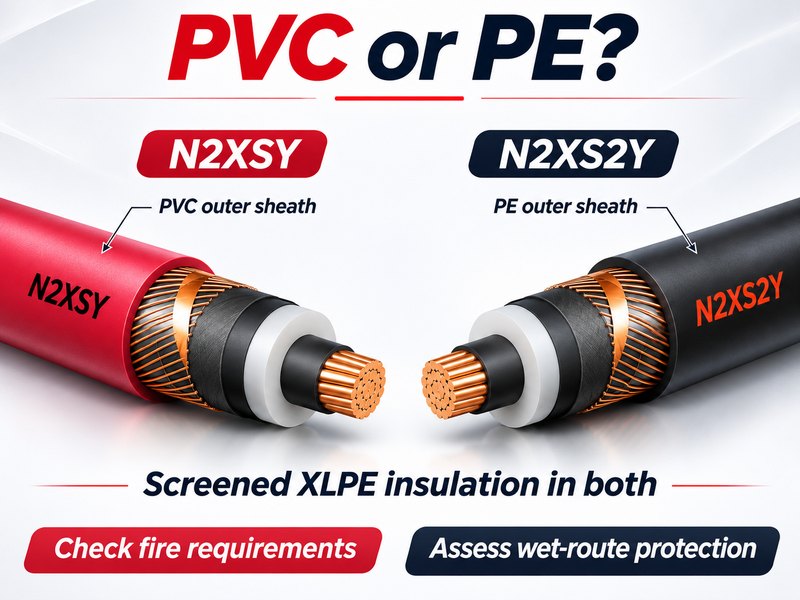
La principal diferencia entre el cable N2XSY y N2XS2Y es la funda exterior.: PVC para N2XSY y polietileno (educación física) para N2XS2Y. Ambas familias utilizan conductores de cobre y aislamiento XLPE apantallado en las construcciones de media tensión que se analizan aquí.. Elegir entre ellos es principalmente una decisión de protección de ruta., no es un cambio de tecnología de aislamiento. N2XS2Y is worth considering where the project specifies a PE jacket for outdoor or underground service; N2XSY remains relevant where a PVC-sheathed construction fits the installation and fire specification. Moisture barriers, mechanical protection and electrical ratings are assessed separately for the actual cable design.

Follow the route from the duct to the building
Imagine a distribution feeder that leaves a substation, crosses a duct bank and enters an industrial building. The circuit voltage stays the same, but the cable encounters different external conditions. Water in the duct, pulling at bends, sunlight on an exposed section and fire requirements at the building entrance each affect the sheath specification.
Para XWA, this is the useful starting point for the comparison. A black jacket or a short model name cannot describe all those interfaces. The objective is a cable construction that fits the complete route, including the points where the surroundings change.
El N2XSY cable range uses a PVC outer sheath. El N2XS2Y cable range uses PE. The appropriate compound, finished dimensions and declared performance belong to the selected product, rather than being inferred from sheath colour.
What the sheath changes—and what stays inside it
| Design feature | N2XSY | N2XS2Y |
|---|---|---|
| Conductor family | Cobre | Cobre |
| Aislamiento principal | XLPE with semiconductive screens | XLPE with semiconductive screens |
| Pantalla metálica | As specified for the model and fault duty | As specified for the model and fault duty |
| Funda exterior | CLORURO DE POLIVINILO | educación física |
| Tensión nominal | Selected U0/U(Um) clasificación | Selected U0/U(Um) clasificación |
| Additional armour or water barriers | Defined by the complete construction | Defined by the complete construction |
A same-size substitution therefore starts with the electrical design held constant: designación de voltaje, conductor area and class, screen construction and short-circuit duty. The new sheath then has to fit the environmental requirement and the installation interfaces.
Both are screened MV cable families. The metallic screen has an electrical function, while the outer sheath protects the construction from its surroundings. Selecting a different jacket does not remove the need for a screen and bonding design.
In a wet duct, distinguish the jacket from the water barriers
A PE sheath is a common project choice for outdoor and underground MV cable. Its value is considered alongside the specified compound, jacket thickness and route exposure. For a wet route, the further question is how the design manages water entering through damage or a cable end.
Longitudinal blocking limits water travel along specified layers. A radial moisture barrier adds a different protection across the cable wall. These are construction features in addition to the outer polymer sheath. In the relevant model families, el (F) y (Florida) variants distinguish additional water-protection arrangements.
IEC 60502-2 includes longitudinal water-penetration provisions and calls attention to radial water-ingress risk when determining applications. That makes a route-based description more useful than simply asking for a “waterproof” cable.
For a circuit with a persistently wet section, we would define the required barrier arrangement and the cable-end protection together. A carefully selected outer sheath can still be undermined by an exposed end during storage, pulling or joint preparation. The cable and its accessories need a continuous protection concept.
At a building entry, the fire specification becomes decisive
Moving from an underground duct to an indoor cable space changes the fire question. The selected compound and the declared cable tests determine its flame behaviour; neither PVC nor PE is a complete fire-performance classification.
IEC 60332-1-2 evaluates flame propagation on a single cable. Grouped-cable tests have a different scope. Halogen acid gas is addressed by IEC 60754-1, while smoke and circuit integrity are separate performance questions. A successful test in one area does not answer the others.
Where the building requires low-smoke, rendimiento libre de halógenos, an appropriately specified sheath system may be a better starting point than either standard PVC or an unspecified PE compound. The project should resolve that requirement before cable lengths and accessory interfaces are fixed.
Our preference is to identify the entrance condition early. Depending on the route and local installation requirements, the solution may be a suitable continuous cable specification or an engineered transition. A new cable joint introduces its own installation and maintenance considerations, so a transition deserves a reason beyond a convenient change of model name.
Preserve the electrical duty when a sheath is substituted
A jacket change can affect finished diameter, handling and the thermal path. Current rating is a result of the complete cable and installation calculation: conductor losses, screen losses, laying arrangement and surrounding thermal conditions all matter. No fixed current-capacity improvement follows from replacing the letter Y with 2Y.
Dimensions also matter at the equipment. Abrazaderas para cables, entry seals, ducts and accessory sealing components must fit the finished construction. An unchanged nominal conductor area does not guarantee the same outside diameter or installation bending requirement.
Sheath condition is another part of acceptance. IEC 60229 provides a protective-covering test framework for extruded oversheaths with special protective functions. The relevant cable standard and installation specification determine which tests apply. These checks address the covering; they are distinct from a main-insulation test.
el más amplio MV underground route explanation covers how soil, ducts and route transitions change the installation basis.
Turn the route decision into a clear cable description
A useful specification identifies the voltage rating, conductor and screen requirements, then states the outer sheath and any required water barriers. It also connects those features to the route and accessory dimensions. That is more informative than describing either model as universally better.
N2XSY makes sense where the specified PVC construction suits the route. N2XS2Y makes sense where a PE jacket meets the environmental design. When longitudinal blocking, a radial barrier or a different fire-performance system is required, those features should be visible in the construction rather than left implicit.
XWA can discuss both cable families against an MV project schedule. Share the voltage designation, conductor and screen sizes, route conditions and required lengths for a construction-specific supply discussion.