
Calculate copper or aluminium conductor weight per metre, cable weight in kg/km, and net cable mass for a stated length. Finished cable and drum totals use actual unit-weight data or an explicitly entered construction breakdown, not conductor weight alone.
What the calculated weight includes
| Calculation basis | Result and limit |
|---|---|
| İletken metal | Metal mass from area, çekirdek sayısı, density and length factor. Excludes insulation, ekranlar, zırh, sheath and packing. |
| Actual cable unit weight | Net cable mass from supplied kg/m or kg/km. Best option when a matching datasheet or measured unit weight is available; entered data is not verified automatically. |
| Construction breakdown | Estimated cable mass from conductor metal plus all entered layers. Requires complete component data, without omissions or double counting. |
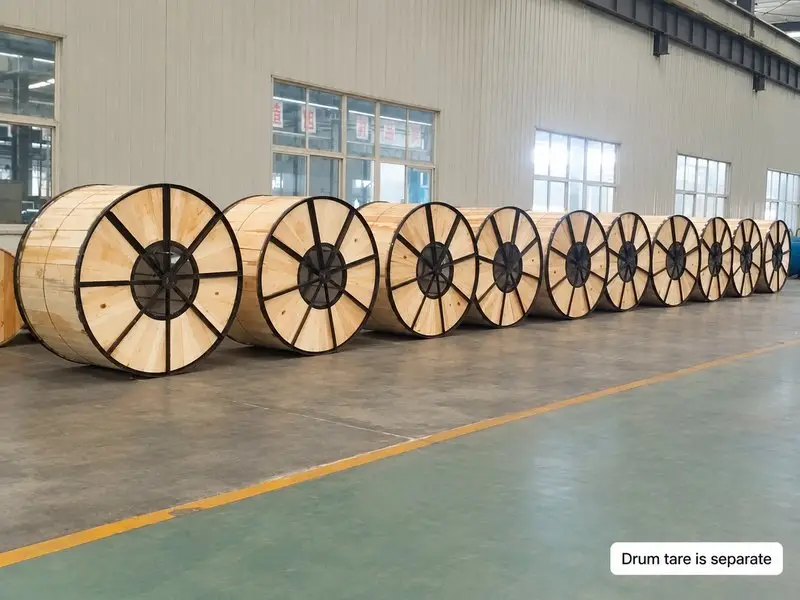
A copper cable weight per metre is not just its copper content. XLPE or PVC insulation, semiconductive layers, metalik ekranlar, zırh, fillers and outer sheath can materially change the finished mass. MV and HV constructions particularly require the actual approved construction or datasheet.
Formulas, densities and a worked example
Conductor kg/km = Σ(area per core in mm² × number of cores × density in g/cm³ × conductor-length factor)
Net cable kg = cable kg/km × total length in m ÷ 1000
Mass including stated tare = net cable kg + drum count × tare kg per drum
The copper preset is 8.89 g/cm³, the engineering wire-table reference at 20°C in NBS El Kitabı 100, hosted by NIST. The aluminium preset is a rounded 2.70 g/cm³ reference; NIST material composition data lists 2.6989 g/cm³. A specified alloy or composite needs its own verified density and metal-area basis. These are reference densities, not product certifications.
For three 50 mm² copper cores, factor 1.000: 3 × 50 × 8.89 = 1333.5 kg/km, veya 1.3335 kg/m. Üzerinde 100 M, the calculated conductor mass is 133.35 kilogram. This deliberately excludes every non-conductor layer.
In a separate hypothetical finished-cable example, an entered 2000 kg/km over 500 m gives 1000 kg net. Two stated 80 kg drum tares give 1160 kg including tare. The 500 m is the total length, Olumsuz 500 m per drum. These example values are not XWA product or packing specifications.
Connect weight to the actual cable construction
A project mass schedule needs cable designation, çekirdek düzenlemesi, iletken malzemesi ve boyutu, actual unit mass, total length and the packing schedule. XWA can receive these details with a configuration inquiry. Calculator results do not establish stock, freight charges, drum capacity or lifting safety.
Cable weight questions
Can nominal conductor size give the exact finished cable weight?
HAYIR. It supports a theoretical metal-mass estimate. The complete cable requires its actual construction or a stated net unit weight; nominal area is not proof of actual metal volume.
How are kg/m and kg/km related?
Multiply kg/m by 1000 to obtain kg/km. Divide kg/km by 1000 to obtain kg/m. This changes the length basis, not what components the weight includes.
Can an aluminium cable weight calculator also calculate ACSR?
Only when every material is explicitly represented with its verified area, density and adjustment. Do not apply aluminium density to an ACSR steel core or an unspecified aluminium alloy. Custom-density groups can represent known metal components, but do not validate the conductor design.
Does the drum result include pallets and accessories?
Only if their mass is included in the stated tare. Different drum sizes or tares need separate records or a documented total-tare basis. The calculation does not select or approve a drum.
Method version 1.0.0 · Reviewed 14 October 2026 · Calculation runs locally; copying, downloading or opening an inquiry is a separate action.