
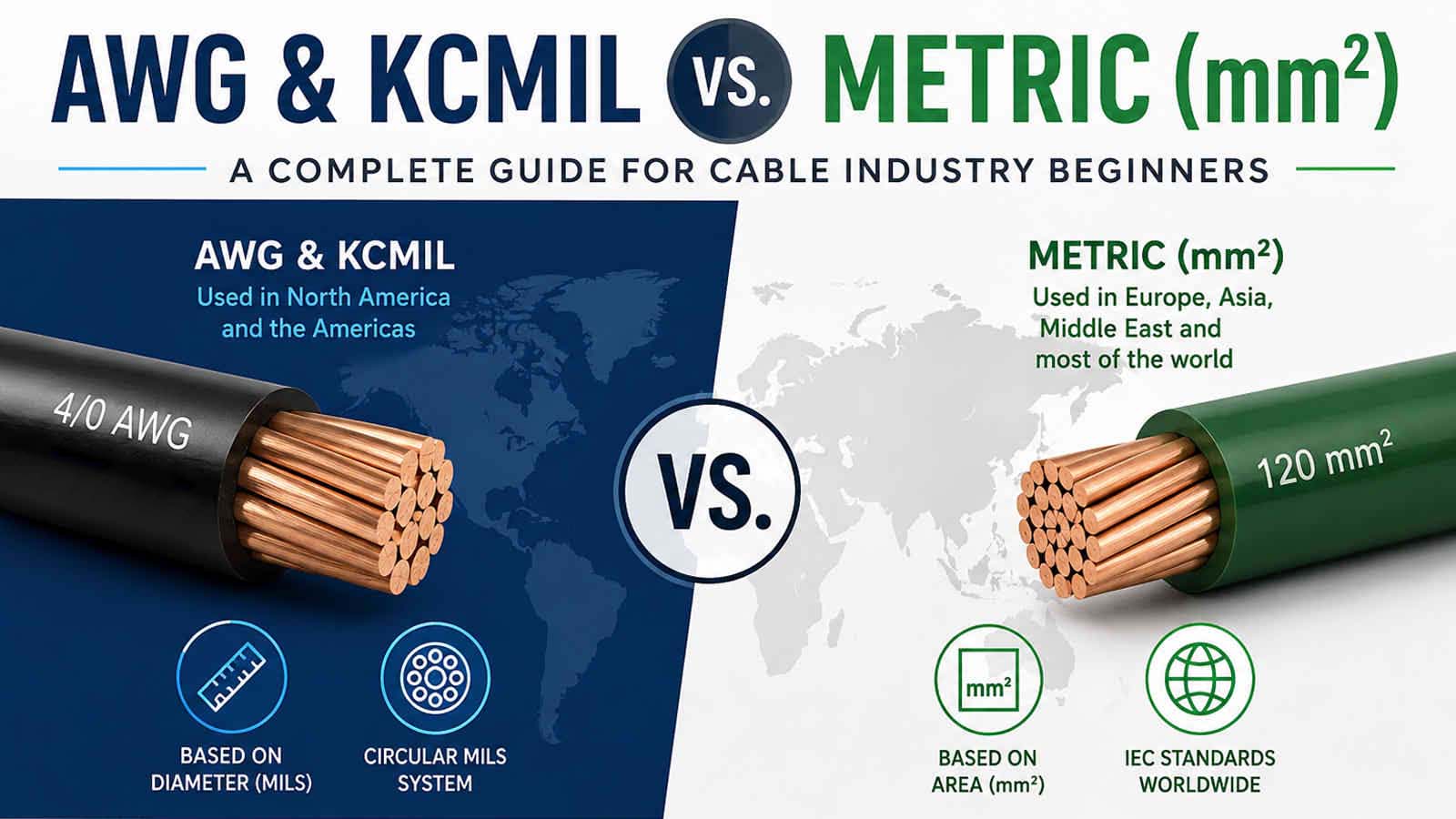
Kablo sektöründe yeniyseniz, İletken boyutlarını belirlemek için hızla tamamen farklı iki sistemle karşılaşacaksınız:
- AWG & kcmil (MCM) – Kuzey Amerika'da kullanılıyor, ve Orta ve Güney Amerika'nın çoğu.
- mm² (milimetre kare) – Avrupa'da kullanılıyor, Asya, Orta Doğu, ve dünyanın geri kalanının çoğu.
Yalnızca dönüşüm sayılarını değil, her iki sistemi de anlama, amamantık onların arkasında – eğer kablo satışlarında çalışıyorsanız çok önemlidir, satın alma, veya proje yönetimi. Bu makale tartıştığımız her şeyi kapsamaktadır: AWG ve kcmil ne anlama geliyor, dairesel millerin nereden geldiği, neden iki sistem var, ve gerçek dünyadaki durumlarla nasıl başa çıkılacağı.
İçindekiler
- AWG – Amerikan Tel Ölçer
- Kcmil (eski MCM) – Büyük İletkenler için
- Dairesel Mil – Gizli Yapı Taşı
- Metrik (mm²) – Mantıksal Alternatif
- Neden İki Sistem Var?? Felsefi Bir Fark
- AWG'nin mm²'ye dönüştürülmesi (Pratik Hafıza Yardımcıları)
- AWG ve mm²'nin Gerçek Dünyada Kullanımı - Kim Neyi Kullanıyor??
- Kablo Profesyonelleri için AWG Hakkında Pratik Tavsiyeler
- AWG hakkında SSS & kcmil & mm²
AWG – Amerikan Tel Ölçer
AWG nedir??
AWG'nin açılımıAmerikan Tel Ölçer. Daha küçük iletkenler için kullanılır (genellikle şuna kadar 4/0 AWG).
Anahtar kural:
AWG numarası ne kadar küçük olursa, iletken ne kadar kalınsa.
- Örnek: 4 AWG olduğundan çok daha kalın10 AWG.
- En büyük ortak AWG boyutu4/0 AWG.
- En küçük ortak AWG boyutu yaklaşık30 AWG (çok ince, elektronik kablolarda olduğu gibi).
AWG nerede kullanılır??
- Ortak kontrol kabloları
- Enstrümantasyon kabloları
- Bina telleri (örneğin, THHN)
- Otomotiv alçak gerilim kabloları
- İletişim kabloları
AWG mantığı (tarihi)
AWG 19. yüzyılda geliştirildi, tel bir dizi delikten çekildiğinde (plakaları çizmek) sabit çaplarla. Çaplar ölçüldümil (1 mil = 0.001 inç). Gösterge numarası telin kaç kez çekildiğiyle ilgiliydi. Bu o zamanlar üretim için mantıklıydı ancak üretim için bir sistem yarattı.çap düzgün bir tam sayıdır (mil cinsinden), ikenkesit alanı düzensiz bir sayı haline gelir mm² cinsinden.
Örnek:
- 10 AWG çapı ≈ 101.9 mil (düzenli)
- 10 AWG alanı ≈ 5.26 mm² (düzensiz)

Kcmil (eski MCM) – Büyük İletkenler için
kcmil nedir?
İletkenler daha büyük olduğunda 4/0 AWG, AWG sistemi duruyor. Yerine, boyut verilmiştirkcmil (kilo dairesel mil).
- kcmil = bin (k) dairesel miller (cmil)
- MCM eski semboldür – kcmil ile tamamen aynı anlama gelir. MCM asla kafanızı karıştırmasın; bu aynı.
kcmil nerede kullanılır?
- Büyük güç kabloları gibi büyük yüksek gerilim kabloları
- Endüstriyel tesislerde besleme kabloları
- Yardımcı ve trafo merkezi kabloları
- Alüminyum ve bakır baralar
Yaygın kcmil boyutları:
250 kcmil, 350 kcmil, 500 kcmil, 750 kcmil, 1000 kcmil (sıklıkla yazılır 1000 MCM)
Dairesel Mil – Gizli Yapı Taşı
Kcmil'i anlamak, anlamalısındairesel mil.
Tanım:
1 dairesel mil (cmil) = çapı olan bir dairenin alanı1 mil (0.001 inç).
Akıllı (ve kafa karıştırıcı) parça:
Normalde, bir dairenin alanı πr²=π/4×d²'dir.
Ancak dairesel mil sisteminde:
Alan (cmil) = d², d mil cinsinden nerede.
Hayır π. Kesir yok. Sadece çap × çap.
Örnek:
Çapı olan sağlam bir iletken 100 mil (0.1 inç):
- Dairesel mil cinsinden alan = 100²=10.000 cmil =10 kcmil.
Bu neden yapıldı??
Yapmaksahada elle hesaplama daha kolay. 19. yüzyılda, bir mühendis çapı ölçebilir (mil cinsinden), karesini al, ve hemen şunu bil “alan” π ile çarpmadan. Dezavantajı: dairesel bir milOlumsuz gerçek bir geometrik kare mil. Bir dairesel mil = π/4 mil kare ≈ 0.7854 mil kare.
Ancak günlük elektrik işlerinde, bu fark önemli değil – çünkü tablolar, standartlar, ve formüller zaten bunu açıklıyor.
Metrik (mm²) – Mantıksal Alternatif
mm² nedir?
Metrik sistemin kullandığımilimetre kare iletken kesit alanı birimi olarak. Bu gerçek bir geometrik alandır: 1 mm² = 1 mm × 1 mm kare.
Anahtar kural:
mm² numarası ne kadar yüksek olursa, iletken ne kadar kalınsa.
Örnek: 120 mm² daha kalındır 70 mm².
mm² nerede kullanılır?
- Avrupa, Asya, Afrika, Orta Doğu, Avustralya
- IEC standartları
- Yenilenebilir enerji projelerinin çoğu (güneş/rüzgar) Amerika kıtası dışında
mm² mantığı
Metrik sistemtasarım odaklı: önce yuvarlak bir alan seçersiniz (2.5, 4, 6, 10, 16, 25, 35, 50 mm², vesaire.), ve çap ne olursa olsun olur (genellikle düzensiz bir sayı).
Örnek: 10 mm² → çap ≈ 3.57 mm (düzensiz).
birüretme bakış açısı, bu sorun değil – modern çizim makineleri bilgisayar kontrollüdür ve istenilen çapı kolayca ayarlayabilir. birindenelektrik hesaplaması bakış açısı, mm² çok uygundur: rezistans, mevcut derecelendirme, ve voltaj düşüşü formüllerinin tümü doğrudan kullanım alanı, π düzeltme faktörü olmadan.
Neden İki Sistem Var?? Felsefi Bir Fark
| Bakış açısı | Metrik (mm²) | BİZ (AWG/kcmil) |
|---|---|---|
| Başlangıç noktası | İstenilen alan (yuvarlak) | İstenilen çap (yuvarlak, mil cinsinden) |
| Çap değeri | Çoğunlukla düzensiz (örneğin. 1.78 mm için 2.5 mm²) | Genellikle düzgün bir tamsayı (örneğin. 100 mil) |
| Alan değeri | Düzenli (örneğin. 2.5, 4, 6 mm²) | Genellikle mm² cinsinden düzensiz (örneğin. 5.26 mm² için 10 AWG) |
| Elektrik hesaplamaları | Doğrudan (hayır π) | Tablolara gizlice yerleştirilmiş π/4 faktörünü gerektirir |
| Saha ölçümü | Çapı ölçün → mm²'yi bulmak için tabloya bakın | Çapı ölç (mil) → karesini alın → cmil/kcmil'i doğrudan alın |
| Tarihsel köken | Endüstrinin ölçümü | 19yüzyıldan kalma tel çekme uygulaması |
İkisi de değil “daha iyi” mutlak anlamda. Bunlar farklı mühendislik kültürleri. Sorun yalnızca mecbur kaldığınızda ortaya çıkardönüştürmek aralarında.
AWG'nin mm²'ye dönüştürülmesi (Pratik Hafıza Yardımcıları)
Erken aşama iletişim için yüksek hassasiyete ihtiyacınız yok. Bu kaba kuralları kullanın:
AWG'den mm²'ye Dönüştürme
| AWG/kcmil | Eşdeğer Kesit Alanı (mm²) |
|---|---|
| 20 | 0.519 |
| 18 | 0.823 |
| 16 | 1.31 |
| 14 | 2.08 |
| 12 | 3.31 |
| 10 | 5.261 |
| 8 | 8.367 |
| 6 | 13.30 |
| 4 | 21.15 |
| 2 | 33.62 |
| 1 | 42.41 |
| 1/0 | 53.49 |
| 2/0 | 67.43 |
| 3/0 | 85.01 |
| 4/0 | 107.2 |
| 250 | 127 |
| 300 | 152 |
| 350 | 177 |
| 400 | 203 |
| 450 | 228 |
| 500 | 253 |
| 600 | 304 |
| 750 | 380 |
| 800 | 405 |
| 1000 | 507 |
kcmil için mm² (yaklaşık)
- 1 mm² ≈ 2 kcmil (Aslında 1 mm² = 1.9735 kcmil – hızlı tahminler için yeterince yakın)
- Örnek: 50 mm² ≈ 100 kcmil
- Örnek: 120 mm² ≈ 240 kcmil → en yakın standart250 kcmil
- Örnek: 300 mm² ≈ 600 kcmil
Tam dönüşüm faktörü (Hassasiyete ihtiyacınız olduğunda):
1 kcmil=0,5067 mm21 kcmil=0,5067 mm21 mm2=1,9735 kcmil1 mm2=1,9735 kcmil
AWG ve mm²'nin Gerçek Dünyada Kullanımı - Kim Neyi Kullanıyor??
Tartışmamıza dayanarak:
- Kuzey Amerika (Amerika, Kanada): AWG + neredeyse yalnızca kcmil.
- Orta Amerika & Karayipler (Meksika, Panama, Kosta Rika, Dominik Cumhuriyeti, vesaire.): çoğunlukla AWG/kcmil, ABD standartlarından ve UL sertifikasyonundan güçlü bir şekilde etkilenmiştir.
- Güney Amerika:
- Kolombiya, Ekvador: tamamen AWG/kcmil.
- Peru, Şili, Venezuela, Bolivya: karışık. Birçok mühendis AWG'yi biliyor; sık sık göreceksin “10 AWG (yaklaşık 5.26 mm²)” çizimler üzerinde.
- Brezilya, Arjantin: IEC'yi takip etme eğilimindeyim (metrik), ancak profesyoneller hâlâ AWG'yi biliyor.
- Avrupa, Orta Doğu, Asya (IEC kullanılırken Japonya/Kore/Tayvan/Çin hariç), Afrika: ağırlıklı olarak mm².
Önemli ipucu:
Asla bir Orta veya Güney Amerikalı insanın sormadan mm²'yi kabul edeceğini varsaymayın. Birçoğu AWG/kcmil konusunda ısrar edecek, özellikle de UL sertifikası talep ediyorlarsa.
Kablo Profesyonelleri için AWG Hakkında Pratik Tavsiyeler
1. Her zaman önce birim sistemini isteyin
Bir istek aldığınızda, birim açıkça belirtilmemişse:
Lütfen onaylayın: İletken boyutuAWG/kcmil veyamm²?
Bu tek soru kurtarır 90% gelecekteki kafa karışıklığının.
2. Körü körüne dönüştürmeyin ve varsaymayın
Bir müşteri diyorsa “500 MCM”, YapmakOlumsuz ~253 mm²'ye dönüştürün. İkisi etkilenmeden birbirinin yerine kullanılamaz:
- Büküm yapısı (kablo sayısı)
- Genel çap
- Kapasite tabloları (NEC ve IEC)
- Sertifikalar (UL ve VDE/CE karşılaştırması)
3. Sınırı bilin
- kadar 4/0 AWG → AWG'yi kullan
- Üstünde 4/0 AWG → kcmil/MCM kullanın
- 4/0 AWG ≈ 107 mm² anahtar noktasıdır
4. Fabrikalarla iletişim için yuvarlatılmış dönüşümleri kullanın, nihai üretim için değil
Biriyle konuştuğunuzda metrik tabanlı kablo fabrikası (örneğin, Çin'de veya Avrupa'da), söyleyebilirsin:
“Bu yaklaşık olarak eşdeğerdir 250 mm², ancak UL sertifikasına ihtiyacımız var ve tam boyut 500 kcmil.”
Fabrikanın bunu bilmesi gerekiyor.tam istenen standart, yalnızca dönüştürülen mm² değil.
5. MCM = kcmil
Asla kafanız karışmasın. Onlar aynı. Yani eğer görürsen “350 MCM” Ve “350 kcmil” – bunlar aynı kablo.
AWG hakkında SSS & kcmil & mm²
AWG (Amerikan Tel Ölçer) tarihsel olarak iletken çapına dayalı bir Kuzey Amerika kablo boyutlandırma sistemidir, mm² doğrudan iletken kesit alanına dayalı bir metrik sistemdir. İletken büyüdükçe AWG sayıları azalır, iletken büyüdükçe mm² değerleri artar.
AWG daha küçük iletkenler için kullanılır, genellikle şuna kadar 4/0 AWG. Daha büyük iletkenler için, sistem kcmil olarak değişir (MCM olarak da adlandırılır), binlerce dairesel mili temsil eden.
Evet. MCM ve kcmil tamamen aynı birimdir. “MCM” eski terimdir, “kcmil” ise modern teknik terimdir.
AWG sistemi tarihsel tel çekme süreçlerinden doğmuştur. Daha küçük AWG numaraları, daha az çizim adımı ve dolayısıyla daha büyük iletken çapı anlamına gelir.
Tarihsel olarak farklı bölgeler farklı mühendislik standartları geliştirmiştir.:
– Kuzey Amerika çoğunlukla AWG/kcmil ve UL standartlarını kullanıyor.
– Dünyanın çoğu mm² ve IEC standartlarını kullanıyor.
Bugün her iki sistem de devam ediyor çünkü yerel düzenlemeler, sertifikalar, ve mühendislik uygulamaları farklı kalıyor.
AWG ve kcmil çoğunlukla kullanılır:
– Amerika Birleşik Devletleri
– Kanada
– Meksika
– Orta Amerika'nın büyük bir kısmı
– UL veya NEC standartlarından etkilenen birçok Güney Amerika ülkesi
mm² sistemi esas olarak kullanılır:
– Avrupa
– Asya
– Orta Doğu
– Afrika
– Avustralya
– IEC standardındaki pazarların çoğu
Mutlaka değil. Kesit alanı yakın olsa bile, farklılıklar mevcut olabilir:
– Büküm yapısı
– Genel çap
– Kapasite standartları
– Yalıtım kalınlığı
– Sertifika gereklilikleri (UL ve IEC)
Üretimden önce daima gerekli standardı onaylayın.
Dairesel bir mil (cmil) çapı olan bir dairenin alanıdır 1 mil (0.001 inç). Kcmil sisteminin arkasındaki temel birimdir..
Modern hesap makineleri ortaya çıkmadan önce saha hesaplamalarını basitleştirdi. Mühendisler, alanı dairesel mil cinsinden elde etmek için iletken çapının karesini mil cinsinden kolayca alabilirler.
Çünkü AWG geçmişte yuvarlatılmış kesit alanlarından ziyade çap artışlarına dayanıyordu. Sonuç olarak, dönüştürülen alanlar genellikle yuvarlak olmayan metrik değerler haline gelir.
Modern kablo fabrikaları genellikle metrik bazlı makinelerle çalışır ancak her iki sistemi de gerekli standarda göre iletken çapını ve bükümünü hassas bir şekilde kontrol ederek üretirler..
pratikte:
– IEC siparişleri direkt mm² standartlarına göre üretilmektedir..
– UL/NEC siparişleri AWG veya kcmil ölçü ve toleranslarına göre üretilmektedir..
– Mühendisler, iletken yapısını tam olarak eşleştirmek için dönüşüm tablolarını ve üretim yazılımını kullanıyor, rezistans, ve sertifikasyon gereksinimleri.
Fabrika sadece “numarayı dönüştürmez”; Hedef standarda göre üretim yapar.
Evet. Modern çekme ve büküm makineleri dijital olarak kontrol edilir ve hem AWG/kcmil hem de mm² iletken boyutlarını doğru bir şekilde üretebilir.
Çünkü aynı yaklaşık alan, farklı standartlar kapsamında farklı teknik gereksinimlere karşılık gelebilir.
Örneğin:
– 500 kcmil ile otomatik olarak değiştirilemez 253 mm².
– UL ve IEC standartları farklı iletken yapıları ve test yöntemleri gerektirebilir.
Her zaman hem boyutu hem de standart sistemi belirtin.
Her zaman onayla:
– Birim sistemi (AWG/kcmil veya mm²)
– Standart (UL, NEC, IEC, vesaire.)
– Bakır veya alüminyum iletken
– Tam uygulama
Bu, spesifikasyon hatalarını ve yanlış anlamaları önler.
Her iki sistem de evrensel olarak “daha iyi” değildir. AWG/kcmil, Kuzey Amerika elektrik uygulamalarına derinlemesine entegre edilmiştir, mm² doğrudan elektrik hesaplamaları için daha basittir ve uluslararası alanda yaygın olarak kullanılır. En iyi seçim projenin pazarına bağlıdır, standartlar, ve sertifikasyon gereksinimleri.