
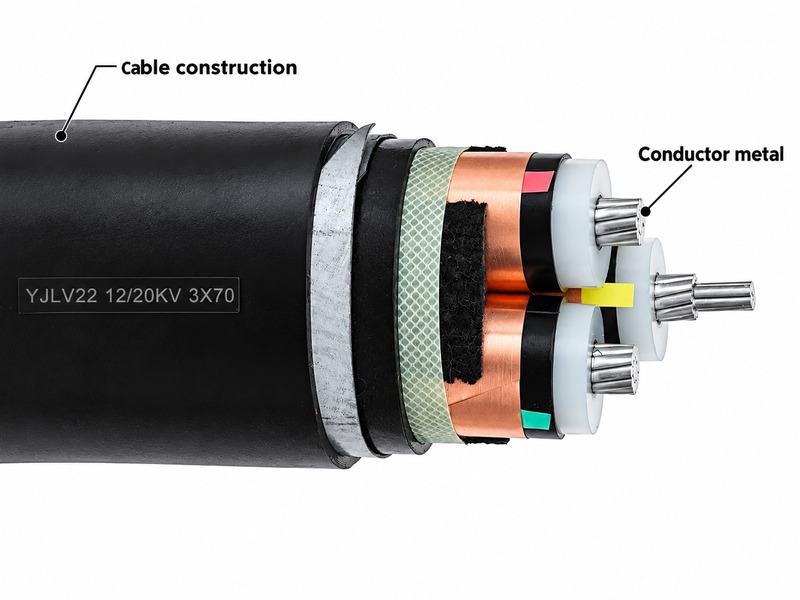
Conductor weight is the mass of the current-carrying metal; cable weight normally means the complete cable, including its insulation, ekranlar, zırh, sheath and other specified components. Both can be expressed in kg/km, so matching units do not guarantee a matching basis. A conductor-content calculation cannot stand in for a finished-cable datasheet, and neither value includes a drum unless packing is explicitly included. The useful comparison starts by identifying what the number contains, which construction it describes and whether it is calculated, nominal or measured.
Two different kg/km values can both be correct
A cable schedule might show metal content for material planning, finished cable mass for handling calculations and packed mass for dispatch. Those are different quantities, not three competing descriptions of the same measurement. Confusion begins when a column is labelled only “weight” and its boundary disappears.
| Mass basis | Dahil | Not established by the number |
|---|---|---|
| Conductor metal, kg/km | The identified conductor materials and their stated calculation basis. | Complete cable mass, packing or current rating. |
| Finished cable net mass, kg/km | All components of the specified cable construction. | Drum tare, pallet mass or a guaranteed measured delivery mass when the value is nominal. |
| Packed mass, kg per drum or consignment | The stated cable length plus the packing included in that record. | Other packing items unless explicitly accounted for, or safe handling capacity. |
Converting kg/km to kg/m does not change this boundary: divide by 1000. A conductor-only value remains conductor-only after conversion. Benzer şekilde, multiplying a unit mass by route length does not make it the weight of a delivery drum when the supplied length or packing basis differs.

A metal-content calculation stops before the finished cable
For an ideal straight-metal estimate, conductor mass in kg/km is the sum of metal area per core in mm2 × core count × density in g/cm3. The cancellation of the length and volume conversion factors is why this particular set of units gives the compact expression.
Consider three hypothetical 70 mm2 aluminium conductors and a rounded reference density of 2.70 g/cm3: 3 × 70 × 2.70 = 567 kg/km. Over 100 M, that is 56.7 kg of conductor metal on the stated basis. Yalıtım, semiconductive materials, metallic screens, yatak takımı, zırh, fillers and outer sheath have not been added. The answer is not a finished-cable specification, including for the real sample pictured in this article.
NIST’s elemental aluminium data lists 2.6989 g/cm3; 2.70 is a rounded reference, not a density guarantee for every aluminium alloy. Copper-wire calculations commonly use the 8.89 g/cm3 engineering reference documented in the NIST-hosted engineering density reference. The material and reference convention belong with the calculation.
Stranding adds another boundary. Individual wires follow helical paths, so their length per unit axial conductor length need not equal that of a straight rod. NBS Handbook 100 discusses this effect for its wire tables; it does not justify applying one universal mass allowance to every conductor. Actual construction or a verified adjustment is needed where that distinction matters.
Nominal conductor area is also not a certificate of measured metal volume. IEC 60228:2023 covers nominal cross-sectional areas together with wire and resistance requirements. A nominal-area mass estimate is not an independent test of conformity to that standard.
The missing mass belongs to a specific construction
In an MV power cable construction, the conductor is surrounded by an insulation system and the specified screening and protective layers. Changing those components changes mass without necessarily changing the headline conductor area. A different metallic-screen design, an added armour layer or a changed sheath arrangement cannot be represented by a universal “extra percentage.”
The public scope of IEC 60502-2 addresses construction, dimensions and tests for its defined extruded-insulation cable range. IEC 60840 addresses tests and requirements for its own higher-voltage cable-system range. Neither public scope is a kg/km lookup table for every offered design. A standard reference and a conductor designation therefore cannot replace the actual construction record.
There are two defensible routes to a complete cable-mass figure. One uses the stated net unit mass of the exact finished cable. The other adds a complete, documented component breakdown. For a breakdown, every component must appear once: orkestra şefi, insulation systems, ekranlar, armour where present, kılıf, fillers and other construction items. Screen wires must not be counted in both a metal subtotal and a separate screen subtotal.
A geometric estimate of a layer also needs its actual dimensions, material density and applicable construction corrections. Tape overlap, wire lay and filler arrangement cannot be recovered from the outer diameter alone. If these inputs are unknown, the correct result is an incomplete estimate, not an invented finished mass.
Equal area is not an equal-duty comparison
At the same metal area and assumed axial length, aluminium has a lower metal mass than copper. That observation is useful, but it is not a complete comparison of two cables serving the same circuit. Different electrical and installation requirements can lead to different conductor areas and constructions.
For an aluminium power cable, the finished-cable comparison must retain the selected conductor area, çekirdek düzenlemesi, insulation and protective layers. Comparing its metal subtotal with the full mass of a copper cable exaggerates the apparent difference because the boundaries do not match.
The same rule applies within one material. Two cables with the same nominal area can have different complete mass because their constructions differ. Heavier is not automatically better, and lighter is not proof of under-sized metal. A meaningful review compares the approved construction, the stated mass basis and the applicable test results rather than turning a scale reading into a complete quality judgment.
Keep the cable length separate from the drum count
Suppose a hypothetical finished cable is stated at 1800 kg/km and is supplied in two lengths, 300 m and 200 M. Its total length is 500 M, giving 1800 × 500 ÷ 1000 = 900 kg net cable mass. If the two stated drum tares are 70 kg and 90 kg, the mass including those tares is 900 + 70 + 90 = 1060 kg.
Multiplying the 500 m by two would count the cable twice. Applying one drum’s tare to both drums would also change the answer. Pallets, protective covers or accessories need separate inclusion if they are not already covered by the stated tare. These numbers illustrate bookkeeping only; they are not a shipment record or drum specification.
Mass and capacity remain separate. The completed total does not establish whether a drum can hold the length, whether its barrel suits the cable’s bending limit or whether the handling equipment is adequate. Those constraints belong in MV cable drum-length and route planning.
Before comparing two weight figures, align three things: the components included, the unit-length basis and the exact cable identity. For dispatch, add the actual lengths and stated packing masses separately. That produces a traceable mass schedule without asking a conductor-content formula to describe a cable it has not accounted for.