
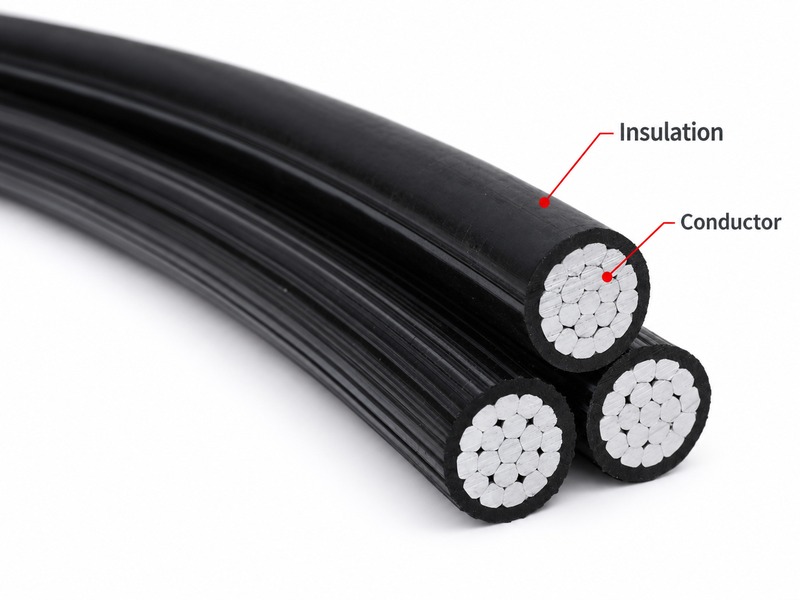
An ABC insulation piercing connector makes an electrical branch connection by penetrating the insulation and contacting the conductor, without stripping insulation at that interface. Reliable service depends on more than a stated conductor-size range: the main and branch conductors, their insulation, the tightening system and the seals must form a compatible, qualified combination. A broken shear head or a continuity reading alone cannot establish that combination. For XWA Cable’s ABC-related technical content, the essential distinction is between a connector that physically fits and an interface whose electrical and environmental performance is supported by relevant evidence.
This article concerns low-voltage aerial bundled systems, not a universal method for tapping building wiring. It explains the cable-to-accessory interface; it does not claim that XWA manufactures or certifies the connectors discussed.

Two cable ranges have to meet at one connection
A connector joins two separate conductor interfaces. Its main-side range and branch-side range can differ. Both must be checked against the actual conductor, not against the total area of an aerial bundle. A designation such as a three-phase bundle with a neutral messenger describes several members; it is not the size of the individual core entering an IPC.
Cross-sectional area is only one part of compatibility. Alluminio, aluminium alloy and copper are not interchangeable merely because their nominal areas coincide. Costruzione del conduttore, the accessory’s declared material combinations and the condition of the insulation also matter. A connector intended for an insulated conductor must not automatically be assumed suitable for a bare member, or vice versa.
The insulation is part of the contact interface, not just a covering to ignore. The teeth must pass through the intended insulation and establish the designed contact while the seal remains effective. Different insulation materials, thicknesses or an additional sheath can change that interaction. IL ABC cable construction therefore belongs in the compatibility assessment alongside the connector reference.
| Apparently suitable condition | What is still unresolved |
|---|---|
| The main conductor falls within the marked area range. | The separate branch range and the permitted main/branch material combination. |
| Two conductors have the same nominal area. | Whether their construction and insulation match the qualified interface. |
| The connector housing closes around the core. | Whether contact penetration and sealing are correct for that core. |
| A similar connector worked on another line. | Whether the connector reference, cable construction and application were actually the same. |
Physical fit is a necessary condition, not a substitute for compatibility evidence. The practical record is a paired description: main conductor plus branch conductor, with material, zona, insulation construction and connector reference identified separately.
A shear head controls one part of the process
Many IPC designs use a torque-limiting shear head. Its intended role is to control tightening in accordance with the particular connector design. It reduces reliance on an arbitrary field torque, but it does not make the connector independent of conductor placement, component condition or the approved installation method.
A sheared head indicates that the tightening mechanism has reached its designed break-off condition. It does not, da solo, verify that the correct core was used, that the conductor was positioned correctly, or that every seal and branch-end component is present. This distinction matters because the visible event is easier to inspect than the hidden contact beneath the insulation.
No universal tightening torque is given here. The relevant connector instructions and network operator’s approved procedure govern the setting, holding method and installation sequence. A nominal torque from a different accessory is not a valid replacement. Re-tightening after break-off or reusing a previously installed connector also requires explicit authorization for that design; it must not be assumed acceptable.
CEB’s 018-2:2018 utility specification illustrates how shear-head tightening, insulation penetration and sealing are addressed together. It is a utility-specific historical document, not a general permission to apply its assembly details to every connector.
Sealing must survive where the insulation is pierced
The contact creates a deliberate penetration in insulation that previously separated the conductor from its surroundings. The sealing arrangement must protect that interface in the intended service environment. Describing the housing as weather-resistant does not explain how water is kept away from the pierced region or an exposed branch end.
Depending on the design, elastomeric seals and a dedicated branch-end cap contribute to the complete assembly. A cap that is missing, incorrectly seated or incompatible with the branch geometry leaves a different condition from the one represented by the qualified assembly. The same applies to damaged seals or an insulation surface outside the intended application.
Compounds or grease mentioned in a specification must be understood in the context of that connector’s supplied components and instructions. Adding an unspecified substance in the field is not an acceptable substitute for a missing seal, and can introduce material-compatibility questions. A photograph of a closed housing cannot demonstrate water-tightness.
IN 50483-6:2026 covers environmental testing, including climatic and corrosion ageing, for relevant ABC accessories. Its public scope addresses exposure such as radiation, umidità, water spray, Calore, cold and pollution. That scope supports the need for environmental evidence; it does not establish a universal service life or a blanket waterproof claim for an unidentified product.
A continuity reading cannot predict service behavior
Initial continuity answers a limited question: an electrical path exists at the moment of the check. It does not establish how a contact behaves through load cycles, thermal changes or applicable fault duty. Electrical resistance at a real connection is finite; the meaningful engineering issue is its suitability and stability, not a claim of literally zero contact resistance.
Contact heating follows P = I2R. As a purely illustrative calculation, 100 A through 100 micro-ohms produces 1 W at that resistance; 200 A produces 4 W. These are not connector ratings or acceptance limits. The example shows why apparently small resistance cannot be considered independently of current. It does not predict temperature, which also depends on heat transfer and the complete assembly.
BSEN 50483-4:2026 covers connectors for electrical connection of ABC within the series’ low-voltage scope, with type tests. BSEN 50483-5:2026 addresses electrical ageing of the relevant connections. Its public scope distinguishes Class A, involving heat cycles and short-circuit current tests, from Class B, involving heat cycles only and intended for networks where overloads or short-circuits are cleared rapidly by protection.
Those descriptions are not a shortcut for selecting a class without network information. The protection arrangement and applicable specification must match the documented qualification. The full standards and project requirements determine methods and acceptance criteria; the publicly available summaries do not provide all of them.
Test evidence is useful only when its identity is traceable: connector reference, conductor combinations, applicable standard edition and relevant test scope must be clear. A generic standard number on a datasheet is less informative than evidence that corresponds to the actual interface. This also separates accessory type qualification from routine tests on the cable itself.
Keep electrical connection, line support and application scope separate
An IPC establishes a connection; it must not be treated as a substitute for the line’s suspension or tensioning arrangement. Branch movement and cable weight need the support specified for the installation, rather than uncontrolled force passing through the contact. The distinction is particularly important where a member has both neutral and support duties, as explained in the ABC neutral messenger’s electrical and mechanical roles.
Il più ampio overhead cable system includes different constructions and accessory interfaces. Similar appearance does not transfer an approval from one construction to another. In its 2022 technical discussion, the IET highlighted insulation differences and termination movement when overhead-distribution IPCs were used on consumer meter tails. That UK discussion is not reproduced here as current worldwide installation law; its enduring lesson is to check the actual application and the scope of the relevant qualification.
Insulation piercing is also not permission for live work. Electrical work requires competent personnel, network authorization and appropriate controls. HSE’s official work-planning safety guidance explains why overhead lines must be treated as live unless their owners establish otherwise, and why work must be planned around the hazard. This article is not an installation procedure.
A defensible ABC connection identifies the two conductors, the matching connector, the complete seal arrangement and the applicable electrical and environmental evidence. Dimensioni del cavo, tightening indication, continuity and system support each answer a different question. None should be used to conceal a missing answer elsewhere in the assembly.