
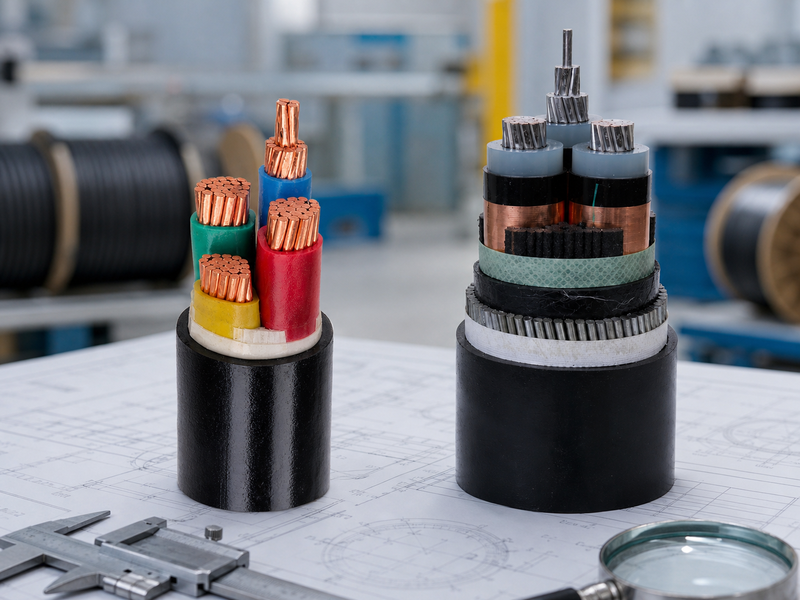
XLPE and PVC are two of the most common insulation systems used in power cable design, but they solve different engineering problems. PVC is a thermoplastic material widely used in low-voltage building and industrial cables because it is flexible, economical, and practical for general indoor or protected routes. XLPE is a cross-linked thermoset insulation used where higher thermal endurance, stronger electrical performance, and more demanding power distribution conditions are required.
The main difference is not only material price. The correct choice depends on voltage class, 도체 온도, 단락 의무, 경로 조건, 설치 방법, fire behavior requirements, 기계적 보호, and documentation under the project standard. 에이 0.6/1 kV building feeder may work well with PVC insulation, while a 6/10 kV, 8.7/15 kV, 12/20 kV, 또는 18/30 kV distribution route normally requires XLPE insulation under common medium-voltage cable standards.
The practical difference starts with polymer behavior
PVC, or polyvinyl chloride, softens when heated because it is thermoplastic. Cable-grade PVC compounds can be formulated for flame retardance, 유연성, 내유성, color identification, and sheath performance. In many low-voltage installations, this balance makes PVC a useful insulation or sheath material.
XLPE, or cross-linked polyethylene, is polyethylene whose molecular structure has been cross-linked during manufacturing. This cross-linking changes how the material reacts to heat and electrical stress. It does not melt like a simple thermoplastic during normal operation, and it can support higher conductor temperature ratings in many power cable designs. This is one reason XLPE is the dominant insulation material for many modern low-voltage, medium-voltage, 고전압, and extra-high-voltage power cables.
A concise engineering definition is useful: PVC is usually selected for economical low-voltage insulation and sheath systems; XLPE is selected when the cable must handle higher thermal stress, higher electrical stress, or medium-voltage power distribution duty.
Temperature rating changes current capacity and safety margin
Temperature rating is one of the most important technical differences between XLPE and PVC insulated cables. Many common PVC insulated power cables are designed around a lower continuous conductor operating temperature than XLPE insulated cables. XLPE insulation is commonly associated with 90 degrees Celsius continuous conductor operation in many standards and product designs, while standard PVC insulation is often associated with lower continuous temperature classes such as 70 degrees Celsius, depending on the compound and standard.
This difference affects current-carrying capacity. A cable that can operate at a higher conductor temperature may carry more current under the same installation conditions, but only when the conductor size, 설치 방법, 주변 온도, 그룹화, 토양 열 저항력, and standard calculation method support that result. Temperature rating is not a permission to ignore derating.
| 목 | Typical PVC insulated cable logic | Typical XLPE insulated cable logic |
|---|---|---|
| Material type | Thermoplastic insulation compound | Cross-linked thermoset insulation |
| Common use range | Low-voltage building, 제어, auxiliary, and general industrial circuits | Low-voltage power feeders and most medium-voltage power distribution cables |
| Thermal behavior | Softens more readily under heat | Better thermal stability after cross-linking |
| Electrical stress duty | Suitable for many LV circuits | Preferred for MV and higher electrical stress applications |
| Cost position | Usually lower material and processing cost | Usually higher insulation and process cost, but may reduce size or improve rating in demanding routes |

Voltage class is often the fastest selection filter
을 위한 low-voltage power distribution, both PVC and XLPE insulated cable constructions may be available. The correct design depends on the project standard, 노선, fire requirement, 도체 크기, and installation environment. For medium-voltage cable, XLPE is normally the appropriate insulation system because the cable must control electrical stress through conductor screen, 격리, 절연 스크린, 금속 스크린, 칼집, and testing requirements.
IEC 60502-1 covers power cables with extruded insulation for rated voltages from 1 kV까지 3 kV. IEC 60502-2 covers extruded insulated power cables for rated voltages from 6 kV까지 30 kV. 실제 사양작업에 있어서, this means the insulation choice must be read together with the rated voltage expression, ~와 같은 0.6/1 kV, 1.8/3 kV, 6/10 kV, 8.7/15 kV, 12/20 kV, 또는 18/30 kV.
When the route is a commercial building feeder, utility substation connection, mining facility, industrial plant, renewable-energy collector circuit, or infrastructure distribution line, voltage class should be confirmed before comparing material cost. A lower-cost insulation system is not a saving if it does not match the electrical stress level.
Cost comparison must include the installed system
PVC insulated cable often has a lower initial material cost than XLPE insulated cable, especially in common low-voltage sizes. This can make PVC suitable for many indoor circuits, control wiring, lighting distribution, and auxiliary power routes where operating temperature and electrical stress are moderate.
XLPE insulated cable may cost more per meter, but the installed system can be more efficient in demanding power routes. Higher temperature capability, stronger dielectric performance, and suitability for medium-voltage construction can reduce technical risk. In some low-voltage feeder designs, XLPE may also support a more compact conductor selection under the applicable calculation method, although final sizing must follow the electrical design and installation derating.
The real cost comparison should include conductor material, 도체 크기, 절연 화합물, 외장재, 갑옷, 화면, 드럼 길이, 테스트, 포장, 설치 방법, 경로 보호, 선적 서류 비치, and cable termination accessories. A cable that looks cheaper on unit price can create additional cost if it requires a larger size, lower operating margin, different protection method, or more restrictive installation route.
Installation environment decides whether low cost becomes risk
PVC insulation is practical in many protected low-voltage routes. It performs well when the cable operates within its rated temperature, chemical exposure is controlled, mechanical damage is limited, and the project standard accepts the material. PVC is also common where color identification and flame-retardant properties are required in building and industrial wiring systems.
XLPE is better aligned with routes that face higher load density, longer operation at elevated temperature, higher short-circuit duty, underground distribution, direct burial with suitable sheath and armor, or medium-voltage electrical stress. The insulation system should be coordinated with sheath selection. PVC, 체육, and LSZH sheaths each solve different outer protection and fire behavior problems; insulation and sheath should not be treated as the same decision.
| 프로젝트 조건 | More suitable direction | 이유 |
|---|---|---|
| General low-voltage indoor feeder | PVC or XLPE, depending on rating and standard | Both may be technically possible; final selection depends on temperature, 화재 행동, 및 설치방법 |
| Medium-voltage distribution route | XLPE | Electrical stress control and MV standard requirements normally require XLPE insulation systems |
| High ambient temperature or high load factor | Often XLPE | Higher thermal endurance can improve design margin when derating is calculated correctly |
| Cost-sensitive auxiliary LV circuits | Often PVC | Material economy and practical handling can be sufficient for moderate-duty circuits |
| Fire-sensitive buildings or enclosed public areas | Depends on PVC, LSZH, or project fire requirement | Smoke, halogen, flame spread, and local code requirements must be checked separately from insulation material name |
Fire behavior is not answered by XLPE or PVC alone
A common mistake is to treat XLPE versus PVC as a complete fire-performance comparison. It is not. Fire behavior depends on the complete cable compound system, including insulation, 침구, filler, 칼집, flame-retardant additives, 할로겐 함량, smoke emission, and the test standard used in the project.
PVC contains chlorine and can be formulated to resist flame propagation, but halogen acid gas and smoke requirements may restrict PVC use in certain buildings, 터널, rail systems, 데이터 센터, or public facilities. XLPE insulation itself does not automatically make a cable low-smoke or halogen-free. A cable can use XLPE insulation with PVC sheath, PE 외장, or LSZH sheath depending on the specification.
For fire-sensitive projects, the better question is not only XLPE or PVC. The specification should define flame-retardant grade, halogen requirement, smoke requirement, acidity requirement, CPR or local reaction-to-fire classification where applicable, and the related test standard.
Mechanical protection is a separate design layer
Insulation material does not replace mechanical protection. A PVC insulated low-voltage cable may still need steel wire armor, 강철 테이프 갑옷, 도관, 쟁반, 도관, or protective covering when the route faces impact or compression. An XLPE medium-voltage cable may also require armor or special sheath when installed underground, in an industrial plant, near road crossings, or in areas with pulling and handling risk.
Mechanical design should review cable weight, 굽힘 반경, 긴장을 당기는, 드럼 치수, route turns, installation equipment, and termination space. XLPE insulation improves electrical and thermal performance, but poor installation can still damage the sheath, 화면, 갑옷, or insulation. PVC insulation can be economical, but it should not be placed in an environment beyond its mechanical and thermal design.
Testing and documentation should match the selected insulation system
Testing requirements differ by voltage class and standard. Low-voltage cables commonly require conductor resistance checks, 전압 테스트, 치수검사, and visual checks. Medium-voltage XLPE cables add stricter electrical stress and quality-control requirements, such as partial discharge testing, high-voltage testing, 외장 무결성 검사, screen checks, and dimensional controls under the selected standard.
Documentation should be aligned before production. Useful documents include technical data sheet, 건축 도면, 정격 전압, 지휘자 수업, 도체 재료, 단열재, 단열재 두께, 외장재, 갑옷 종류, 적용 가능한 표준, 드럼 길이, 포장방법, 정기 테스트 보고서, and dimensional inspection record. These documents are not only administrative paperwork; they reduce the chance that a low-voltage PVC cable, low-voltage XLPE feeder, or medium-voltage XLPE cable is specified under the wrong assumptions.
When PVC is the better engineering choice
PVC is often the better choice when the circuit is low voltage, the environment is controlled, the operating temperature is moderate, the route is protected, and the project values simple handling and cost control. Building wiring, auxiliary circuits, control-related power circuits, indoor low-voltage feeders, and standard industrial connections can all use PVC-based constructions when the standard permits.
The strongest argument for PVC is not that it is universally better. It is that a properly specified PVC cable can be efficient, economical, and practical in the right duty class. Over-specifying XLPE for every low-voltage application can add cost without improving the part of the system that actually limits performance.
When XLPE is the better engineering choice
XLPE is usually the better choice when the cable carries higher load, operates near higher thermal limits, faces medium-voltage electrical stress, or requires stronger long-term dielectric performance. Medium-voltage power cables, high-load LV feeders, underground industrial routes, utility distribution, renewable-energy collection systems, and infrastructure substations often point toward XLPE insulation.
The strongest argument for XLPE is design margin. Higher thermal capability and better electrical performance can support more demanding systems, but only when conductor sizing, sheath selection, 갑옷, 누워있는 방법, and testing are specified together. XLPE is not a substitute for correct installation engineering.
Specification checklist for XWA cable configuration
For an accurate XLPE or PVC cable configuration, the specification should identify the electrical and installation conditions before material selection is finalized. The following checklist helps keep the decision tied to engineering reality rather than material names alone.
| Specification item | 왜 중요한가요? |
|---|---|
| 정격전압 | Separates LV applications from MV insulation systems and applicable standards |
| Conductor material and class | Affects conductivity, 유연성, 종료 방법, 무게, 그리고 비용 |
| 도체 크기 | Must satisfy current capacity, 전압 강하, 단락 의무, and installation derating |
| 단열재 | Defines thermal and dielectric behavior; choose PVC or XLPE according to duty |
| 외장재 | Controls outer protection, 풍화, chemical resistance, 연기, and halogen behavior |
| Armor or screen | Required for mechanical protection or MV electrical stress control where applicable |
| 설치 경로 | 직접 매장, 도관, 쟁반, air, 터널, plant, and outdoor routes create different risks |
| Standard and tests | Connects construction, 치수, electrical tests, 및 문서 |
Common mistakes in XLPE vs PVC decisions
The first mistake is comparing only price per meter. Material cost matters, but the installed route, 도체 크기, derating, protection method, and testing can change the total result. The second mistake is assuming that PVC is always low quality or that XLPE is always the best option. Both are correct in different operating envelopes.
The third mistake is mixing insulation and sheath decisions. A cable may have XLPE insulation with PVC sheath, XLPE insulation with PE sheath, or XLPE insulation with LSZH sheath. A material named in the product title may describe only one part of the cable. The fourth mistake is ignoring the standard. IEC, 학사, 안에, VDE, UL, or national specifications can define construction and testing requirements that override a simple material preference.
엔지니어링 결론
XLPE vs PVC insulated cable selection should start with voltage class, 작동 온도, 설치 경로, 화재 행동, 기계적 보호, and testing requirements. PVC remains practical and economical for many low-voltage applications. XLPE is the stronger choice for medium-voltage systems and higher thermal or electrical stress conditions.
For XWA cable configuration, the insulation material should be selected together with conductor, 칼집, 갑옷, 기준, 노선, 및 문서. This produces a clearer specification and reduces avoidable mismatch between cable construction and project duty.
FAQ
Is XLPE always better than PVC for power cables?
아니요. XLPE provides stronger thermal and electrical performance, but PVC can be the more practical and economical choice for many low-voltage protected circuits. The correct choice depends on duty class and installation conditions.
Can a cable use XLPE insulation and PVC sheath at the same time?
예. Many power cable constructions use XLPE insulation for electrical performance and PVC sheath for outer protection. The insulation and sheath materials should be specified separately.
Why is XLPE common in medium-voltage cables?
Medium-voltage cables need stronger dielectric performance, electrical stress control, and stricter factory testing. XLPE insulation is widely used because it fits these requirements better than ordinary PVC insulation.
Does PVC cable have poor fire performance?
꼭 그런 것은 아니다. PVC can be formulated for flame retardance, but smoke and halogen requirements must be checked separately. Fire-sensitive projects may require LSZH or specific flame test performance.
What information is needed for an XLPE or PVC cable configuration?
The core data includes rated voltage, 도체 재료, 도체 크기, 격리, 칼집, 갑옷, 설치 경로, 기준, 테스트 요구 사항, 드럼 길이, and documentation requirement.