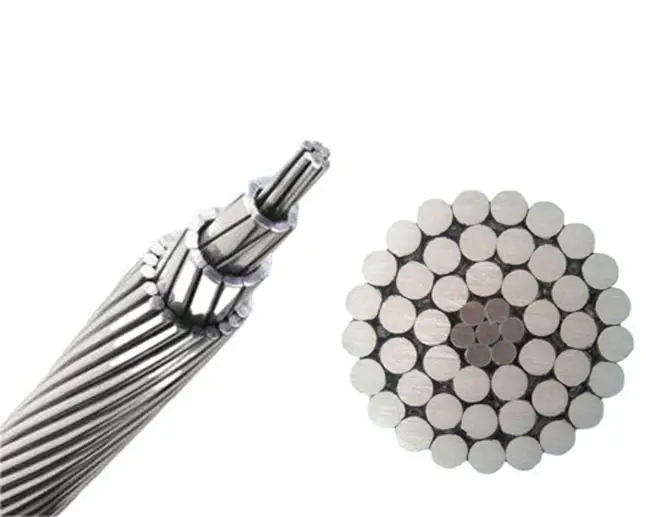
ACSR (Conducteur en aluminium renforcé d'acier) câble represents the pinnacle of power transmission technology, combining decades of engineering excellence with cutting-edge manufacturing standards. As a trusted name in the electrical infrastructure industry, XWA has developed an ACSR cable solution that delivers optimal performance for overhead power transmission and distribution systems worldwide.
The innovative design of XWA ACSR cable features high-purity aluminum strands concentrically stranded around a galvanized steel core, creating a composite conductor that maximizes both electrical efficiency and mechanical strength. This unique construction makes XWA ACSR cable the preferred choice for utilities, industrial facilities, and infrastructure projects requiring reliable, high-capacity power transmission across varying terrains and environmental conditions.

Compact ACSR
Comparé à l'ACSR rond ordinaire, C-ASCR a un diamètre extérieur plus petit, surface plus lisse, résistance au vent et perte corona inférieures, et c'est plus cher, ce qui le rend très approprié pour les lignes de transmission haute tension et ultra haute tension avec la même section conductrice.

ACSR Product Winding
Il s'agit du processus d'enroulement/bobinage du produit fini dans l'ACSR. (fil toronné à âme d'acier en aluminium) processus de production, qui est également l'une des étapes finales de l'ensemble du processus de production.

ACSR Stranding Line
Il s'agit du processus de formation de toronnage/compression de la couche externe du fil d'aluminium dans l'ACSR (fil toronné à âme d'acier en aluminium) production, qui est l’une des étapes essentielles du processus de fabrication.
ACSR Conductor Technical Specifications
- Conductor Cross-Section: 16mm² to 1250mm²
- Breaking Load: 6.08kN to 316.04kN
- DC Resistance: 1.7934Ω/km to 0.0232Ω/km @ 20°C
- Current Capacity: 85A to 1165A
- Operating Temperature: -5°C to +50°C (ambient)
- Wind Pressure Rating: 80-130kg/m²
| Conductor Name | Stranding (Al/St) | Al Cross Section (mm²) | Steel Cross Section (mm²) | Total Area (mm²) | Overall Diameter (mm) |
|---|---|---|---|---|---|
| ACSR 150/25 | 24/7 | 150 | 25 | 175 | 17.1 |
| ACSR 185/30 | 26/7 | 185 | 30 | 215 | 18.5 |
| ACSR 240/40 | 30/7 | 240 | 40 | 280 | 20.7 |
| ACSR 300/50 | 30/7 | 300 | 50 | 350 | 23.3 |
| ACSR 400/65 | 54/7 | 400 | 65 | 465 | 27.4 |
| ACSR 500/85 | 54/7 | 500 | 85 | 585 | 30.5 |
| ACSR 630/100 | 72/7 | 630 | 100 | 730 | 34.2 |
Key Performance Advantages
Superior Mechanical Strength
The steel reinforcement in XWA ACSR cable provides exceptional tensile strength, permettre:
- Long-Span Capability: Spans exceeding 500m between support structures reduce tower requirements and installation costs by up to 30%
- Reduced Sag: Minimal deformation under load ensures consistent performance and safety clearance requirements
- Load Bearing Capacity: Withstands mechanical stresses from wind, ice accumulation, and environmental factors with breaking loads from 6kN to over 300kN
Exceptional Electrical Performance
XWA’s ACSR cable design optimizes power transmission efficiency:
- High Conductivity: Aluminum strands minimize resistive losses, with DC resistance as low as 0.0232Ω/km for large conductors
- Current Capacity: Ranges from 85A for distribution applications to 1165A for high-capacity transmission lines
- Voltage Compatibility: Suitable for applications from distribution voltage (11kV-33kV) to ultra-high voltage transmission (up to 1000kV)
Cost-Effectiveness
The strategic material selection offers significant economic benefits:
- Material Efficiency: Aluminum costs approximately 40-60% less than copper while delivering 61% of copper’s conductivity
- Weight Reduction: Approximately 50% lighter than equivalent copper conductors, reducing support structure requirements
- Installation Savings: Lower transportation costs and simplified installation procedures decrease total project costs by 15-25%
Comprehensive Applications of ACSR Cable
Les câbles XWA ABC sont destinés à diverses industries et applications dans le monde entier. Comprendre où et comment nos câbles fonctionnent aide les clients à prendre des décisions éclairées pour leurs besoins spécifiques.

Power Transmission
- Ultra-High Voltage Transmission: 750kV to 1000kV lines for interconnecting regional power grids and transporting electricity over hundreds of kilometers
- High-Voltage Transmission: 110kV to 500kV networks for city-to-city power distribution and major industrial facility supply
- River and Valley Crossings: Exceptional span capability enables efficient crossing of natural obstacles without additional support structures

Distribution Systems
- Primary Distribution: 11kV to 33kV feeders connecting substations to urban and suburban areas
- Secondary Distribution: Lower voltage networks delivering power to residential and commercial customers
- Rural Electrification: Long-distance distribution to remote communities with challenging terrain

Specialized Infrastructure
- Railway Electrification: Overhead catenary systems for electric railways requiring high mechanical strength and wear resistance
- Complexes industriels: Power distribution within refineries, usines chimiques, and manufacturing facilities where durability and reliability are critical
- Intégration des énergies renouvelables: Wind farm and solar plant grid connections requiring long-distance power transmission
- Emergency Power Systems: Temporary transmission lines for disaster recovery and construction projects
XWA Quality Assurance and Certification
- CEI 61089: Conducteurs multibrins électriques aériens à pose concentrique de fil rond
- ASTM B232: Concentric-lay-stranded aluminum conductors, coated-steel reinforced
- BS EN 50182: Conductors for overhead lines
- GB/T 1179: Chinese national standard for overhead conductors
Quality Control Processes
- Material Testing: All aluminum and steel components undergo rigorous quality verification
- Mechanical Testing: Tensile strength, fatigue resistance, and elongation testing on every production lot
- Electrical Testing: DC resistance, conductivity verification, and current capacity validation
- Corrosion Resistance Testing: Salt spray and environmental exposure testing for harsh condition applications
XWA ACSR Cable Product Portfolio
Standard ACSR Conductors, XWA offers a comprehensive range of standard ACSR configurations:
- Distribution Grade: 16mm² to 100mm² for local distribution networks
- Transmission Grade: 125mm² to 630mm² for high-voltage transmission
- Extra-High Voltage: 800mm² to 1250mm² for ultra-high voltage applications
Specialized Variants, customized solutions for specific application requirements:
- Anti-Corrosion ACSR: Additional grease protection for coastal and industrial environments
- High-Temperature ACSR: Enhanced thermal performance for increased current capacity
- Aluminum-Clad Steel Core (ACSR/AW): Improved corrosion resistance and conductivity
- Expanded Diameter ACSR: Reduced corona losses for high-voltage applications
Why Choose XWA ACSR Cable
- R&D Investment: Ongoing research into advanced materials and construction methods
- Custom Solutions: Engineering support for specialized application requirements
- Technical Support: Comprehensive application guidance and installation assistance
- Quality Control: Every conductor undergoes rigorous testing before shipment
- Traceability: Complete material lot tracking for quality assurance
- Capacity: High-volume production capability for large-scale projects
- Application Engineering: Assistance with conductor selection and specification
- Logistics Support: Global shipping capabilities and inventory management
- After-Sales Service: Technical support and warranty coverage

Câble conducteur ACAR
ACAR (Conducteur en aluminium, Alliage d'aluminium renforcé) Les conducteurs sont conçus pour la transmission et la distribution d'énergie aérienne à haut rendement dans des conditions de faible & réseaux moyenne tension, combinant la haute conductivité de l'aluminium avec la résistance supérieure des noyaux en alliage d'aluminium pour des performances optimales.

Câble ABC
Câble ABC (Câble aérien groupé) est un compact, câble d'alimentation isolé aérien largement utilisé pour la distribution d'énergie basse tension en milieu urbain, rural, et zones résidentielles.

Câble AAC/AAAC
Conducteur entièrement en alliage d'aluminium - Les câbles aériens AAC/AAAC sont légers, rentable, et largement utilisé pour la distribution d'énergie à courte distance en milieu urbain, rural, et zones résidentielles.
Contact XWA today to discuss your specific ACSR cable requirements and discover how our technical expertise and quality manufacturing can enhance your power transmission infrastructure projects.
Frequently Asked Questions of ACSR Cable
What makes XWA ACSR cable different from other conductors?
XWA ACSR cable combines high-purity aluminum strands with a galvanized steel core, offering optimal conductivity and mechanical strength in a single conductor. This design provides superior performance compared to all-aluminum or all-steel conductors, especially for long-span overhead applications.
What voltage levels are XWA ACSR cables suitable for?
XWA ACSR cables are designed for applications ranging from distribution voltage (11kV-33kV) through high-voltage transmission (110kV-500kV) to ultra-high voltage transmission (up to 1000kV), making them suitable for virtually all overhead power transmission requirements.
How does XWA ensure quality and reliability?
XWA maintains comprehensive quality control systems including material testing, mechanical verification, electrical performance validation, and corrosion resistance testing. All products comply with international standards including IEC 61089, ASTM B232, and BS EN 50182.
What is the typical service life of XWA ACSR cable?
Lorsqu’il est correctement installé et entretenu, XWA ACSR cables typically exceed 40 years of service life, even in harsh environmental conditions. The galvanized steel core and natural aluminum corrosion resistance contribute to exceptional longevity.
Can XWA provide customized ACSR solutions?
Oui, XWA offers customized ACSR conductors including anti-corrosion variants, high-temperature models, aluminum-clad steel core options, and expanded diameter designs for specific application requirements.
