
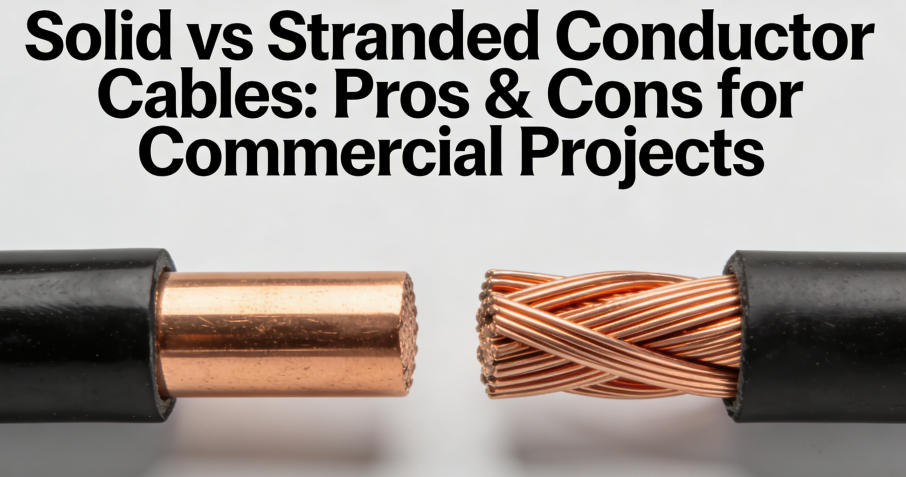
Understanding the Core Difference: Solid vs Stranded Wire
The fundamental difference lies in the conductor’s construction. A solid core cable uses a single, solid piece of metal (typically copper or aluminum) as the conductor. In contrast, a stranded electrical cable is composed of multiple smaller wires twisted or braided together to form a single conductor.
This structural difference dictates their physical properties, performance, and suitability for various commercial wiring applications.
Solid Conductor Cables: In-Depth Analysis
Pros of Solid Wire for Commercial Use
- Lower Cost: Generally less expensive to manufacture than stranded cables, leading to lower material costs for large-scale commercial projects.
- Superior Current Capacity: For a given cross-sectional area (AWG size), a solid conductor can sometimes carry slightly more current in stable, fixed installations due to less surface area oxidation.
- Simpler Termination: Easier to insert into screw-type terminals (like those on outlets, switches, and breakers) and make connections with wire nuts. This can speed up installation in simple, high-volume scenarios.
- Less Susceptible to Corrosion: With a single surface area, there’s less opportunity for corrosive elements to penetrate compared to the interstitial spaces in a stranded wire.
Cons of Solid Core Cable
- Inflexibility and Rigidity: The primary drawback. Solid wire is stiff and difficult to bend repeatedly, making it unsuitable for applications requiring movement or complex routing.
- Work-Hardening and Breakage: If bent back and forth multiple times, solid wire can “work-harden” and become brittle, eventually snapping. This makes it risky for any connection subject to vibration or minor movement.
- Higher Skin Effect at High Frequencies: In applications involving very high-frequency AC (less common in standard power distribution), solid wire can exhibit greater power loss.
Best Applications for Solid Conductor Cables in Commercial Settings
- Fixed In-Wall Wiring: Standard branch circuit wiring for outlets, lighting, and switches in walls, conduits, and ceilings where the cable will remain undisturbed.
- Backbone Cabling: Structured cabling for data (e.g., Cat5e, Cat6) often uses solid conductors for longer runs within building pathways.
- Underground Feeder (UF) Cables: For direct burial applications where the cable is laid once and remains static.
Stranded Conductor Cables: In-Depth Analysis
Pros of Stranded Wire for Commercial Use
- Exceptional Flexibility and Durability: The standout advantage. Stranded cable can withstand repeated bending, twisting, and vibration without breaking. This flexibility of stranded wire is crucial in many industrial and commercial contexts.
- Better for Frequent Movement: Ideal for applications on moving machinery, robotics, assembly line equipment, and door wiring.
- Easier Installation in Tight Spaces: Softer and more pliable, making it easier to pull through conduits with multiple bends or route through crowded control panels and patch panels.
- Improved Fatigue Resistance: Handles vibration and thermal expansion/contraction much better than solid wire, leading to longer-lasting connections in dynamic environments.
Cons of Stranded Electrical Cable
- Higher Cost: More complex manufacturing process typically makes it more expensive per foot than equivalent gauge solid wire.
- Potential for Corrosion: The spaces between strands can trap moisture and promote corrosion if not properly protected or if used in damp environments without suitable insulation.
- Slightly More Complex Termination: Strands can fray when stripped. They often require ferrules, pin terminals, or special care when used with screw-down terminals to ensure all strands are captured and a reliable connection is made.
Best Applications for Stranded Conductor Cables in Commercial Settings
- Control Panels and PLC Wiring: Inside enclosures where wires need to be routed to various components and terminals.
- Industrial Machinery and Automation: Wiring on motors, conveyor systems, and robotic arms that experience constant movement or vibration.
- Power Cords and Equipment Cords: Any cord that is plugged in and moved (e.g., extension cords, appliance cords, tool cords).
- Commercial Vehicle and Marine Wiring: For environments with constant vibration and movement.
- Temporary Power Systems: For construction sites or event power where cables are frequently deployed, repositioned, and coiled.
Key Decision Factors for Your Commercial Project
When choosing between solid vs stranded wire for commercial buildings, consider these factors:
- Application Static vs. Dynamic: Is the installation permanent and fixed (favor solid) or subject to movement, bending, or vibration (favor stranded)?
- Conduit and Pulling: For long, straight conduit runs, solid is often easier. For conduits with many bends or crowded pathways, stranded’s flexibility is a major asset.
- Termination Type: Match the wire to the connection hardware. Screw terminals favor solid wire, while lug, crimp, or spring-clamp terminals work well with stranded.
- Cost vs. Performance: While solid wire has a lower upfront cost, the long-term reliability of stranded in demanding applications can prevent costly downtime and repairs.
- Code and Standards: Always consult the National Electrical Code (NEC) or local regulations, as some applications may have specific requirements.
Conclusion
There is no universal “best” choice. The decision between solid and stranded conductor cables hinges on the specific demands of the commercial electrical installation.
- Choose Solid Conductor Cables for standard, fixed building wiring where cost-effectiveness and simple termination are priorities, and no movement is expected.
- Choose Stranded Conductor Cables for dynamic environments, control systems, machinery, and any application where flexibility, durability, and resistance to fatigue are critical to performance and safety.
By carefully evaluating the pros and cons of cable types against your project’s requirements, you can ensure a reliable, code-compliant, and efficient electrical infrastructure.
FAQ: Solid vs Stranded Conductor Cables
Q1: Which is better for in-wall wiring in a commercial office building?
A1: For standard in-wall branch circuit wiring (outlets, lights), solid core cable is typically the better and more cost-effective choice. It is designed for permanent, fixed installations and is easier to terminate on standard devices.
Q2: Can I use stranded wire in a conduit for a commercial building?
A2: Yes, stranded electrical cable is perfectly acceptable and often preferred in conduit, especially if the conduit run has several bends. Its flexibility makes it easier to pull through, reducing installation time and risk of damage.
Q3: Does stranded wire carry less current than solid wire?
A3: For the same American Wire Gauge (AWG) size, their current-carrying capacity (ampacity) is virtually identical according to code standards. The misconception sometimes arises because stranded wire has a slightly larger outer diameter, but its conductive cross-sectional area is the same.
Q4: Why are equipment power cords always stranded?
A4: Power cords require high flexibility and durability to withstand repeated bending, coiling, and movement without breaking. Stranded conductor cables are inherently fatigue-resistant, making them the only safe and practical choice for this application.
Q5: Is solid or stranded wire more reliable for connections subject to vibration?
A5: Stranded wire is far more reliable in vibrating environments. Solid wire can work-harden and snap when subjected to constant vibration, leading to connection failure. Stranded wire’s multiple small strands absorb vibration, providing superior long-term reliability in industrial settings.