
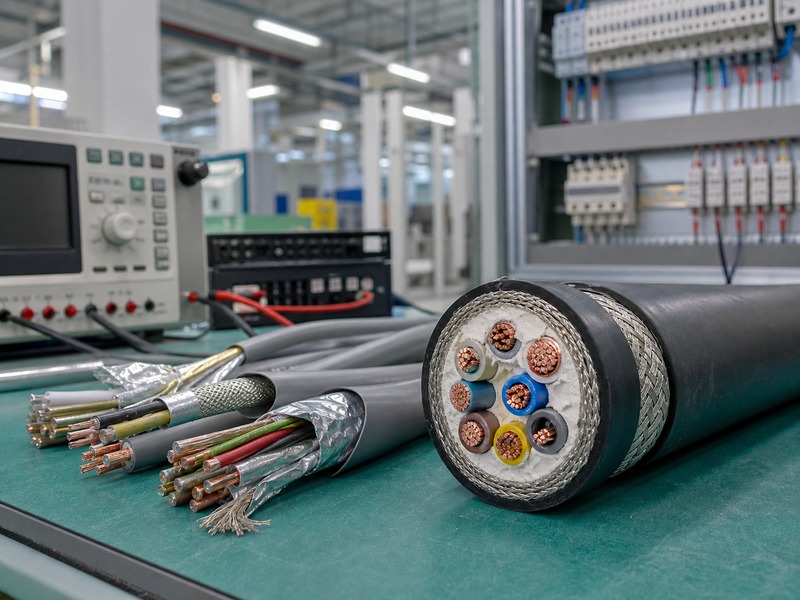
Control cable shielding and core number selection should start from the signal type, 전압 레벨, noise environment, cabinet layout, spare-core philosophy, and termination method. Shielding controls electromagnetic interference. Core count controls circuit grouping, installation space, future modification capacity, and identification work inside panels. A cable that looks correct by voltage rating can still create site problems if the shield, pair grouping, core numbering, or drain wire does not match the control system.
From XWA Cable’s factory and engineering view, a control cable specification needs more than “shielded control cable” 또는 “12-core cable.” The project file should define conductor size, conductor class, insulation material, core identification, individual or overall shield, drain wire, 갑옷, 칼집, flame requirement, rated voltage, test requirement, drum length, and marking. 그만큼 제어 케이블 product page gives the product context; this article explains the engineering logic behind shielding and core count.
Shielding And Core Count Solve Different Problems.
Shielding and core count often appear in the same control cable enquiry, but they do not solve the same problem. Shielding reduces unwanted electrical noise between the cable and nearby equipment. Core count defines how many control circuits, auxiliary contacts, signals, or spare conductors the cable can carry.
A shielded cable with the wrong core count creates termination congestion or forces extra cable runs. A cable with enough cores but no suitable shield can create signal instability near drives, 모터, 변압기, contactors, or radio-frequency sources. The final construction must match both the electrical environment and the panel wiring plan.
| Design Question. | Shielding Decision. | Core Number Decision. | Factory Data Needed. |
|---|---|---|---|
| Does the route pass near power cables or drives? | Overall shield or pair shield may be needed. | Separate noisy and sensitive circuits where possible. | Route environment and signal type. |
| Does the cable carry analog or low-level signals? | Better shield coverage and drain wire detail matter. | Twisted pairs may fit better than simple numbered cores. | Signal type and wiring diagram. |
| Does the cabinet need future expansion? | Shield type stays linked to signal risk. | Spare cores may reduce later rework. | Core list and spare-core plan. |
| Does the installation need mechanical protection? | Shield does not replace armor. | Core count affects diameter and bending. | Armor, 칼집, and installation method. |


When Overall Shielding Is Enough.
An overall shield wraps the complete cable assembly under the outer sheath. It helps reduce external electromagnetic interference and provides a continuous shielding layer for the group of cores. This construction fits many general control circuits where the cable runs through an industrial plant, control room, machine line, or substation auxiliary system.
Overall shielding works best when all cores inside the cable share a similar signal level and noise sensitivity. Typical examples include relay control, interlock circuits, low-voltage control supply, start-stop control, and auxiliary status wiring. The shield should have suitable coverage, continuity, and termination design. XWA can supply overall shield structures such as copper tape, aluminum-polyester tape with drain wire, or copper braid where the specification requires it.
When Pair Shielding Or Individual Screening Makes More Sense.
Individual pair shielding or individual core group shielding fits applications where signals inside the same cable need separation. Analog signals, pulse signals, communication circuits, sensor feedback, and instrumentation-related wiring may suffer from crosstalk if all circuits only share one overall shield.
Pair shielding adds structure and cost. It also increases cable diameter and termination work. The benefit appears when signal integrity matters more than compact construction. In these cases, XWA reviews pair count, pair twist, shield type, drain wire arrangement, 격리, 칼집, and marking so the supplied cable matches the control system drawing.
| Shield Structure. | Common Use. | Strength. | Limit. |
|---|---|---|---|
| Unshielded control cable. | Simple switching, dry contact, short clean routes. | Smaller diameter and simpler termination. | Weak noise protection near interference sources. |
| Overall foil shield with drain wire. | General industrial control and cabinet wiring. | Good coverage and practical termination. | Less separation between internal circuits. |
| Copper braid shield. | Routes needing flexibility and mechanical durability. | Good continuity and robust handling. | Usually higher cost and larger diameter. |
| Individual pair shield plus overall shield. | Mixed analog, pulse, and sensitive control signals. | Better crosstalk control. | More complex construction and termination. |
Shield Grounding Must Match The Control System.
Shield performance depends on the grounding method. A shield that remains floating may not control noise as intended. A shield grounded incorrectly can create unwanted circulating current or ground-loop problems. The correct method depends on the signal frequency, circuit design, equipment grounding system, and cabinet practice.
Many low-frequency analog and instrumentation circuits use one-end shield grounding to reduce ground-loop risk. Higher-frequency noise control may require a different bonding approach. XWA does not define the control-system grounding philosophy from the cable alone. The cable construction provides the shield, drain wire, and continuity; the system design defines how the shield terminates.
Core Number Starts With The Circuit List.
Core number selection should follow the circuit list, not a habit such as always using 7-core or 12-core cable. The circuit list should show each control function, 전압, signal type, spare core, terminal reference, and route. This prevents one cable from mixing circuits that should stay separate.
예를 들어, motor start-stop control, fault feedback, local-remote selection, emergency stop, and status indication may appear in the same cabinet. Some projects place these functions in one multicore cable. Other projects split safety, analog, and noisy circuits into separate cables. The better structure depends on electrical risk, maintenance logic, termination space, and site standards.
Too Few Cores And Too Many Cores Both Create Problems.
Too few cores can force late-stage cable additions, junction changes, or reuse of cores for functions not shown in the original drawing. This creates documentation risk and makes troubleshooting harder. Too many cores increase cable diameter, 굴곡 반경, tray fill, gland size, and termination congestion. Extra spare cores also need identification and end treatment.
XWA usually treats spare cores as an engineering decision. A small number of spare cores can support commissioning changes. A large number of spare cores can make the cable harder to install and terminate. The project file should define the spare-core quantity instead of leaving it to factory assumption.
| Core Count Choice. | Useful Condition. | Risk If Misused. |
|---|---|---|
| 2 에게 4 코어. | Simple commands, auxiliary power, or status circuits. | Limited flexibility for future changes. |
| 5 에게 12 코어. | Common machinery and panel control circuits. | Mixed signal types can create noise and maintenance issues. |
| 16 에게 37 코어. | Large control panels and multi-signal routes. | Diameter, gland size, 굴곡 반경, and termination space increase. |
| Paired or triad construction. | Analog, instrumentation, pulse, or communication-related signals. | More complex marking and termination requirements. |
Conductor Size And Class Affect Termination More Than Many Specifications Show.
Control cable conductor size often ranges from small cross sections for signal control to larger cross sections for auxiliary supply or longer routes. The selected size must match current, 전압 강하, terminal size, 기계적 강도, and project standard. IEC 60228 conductor classes are commonly used as a reference for conductor construction and resistance.
Flexible conductors help in moving equipment, tight cabinet routes, and repeated bending areas. Solid or less flexible constructions may fit fixed installation where movement is limited. Terminal blocks, ferrules, glands, and field wiring practice must match the conductor class. XWA confirms conductor class and nominal area before production because this detail affects both factory construction and site termination.
Insulation And Sheath Depend On Voltage, Fire, 기름, And Outdoor Conditions.
Control cables often use PVC insulation and PVC sheath for general industrial control. XLPE or other insulation systems may appear where higher thermal performance or specific project requirements apply. LSZH sheath can fit enclosed areas where smoke and halogen emission matter. Oil-resistant, 자외선 방지, flame-retardant, or cold-resistant sheath may fit special environments.
The sheath decision should follow the route. Cable trays, 덕트, buried routes, machinery areas, outdoor exposure, and chemical zones do not require the same outer protection. Shielding reduces electrical noise, but it does not protect the cable from impact, 기름, 햇빛, 수분, or flame spread. Armor and sheath performance must be specified separately.
Shielding Does Not Replace Cable Segregation.
A shielded control cable can still perform poorly if the route places it tightly beside high-current power cables, variable frequency drive output cables, welding cables, or strong electromagnetic sources. Cable segregation, crossing angle, tray layout, gland plate bonding, and cabinet grounding remain important.
This is where factory specification and installation design meet. XWA can manufacture the required shielded control cable construction, but the site route controls much of the noise exposure. If a sensitive control cable must share a congested tray, stronger shielding or separate routing may reduce risk. The best solution often combines cable construction, route planning, and cabinet termination practice.
Inspection And Test Points Before Shipment.
Control cable quality review should cover conductor resistance, core count, insulation color or numbering, shield continuity, drain wire arrangement, sheath thickness, marking, diameter, drum length, and visual condition. Electrical checks confirm basic conformity. Dimensional and marking checks prevent many site problems.
For shielded cables, shield continuity deserves attention. A broken foil, poor braid coverage, missing drain wire, or unclear shield termination detail can reduce field reliability. XWA records the approved construction and checks production against that file. 그만큼 국제 케이블 표준 article gives broader context for standards and document control.
How XWA Converts A Control Cable Requirement Into Production Data.
XWA converts the project requirement into a production file before manufacturing. The file defines rated voltage, 도체 재료, conductor size, conductor class, core number, core identification, 격리, shield structure, drain wire, 갑옷, 칼집, marking, test requirement, drum length, and packing method.
For communication-related control routes, product selection may connect with the RS485 Cable page. RS485-style circuits need impedance and pair design considerations that differ from ordinary relay control wiring. A cable that works for dry contacts may not suit serial communication or pulse feedback.
Project Data Checklist For XWA Configuration.
| Data Field. | Why XWA Needs It. | Example Detail. |
|---|---|---|
| Rated voltage. | Defines insulation level and marking. | 300/500 다섯, 450/750 다섯, 0.6/1 kV, or project standard. |
| Core number or pair count. | Defines internal construction and diameter. | 7 코어, 12 코어, 24 코어, 4 pairs, 또는 8 pairs. |
| Conductor size and class. | Controls resistance, flexibility, and termination fit. | 0.75 mm2, 1.0 mm2, 1.5 mm2, class 2 or class 5. |
| Shield type. | Controls noise protection and termination style. | Overall foil, copper tape, copper braid, individual pair screen. |
| Drain wire. | Supports practical shield termination. | Tinned copper drain wire under foil shield. |
| Sheath and environment. | Matches fire, 기름, 자외선, 연마, and indoor/outdoor exposure. | PVC, LSZH, oil-resistant, 자외선 방지, flame-retardant. |
| Route and cabinet layout. | Supports diameter, bend, gland, and segregation review. | Tray, 도관, panel, machine line, outdoor run. |
| Marking and packing. | Supports installation and traceability. | Meter marking, drum length, cable code, destination mark. |
FAQ.
Is a shielded control cable always better than an unshielded control cable?
아니요. Shielding helps when electrical noise, crosstalk, or sensitive signals create risk. It also increases construction complexity and termination requirements. Simple dry-contact circuits on short clean routes may not need shielding.
Should a control cable use overall shield or individual pair shield?
Overall shield fits many general control circuits. Individual pair shield fits mixed or sensitive signals where crosstalk matters. The signal type, route noise, cabinet grounding, and termination method decide the better construction.
How many spare cores should a control cable include?
Spare cores should follow the project maintenance and commissioning plan. A small reserve can support later changes. Too many spare cores increase diameter, 굴곡 반경, gland size, and termination work.
Does shielding remove the need for cable route separation?
아니요. Shielding reduces one noise path, but route separation still matters near high-current power cables, drives, 변압기, and switching equipment. Cable construction and installation layout work together.
What information does XWA need to quote a shielded control cable?
XWA needs rated voltage, core number or pair count, conductor size, conductor class, shield type, drain wire requirement, 갑옷, sheath material, 기준, drum length, marking, 포장, and route environment.
Engineering Conclusion.
Control cable shielding and core number selection should match the signal, route, cabinet, and maintenance plan. Shielding controls interference risk. Core number controls circuit capacity, identification, and termination work. Neither decision should come from habit alone.
XWA Cable can configure shielded and unshielded control cable constructions from the approved project data. Clear signal type, core list, shield structure, sheath requirement, drum length, and marking details help the factory prepare a cable that fits both the electrical system and the installation site.