
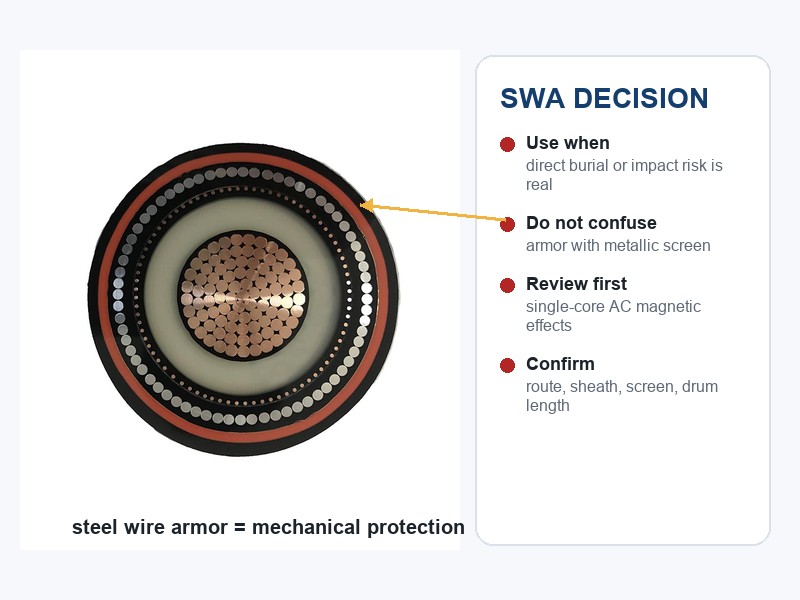
Steel wire armored MV cable is used when a medium-voltage route needs mechanical protection beyond the insulation screen, metalni ekran, posteljina, i vanjski omotač. It is most relevant for direct burial, industrial corridors, rough ground, utility crossings, and routes where impact, crushing, excavation contact, or handling stress cannot be controlled by civil protection alone. SWA is not a universal upgrade: it adds diameter, težina, stiffness, termination work, and electromagnetic considerations, especially in single-core AC circuits.
The practical engineering question is not whether steel wire armor is strong. The question is whether the route risk justifies the added armor layer and whether the finished cable can still be pulled, savijen, prekinut, bonded, testirano, spakovano, and installed within the project limits.
Kratak odgovor: SWA protects against route risk, not electrical stress
In a medium voltage cable, steel wire armor is a mechanical protection layer. It sits outside the cable core system and helps resist external pressure, uticaj, pulling abuse, and accidental contact. It does not replace the conductor screen, izolacioni ekran, metalni ekran, ili omotač. Those layers control the electric field, kontinuitet ekrana, earth-fault path, moisture boundary, and environmental protection.
This distinction matters because an MV cable can look stronger after armor is added while still being incorrectly specified. A route exposed to mechanical damage may need armor, but the cable still needs the correct voltage designation, veličina provodnika, izolacioni sistem, metalna površina ekrana, materijal omotača, aranžman vezivanja, rutinski testovi, i kompatibilnost dodatne opreme.
XWA normally reviews SWA together with the complete MV kabl za napajanje izgradnja. For voltage-specific systems such as 33kV Cable, the armor decision is checked against cable diameter, dizajn ekrana, route layout, dužina bubnja, and installation method rather than treated as a separate add-on.
Where steel wire armor makes engineering sense
SWA construction is most useful where the cable route exposes the outer sheath and core to real mechanical threat. Direct burial is the common case, especially where the route crosses public ground, plant roads, industrijska dvorišta, rocky soil, compacted backfill, or future excavation zones. The armor layer provides a stronger physical barrier than a non-armored sheath alone.
Industrial routes are another strong fit. Medium voltage feeders near foundations, equipment pads, conveyor areas, rudarske rute, trafostanice, renewable-energy collection routes, and heavy maintenance zones may face crushing, uticaj, vibracija, or accidental contact during later site work. In these conditions, the armor layer reduces the probability that external force reaches the insulation system.
| Stanje rute | SWA relevance | Engineering limit |
|---|---|---|
| Direct burial in exposed ground | Often useful when civil protection is limited. | Bedding, dubina ukopa, traka upozorenja, and cover protection still matter. |
| Industrial plant corridor | Useful where equipment, fondacije, or maintenance activity create impact risk. | Pulling route and termination space must be reviewed early. |
| Rocky backfill or rough trench | Može smanjiti rizik od oštećenja jezgra kabla. | Oštre kamenje ne smije biti prislonjeno na korice ili oklop. |
| Zaštićena banka kanala | Može biti nepotrebno ako kanali pružaju pouzdanu mehaničku zaštitu. | Dodatni prečnik može smanjiti marginu punjenja kanala i povećati vučnu silu. |
| Dugo jednožilno AC kolo | Zahtijeva poseban pregled prije odabira magnetnog oklopa. | Magnetski oklop može stvoriti dodatne gubitke i zagrijavanje ovisno o dizajnu kola. |
Oklop, ekran, i plašt su različite odluke
Najčešća greška u specifikaciji je tretiranje oklopa, štit, i omotač kao istu zaštitnu funkciju. To su zasebne odluke. Metalni ekran ili štit je dio električnog dizajna. It helps control the electric field around the insulation and provides continuity for fault-current and earthing requirements according to the project design. The armor layer is mainly mechanical. The outer sheath is the environmental boundary against moisture, abrazija, hemikalije, sunčeva svetlost, and site exposure.
A cable can be shielded and unarmored. A cable can be armored and still need a correctly designed metallic screen. A cable can have strong steel wire armor but still fail a project requirement if the sheath material is unsuitable for the installation environment. XWA separates these layers during construction review so the final cable does not rely on one layer to perform another layer’s job.
This topic connects with the existing XWA article on armored and unarmored cable route decisions. That comparison explains the broader route choice. This article focuses more narrowly on steel wire armor in MV power cable construction.

The construction changes created by SWA
A typical armored MV cable starts with the conductor, ekran provodnika, XLPE or EPR insulation, izolacioni ekran, metalni ekran, bedding or inner sheath, armor layer, i vanjski omotač. The exact sequence changes by cable design, standard, core count, zahtjev za blokiranje vode, and regional specification. SWA normally uses galvanized steel wires laid around the bedding or inner sheath before the final outer sheath is extruded.
The armor layer changes more than appearance. It increases overall diameter and cable mass. It can change minimum bending radius because the finished cable becomes stiffer. It can change drum size and transport planning. It can affect accessory preparation because the armor must be stripped and terminated correctly. It can also affect electrical losses if magnetic armor is used around single-core AC cables.
| Layer or parameter | Role in the finished cable | SWA-related point |
|---|---|---|
| Dirigent | Carries load current. | Copper or aluminum selection affects diameter, težina, i termičko ponašanje. |
| XLPE or EPR insulation | Provides dielectric strength for the voltage class. | Armor does not compensate for incorrect insulation level. |
| Metalni ekran | Supports electric-field control, kontinuitet, and fault-current design. | Screen area must be specified separately from armor. |
| Bedding or inner sheath | Odvaja i podržava oklopni sloj. | Štiti donje slojeve od pritiska oklopa tokom proizvodnje i servisiranja. |
| Oklop od čelične žice | Pruža mehaničku zaštitu i vlačnu potporu. | Dodaje težinu, stiffness, i pomoćni rad. |
| Vanjski omotač | Štiti od spoljašnjeg okruženja. | Izbor materijala i dalje ovisi o tlu, sunčeva svetlost, ulje, plamen, ili izlaganje hemikalijama. |
Jednožilni AC krugovi zahtijevaju posebnu pažnju
Čelik je magnetan. Ta činjenica postaje važna kada oklop okružuje jednožilni AC kabl. Magnetni metalni sloj oko jedne faze može biti izložen naizmjeničnom magnetskom toku, koji mogu stvoriti inducirane efekte, dodatni gubici, i grijanje. Uticaj zavisi od dizajna kabla, struja, konfiguracija oklopa, vezivanje, razmak, raspored instalacije, i rad sistema. Ne treba ga odbaciti uz izbor generičkog kataloga.
Za višežilni kabl, phase grouping can reduce some magnetic effects because the phase currents are located within the same cable body. For single-core MV circuits, non-magnetic armor such as aluminum wire armor may be considered where mechanical protection is required. Another solution may be a protected installation system instead of magnetic armor. The correct decision depends on the route, raspored kola, i specifikaciju projekta.
This is why XWA does not treat SWA as an automatic selection for every medium voltage circuit. The factory construction is reviewed together with phase arrangement, metalik dizajn ekrana, bonding practice, termička ocjena, i kompatibilnost dodatne opreme.
Installation trade-offs are part of the specification
Oklopni kabl je jači, but it is also harder to handle. Additional steel wires increase weight and can require larger drums. Povlačenje napetosti, bočni pritisak, radijus savijanja, route obstacles, punjenje kanala, pristup bubnju, and lifting method all become more important. A cable that is mechanically protected on paper may still create installation risk if the route was designed around a smaller unarmored diameter.
Iz ovog razloga, SWA should be confirmed before drum length and route method are finalized. The installation plan should check whether the cable can enter ducts, pass bends, reach terminations, and fit glands or accessory hardware. Heavy drums also require proper handling control. Neutral safety resources such as the HSE manual handling guidance show why load weight, task layout, and handling method need planned control rather than improvised site movement.
Standards give the framework; the route gives the final answer
IEC 60502-2 is a common reference for extruded-insulation medium voltage power cables. IEEE field-testing and accessory standards are also relevant in systems that follow North American practice. Standards define important construction, testiranje, and system boundaries, but they do not automatically decide whether a route needs steel wire armor. The route condition, specifikacija korisnosti, način instalacije, jezgro aranžmana, zahtjev za omotačem, and documentation package complete the answer.
For an SWA MV cable, the technical schedule should therefore include more than voltage and conductor size. It should define the standard, materijal provodnika, core count, izolacijski materijal, tip i površina ekrana, tip oklopa, materijal omotača, zahtjev za blokiranje vode gdje je primjenjivo, fire or LSZH requirement if relevant, dužina bubnja, test dokumenti, i obim inspekcije.
What XWA will not assume from the word “oklopni”
Riječ “oklopni” is not precise enough for MV cable production. XWA will not assume the armor material, armor wire size, magnetno ponašanje, materijal omotača, oblast ekrana, water-blocking design, or inspection scope from that single word. The technical schedule should state whether the cable is steel wire armored, steel tape armored, aluminum wire armored, or another protected construction.
This is especially important when the cable schedule moves between IEC-style, British-style, and North American terminology. SWA may be common wording in one specification, while another project may define armor through a cable code or utility drawing. XWA treats the route drawing, cable standard, jezgro aranžmana, and document list as the controlling information. If those details are missing, the factory can propose a construction, but the final design should be confirmed against the route and system data before production.
Factory checks before XWA confirms SWA construction
XWA checks SWA construction from the inside out. The conductor and insulation system must match the voltage class. The metallic screen must match the fault-current and grounding requirement. The bedding must support the armor without damaging the screened core. The armor wires must be applied evenly and covered by an outer sheath suitable for the route environment.
Routine production control normally includes dimensional checks, provjere otpornosti provodnika, testovi napona, pregled omotača, and document review according to the agreed standard and specification. If partial discharge, special sheath test, test uzorka, inspekcija treće strane, or project-specific records are required, those items should be listed before production starts. XWA will not invent certification or test data after the cable is made; the document scope must match the agreed design.
Project data required for SWA MV cable configuration
Za konfiguraciju i ponudu, XWA needs enough project information to decide whether steel wire armor is the correct construction. A short description such as “MV cable with armor” is not enough for reliable engineering review.
| Required item | Zašto je važno |
|---|---|
| Voltage designation and system type | Defines insulation level, opseg testiranja, i klasa pribora. |
| Single-core or three-core construction | Controls armor material review, prečnik kabla, i način ugradnje. |
| Materijal i veličina provodnika | Affects current rating, težina, prečnika, and cost structure. |
| Metallic screen type and area | Controls grounding, fault-current capacity, i priprema pribora. |
| Put instalacije | Explains whether SWA is necessary or whether civil protection is enough. |
| Sheath material and environment | Connects the cable to soil, duct, sunčeva svetlost, ulje, plamen, ili izlaganje hemikalijama. |
| Drum length and route bends | Prevents unrealistic packing, povlačenje, and bending assumptions. |
| Required standards and documents | Defines factory tests, inspection records, i izdavanje dokumenata. |
FAQ
Is steel wire armored MV cable always better than unarmored MV cable?
br. SWA is better when mechanical route risk justifies the added armor. In protected ducts, tuneli, tacne, or controlled trenches, unarmored MV cable can be easier to pull, bend, terminate, and pack.
Može li oklop od čelične žice zamijeniti metalni ekran?
br. The metallic screen and armor have different functions. The screen belongs to the electrical design, while steel wire armor mainly provides mechanical protection.
Is SWA suitable for single-core MV cable?
It requires careful review. Magnetic steel armor around single-core AC cable can create additional losses and heating depending on the circuit. Non-magnetic armor or another route-protection method may be more suitable.
What information does XWA need before confirming an SWA MV cable?
XWA needs voltage designation, materijal i veličina provodnika, core count, izolacija, tip i površina ekrana, zahtev za oklop, materijal omotača, ruta instalacije, dužina bubnja, standard, i zahtjevi za dokumentima.
Inženjerski zaključak
Steel wire armored MV cable makes sense when the route creates mechanical risk that civil protection alone cannot control. It should not be selected only because it appears stronger. The correct design balances protection against weight, prečnika, radijus savijanja, povlačenjem napetosti, dizajn ekrana, single-core magnetic effects, accessory work, fabričko ispitivanje, i isporučnu dokumentaciju.
When the route is direct buried, exposed, industrijski, or difficult to control, SWA can be a practical construction. When the route is already protected and pulling space is limited, unarmored or non-magnetic armored designs may give a better engineering result. XWA confirms the construction after reviewing the cable schedule and route data rather than applying one armor rule to every MV project.