
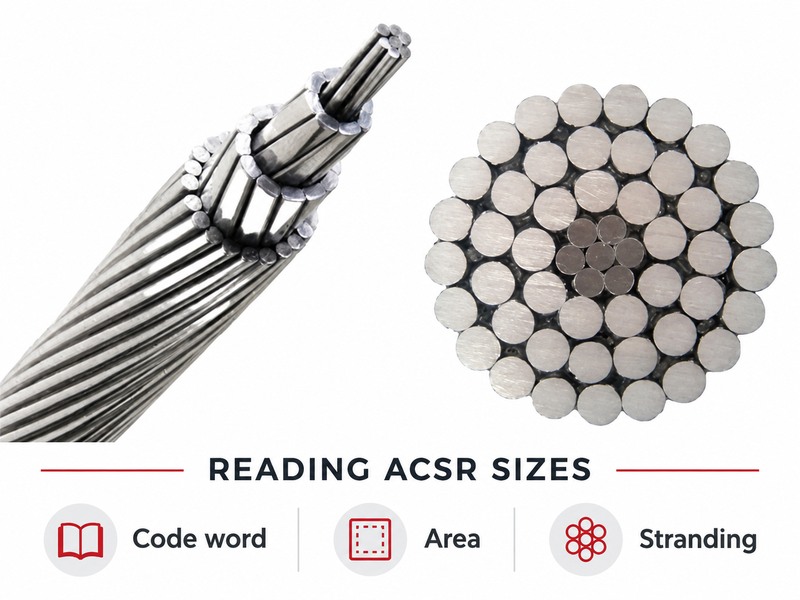
Veličine ACSR vodiča opisuju više od jedne veličine. Vrijednost kcmil obično identificira nominalnu površinu aluminija u relevantnom rasporedu provodnika; oznaka kao npr 26/7 identificira broj aluminijskih i čeličnih žica; a kodna riječ identifikuje konstrukciju unutar imenovanog standarda ili tabele. Nijedno od ovih polja samo po sebi ne definira gotov provodnik. Pročitajte ih zajedno s promjerima žice, oznaka čeličnog jezgra, ukupni prečnik, otpor, i nazivne snage. Ovo sprečava da nominalno sličan provodnik bude prihvaćen kao ekvivalent kada je njegova geometrija, mehaničko ponašanje, ili su okovi različiti.
Odvojite polja prije tumačenja oznake.
A short enquiry such as “ACSR 795” leaves important construction details unresolved. A useful conductor description has distinct fields for family, veličina, unit, nasukavanje, core type, code word, and governing document. Combining them into one familiar name can conceal a missing requirement.
| Field | Šta identifikuje | What it does not establish |
|---|---|---|
| ACSR | Aluminum conductor with steel reinforcement. | A particular size, core grade, or current rating. |
| Nominal size and unit | The area designation used by the selected schedule. | Finished diameter or total metal area unless explicitly stated. |
| Aluminum/steel strand counts | How many wires of each material are specified. | The area of those wires without their diameters. |
| Code word | A construction reference within a recognized table. | Interchangeability across unrelated standards or modified constructions. |
| Core suffix | The specified core material, coating, or strength variant. | A universal quality ranking independent of the applicable standard. |
The XWA ACSR product page is the starting point for construction context. The detailed schedule should preserve each field separately so that drawing, testiranje, and manufacturing requirements remain unambiguous.
A code word points to a table, not to a universal substitute.
ASTM B1006-17(2023) organizes overhead-conductor code words by construction and associates those groups with relevant standards. It also recognizes that suffixes can distinguish construction variants. Consequently, a familiar code word should be read together with its conductor family, sufiks, and governing table.
Do not rank conductor sizes from the everyday meaning of their names. Niti se poznato ime treba koristiti za popunjavanje praznina u crtežu iz sjećanja. Ako raspored imenuje jedan provodnik, ali njegov broj niti ili dimenzije identifikuju drugi, nedosljednost treba razjasniti prije proizvodnje.
Kodna riječ može biti efikasna referenca kada obje strane koriste istu tablicu. Postaje nepouzdan kada stari crtež, novi materijalni sufiks, a dimenzije iz drugog kataloga se tiho kombinuju. Praktično rješenje je zadržati referentni dokument i reviziju uz naziv.
kcmil pretvara područje; ne pretvara dizajn provodnika.
Kružni mil je jedinica površine zasnovana na krugu prečnika hiljaditi deo inča. Jedan kcmil je 1,000 circular mils. Iz NIST faktora konverzije, 1 kcmil je približno 0.5067075 mm². Stoga, 795 kcmil se pretvara u približno 402.832 mm².
Ovo su samo aritmetičke konverzije:
| Površina u kcmil | Konvertirana površina, mm² (zaobljen) |
|---|---|
| 336.4 | 170.456 |
| 477 | 241.699 |
| 795 | 402.832 |
| 954 | 483.399 |
The NIST referenca za konverziju jedinica daje osnovni faktor. Konvertovani broj zadržava značenje originalnog polja površine; ne uključuje automatski čeličnu površinu niti postaje odobrena metrička oznaka provodnika.
795 kcmil nije automatski zamjenjiv s označenim vodičem 400 mm². Čak i tamo gde su aluminijumske površine blizu, predloženi dizajni mogu se razlikovati po površini čelika, dimenzije žice, ukupni prečnik, masa, snagu, i armature. ASTM B232/B232M takođe navodi da se njegovi sistemi SI i inch-pound moraju koristiti nezavisno jer tabelarne vrednosti možda nisu tačne ekvivalente. Konverzija objašnjava količinu; važeći standard definira specificirani proizvod.

Strand count and area are different fields.
In conventional aluminum/steel stranding notation, 26/7 means 26 aluminum wires and seven steel wires. It does not mean 26 mm² of aluminum and 7 mm² of steel. The component wire diameters are needed to determine metal areas.
By contrast, a schedule explicitly written as nominal Al/St area 240/40 mm² describes area fields, not wire counts. Always read the column heading and unit: a slash has no universal meaning on its own. The notation examples here are independent explanations, not equivalent conductor designs or specifications of the pictured samples.
For a group of equal-diameter round wires, the sum of wire cross-sectional areas is A = n × π × d² / 4, gdje n is wire count and d is wire diameter. Calculate aluminum and steel groups separately. If wire diameters vary, sum the individual areas rather than assuming one diameter throughout.
That geometric sum is not the area of the circle enclosing the finished conductor: spaces remain between round wires. Similarly, adding aluminum and steel areas does not produce an equivalent all-aluminum electrical area. The two materials have different electrical properties, and finished resistance depends on the actual construction.
A small calculation shows why the wire diameter matters.
Consider an illustrative 6/1 round-wire arrangement: six aluminum wires around one steel wire, each with an assumed diameter of 3.00 mm. This is a geometry exercise, not an XWA datasheet, a code-word assignment, or an approved conductor design.
- One wire has an area of π × 3.00² / 4 = 7.069 mm², zaobljen.
- The six aluminum wires provide 42.412 mm² of geometric aluminum area.
- The steel wire contributes 7.069 mm², giving 49.480 mm² of total metal area when calculated before rounding.
Keeping the same 6/1 count but changing all wire diameters to 4.00 mm increases aluminum area to 75.398 mm² and total metal area to 87.965 mm². The strand count is unchanged, yet metal area increases by about 77.8%. This follows the square of the diameter ratio, (4/3)², not a change in the number of wires.
The example does not establish resistance, breaking strength or ampacity. It demonstrates a narrower point: a strand count without wire diameters cannot specify conductor area. I obrnuto, a measured overall diameter alone cannot separate aluminum area, steel area and inter-wire spaces.
The steel suffix belongs in the specification.
ASTM B232/B232M-24 covers round 1350-H19 aluminum wires with coated steel reinforcement and distinguishes core variants. Its public scope, for example, identifies ACSR/GA3 with Class A zinc-coated high-strength steel. Dropping a suffix can therefore remove a material requirement while leaving the size and code word looking familiar.
Do not replace that designation with a vague statement such as “galvanized steel core” if the project specifies more. Core strength and coating requirements need to agree with the finished-conductor schedule and the relevant wire specification. Nor should a stronger core variant be treated as a drop-in substitution: its effect on the approved mechanical design and fittings still needs review.
Round-wire and shaped-wire constructions need separate checks.
IEC 61089 addresses round-wire concentric-lay overhead stranded conductors. IEC 62219 addresses formed or shaped-wire concentric-lay conductors. Their different scopes matter when a designation contains a construction modifier or when a compact-looking alternative is proposed.
A change in wire shape can change the relationship between metal area and overall diameter. Equal nominal area therefore does not prove equal outside dimensions or compatibility with an existing dead-end, splice, or suspension fitting. Equally, a similar diameter does not prove equal aluminum area.
ASTM and IEC references should describe one consistent offered design. Naming several standards on a quotation does not demonstrate that every corresponding construction table is interchangeable. Resolve the governing designation, material requirements, and acceptance criteria explicitly.
Check equivalence across the drawing, not just the size column.
For a proposed replacement or alternative, compare aluminum area, steel area, pramen se računa, wire diameters, total diameter, mass per unit length, resistance at its stated temperature, and rated tensile strength. Record the steel coating and strength class separately. Then check the accessory manufacturer’s dimensional and construction limits for the exact conductor.
This also explains why an AAAC all-alloy conductor should not be substituted using nominal area alone. It has a different material and reinforcement arrangement. Postojeći Poređenje ACSR i AAAC inženjeringa addresses that broader selection question; the task here is to ensure the offered conductor has been identified correctly in the first place.
Current rating is a later check. A code word and area do not state the weather, radna temperatura, or clearance assumptions needed to establish line ampacity. Održavanje identifikacije i ocjene kao zasebnih polja olakšava otkrivanje propusta.
Riješite neusklađenost umjesto usrednjavanja brojeva.
Ako crtež, raspored i etiketa bubnja se ne slažu, prvo uporedite jedinice i značenje svakog polja. Razlika uzrokovana zaobljenom nazivnom površinom nije isto što i različit broj žica ili oznaka jezgre. Nemojte tiho odabrati vrijednost koja vam je najbliža: identifikuju upravljački dokument, zabilježite neslaganje i pribavite odobrenu ispravku prije tretiranja konstrukcije kao ekvivalentne.
Na primjer, “26/7” u koloni za nasukanje ne može potvrditi “240/40 mm²” u koloni područja bez dimenzija žice i važećeg rasporeda. Dvije oznake mogu opisati polja u specifikaciji, ali njihov brojčani izgled ne dokazuje da pripadaju istom provodniku.
Zadržite odobreni identitet do bubnja.
Konačni proizvodni opis treba da se pridruži porodici provodnika, puna kodna riječ i sufiks, standard i revizija, veličina i jedinice, raspored pramenova, i odobrene reference crteža. Zapisnici o inspekciji i identifikacija bubnja tada moraju omogućiti praćenje isporučene dužine do te iste konstrukcije.
Prije nego što XWA potvrdi ACSR konfiguraciju, najkorisniji početni dokument je potreban raspored provodnika ili referentni crtež. Where it contains only “ACSR 400,” “ACSR 795,” or a code word, the missing unit, izgradnja, and core fields need to be resolved. This short clarification prevents an apparently small naming difference from becoming a different manufactured conductor.