
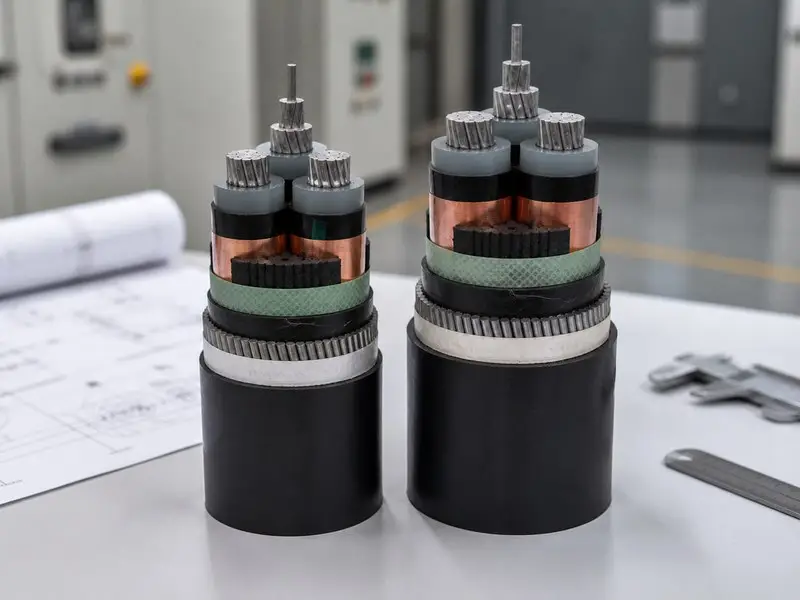
11kabllo kV kundrejt 33 kV përzgjedhja është kryesisht një vendim sistem-tension dhe izolim-projektim. Një kabllo 11 kV përdoret zakonisht për qarqet e shpërndarjes me tension të mesëm të ulët, ndërsa një kabllo 33kV përdoret ku tensioni i rrjetit, distanca e ushqyesit, transferimi i fuqisë, dhe niveli i defektit kërkojnë një klasë tensioni më të lartë. Dallimi nuk është vetëm voltazhi i printuar në këllëf. Ndikon në trashësinë e izolimit, kontrollin e stresit elektrik, dizajni i ekranit metalik, tension testues, diametri i kabllit, rrezja e përkuljes, aksesorë, dhe dokumentacionin e lëshimit.
Dy kabllot i përkasin detyrave të ndryshme të projektimit të TM
Të dy kabllot 11kV dhe 33kV mund të jenë kabllo të tensionit të mesëm XLPE, por nuk kryejnë të njëjtën detyrë. Një furnizues 11 kV shpesh shërben nënstacionet e shpërndarjes, impiantet industriale, rrjete kompakte të shërbimeve, dhe rrugë më të shkurtra TM. A 33kV feeder is commonly used where higher transfer capacity, longer route length, or wider distribution coverage is needed. The exact application depends on the electrical network, not on a simple catalogue preference.
XWA Cable reviews 11kV and 33kV requirements under the broader Kabllo Fuqie MV engineering framework. A voltage-specific page such as 33Kabllo kV is useful for product context, but the final construction still depends on conductor size, niveli i izolimit, zona e ekranit, forca të blinduara, këllëf, gjendja e rrugës, testimi, gjatësia e daulles, dhe kërkesat e dokumenteve.
Voltage designation must be read correctly
MV cable voltage is usually written as U0/U(Një). U0 is the rated power-frequency voltage between conductor and earth or metallic screen. U është voltazhi i vlerësuar midis përçuesve. Um is the maximum system voltage for which the cable may be used. Ky shënim ka rëndësi sepse një frazë e rastësishme si "kabllo 11 kV" mund t'i referohet konstruksioneve të ndryshme të tensionit të vlerësuar në tregje ose specifikime të ndryshme.
Specifikimet e përbashkëta të projektit mund të përdorin emërtime të tilla si 6.35/11(12)kV, 8.7/15(17.5)kV, 12/20(24)kV, 18/30(36)kV, ose 19/33(36)kV në varësi të sistemit dhe praktikës standarde. Përcaktimi i saktë i tensionit duhet të konfirmohet nga standardi i projektit. XWA nuk e trajton "11kV" ose "33kV" si informacion të mjaftueshëm për prodhimin përfundimtar të kabllove.
| Artikulli | 11fokusi i specifikimit të kabllove kV | 33fokusi i specifikimit të kabllove kV |
|---|---|---|
| Roli i rrjetit | Furnizuesit e shpërndarjes së ulët të TM dhe shpërndarja e impianteve. | Ushqyes më të lartë TM, rrugë më të gjata, dhe detyrë më e lartë e transferimit. |
| Emërtimi i tensionit | Shpesh specifikohet rreth 6.35/11(12)kV ose ekuivalent lokal. | Shpesh specifikohet rreth 18/30(36)kV, 19/33(36)kV, ose ekuivalent lokal. |
| Sistemi i izolimit | Trashësia më e ulët e izolimit dhe stresi më i ulët i provës sesa klasat më të larta MV. | Niveli më i lartë i izolimit, diametër më të madh, and stricter stress-control attention. |
| Aksesorë | Smaller terminations and joints where route conditions allow. | Higher voltage-class accessories and larger preparation space. |
| Instalimi | Usually easier bending and handling at the same conductor size. | Larger bending radius, higher drum weight, and closer route review. |

Insulation thickness and electric stress are the real difference
The most important physical difference is the insulation system. A 33kV cable needs a higher insulation level than an 11kV cable. The XLPE insulation thickness, ekrani i përcjellësit, ekran izolues, and metallic screen must control electric stress at a higher operating voltage and test voltage. This normally increases cable diameter and affects bending radius, aksesorë, paketim, dhe mënyra e instalimit.
Higher voltage class also makes interface quality more important. The conductor screen must be smooth, the XLPE insulation must be clean and uniform, and the insulation screen must be properly bonded or strippable according to the design. Any irregularity can create local stress. This is why 33kV cable specification review places strong attention on extrusion quality, dizajni i ekranit, partial discharge behavior, and routine test documentation.
Conductor size is not decided by voltage alone
Voltage class and conductor size solve different parts of the design. Voltage class confirms insulation level. Conductor size confirms current-carrying capacity, rënia e tensionit, short-circuit withstand, and thermal performance. A 33kV cable does not automatically need a larger conductor than an 11kV cable. The required conductor area depends on load current, gjatësia e rrugës, mënyra e instalimit, soil or ambient temperature, grupimi, gjendja e kanalit, and short-circuit requirement.
Për shembull, a short industrial 11kV feeder with high current may use a larger conductor than a lightly loaded 33kV feeder. Anasjelltas, a long 33kV route may need careful voltage drop and loss review even when current is moderate. XWA separates voltage class, conductor sizing, zona e ekranit, and installation rating during engineering review because each item answers a different question.
Metallic screen design changes with fault and grounding conditions
The metallic screen is not only a copper layer around the insulation. It controls the electric field, provides a path for charging current, and may carry earth-fault current until protection operates. A 33kV system can have different fault levels and grounding arrangements from an 11kV system, so the screen area and bonding method must be confirmed.
Screen design should be specified by function: shirit bakri, tel bakri, tel bakri plus shirit, or another metallic shield form. The earlier XWA article on Llojet e ekranit të kabllove MV dhe dizajni i mburojës metalike explains this point in detail. For the 11kV versus 33kV decision, pika kryesore është e thjeshtë: voltage class does not automatically define the screen area; the system fault current and clearing time must also be known.
33kV cable usually needs more installation margin
At the same conductor material and core count, a 33kV cable is usually larger and heavier than an 11kV cable because of the higher insulation level and related construction. This affects minimum bending radius, duke tërhequr tensionin, presioni i murit anësor, mbushje kanali, dimensionet e daulleve, dhe pajisje ngritëse. Prandaj, planifikimi i instalimit duhet të rishikohet përpara se të konfirmohen gjatësitë përfundimtare të kazanit.
Një kabllo 11 kV mund të jetë më e lehtë për t'u instaluar në nënstacione kompakte, rrugët e brendshme, ose ushqyes të shkurtër industrial. Një kabllo 33 kV mund të kërkojë planifikim më të kujdesshëm të rrugës, sidomos aty ku kanalet, përkulet, seksionet direkte të varrimit, ose përfshihen tërheqje të gjata. Nëse rruga është nën tokë, Përzgjedhja e armaturës dhe mbrojtja e këllëfit duhet gjithashtu të rishikohen së bashku me klasën e tensionit.
| Faktori i instalimit | Pse ndryshon | Të dhënat e specifikimeve për të konfirmuar |
|---|---|---|
| Rrezja e përkuljes | Klasa e tensionit më të lartë zakonisht rrit diametrin e përgjithshëm. | Diametri i kabllit, numërimin bazë, forca të blinduara, këllëf, kthesat e rrugës. |
| Ngarkesa tërheqëse | Kablloja më e madhe dhe më e rëndë krijon stres më të lartë instalimi. | Gjatësia e rrugës, gjendja e kanalit, metoda e tërheqjes, presioni i murit anësor. |
| Madhësia e daulles | Kablloja e klasës së tensionit më të lartë mund të zvogëlojë gjatësinë praktike të kazanit. | Gjatësia e kërkuar e dorëzimit, kufiri i paketimit, metoda e shkarkimit të faqes. |
| Aksesorë | Termination and joint dimensions increase with voltage class. | Accessory standard, hapësirën e instalimit, screen and armor details. |
| Testimi | Higher voltage class changes test voltage and PD review requirements. | Standardi i aplikueshëm, inspection plan, routine and sample test scope. |
Standards and tests should be specified before production
IEC 60502-2 përdoret zakonisht për kabllot e fuqisë me izolim të ekstruduar në rangun e tensionit të mesëm, and its scope is relevant to many MV cable specifications. The public IECEE reference for IEC 60502-2 helps identify the standard family, but it does not replace the full project specification. Local utility standards, national requirements, and project inspection plans may add details beyond the base standard.
Testing normally includes routine electrical tests and dimensional checks. Higher voltage classes can place more attention on partial discharge measurement, përballojë tensionin, vazhdimësia e ekranit, sheath integrity, dhe dokumentacionin e lëshimit. The exact test method and acceptance values must follow the agreed standard and project inspection plan. XWA records the approved cable design and test records against the final specification rather than against a generic voltage name.
Accessories and termination space are often underestimated
A 33kV cable termination is not simply a larger version of an 11kV termination. The accessory must match the voltage class, diametri i kabllit, insulation screen type, metallic screen construction, armor if present, and sheath material. Creepage distance, stress-control method, lug size, screen connection, and installation space all matter. A compact panel or substation bay that works for 11kV cable may not have enough space for 33kV accessories.
Jointing also changes. Higher voltage-class joints require careful insulation screen preparation, kontrollin e stresit, pastërti, and dimension matching. If a route has many joints, the accessory system should be reviewed before cable production. This avoids a common specification gap: the cable construction is correct, but the selected accessory does not match the actual screen, forca të blinduara, diametri, ose klasa e tensionit.
Specification data XWA needs before confirming 11kV or 33kV cable
A complete MV cable review needs more than a voltage label. XWA normally confirms the following information before preparing the final construction and quotation file:
- Rated voltage designation, including U0/U(Një), not only “11kV” or “33kV”.
- Standardi i aplikueshëm, siç është IEC 60502-2, local utility specification, ose standardi i projektit.
- Materiali përcjellës, madhësia e përcjellësit, numri i bërthamave, and conductor class.
- Insulation type, lloji i ekranit, zona e ekranit metalik, and fault-current requirement.
- Mënyra e instalimit: varrimi i drejtpërdrejtë, bankë kanalesh, tabaka, tuneli, llogore, ose rrugë e përzier.
- Forca të blinduara, këllëf, water-blocking, rezistent ndaj flakës, LSZH, or UV-resistance requirements.
- Gjatësia e rrugës, gjatësia e daulles, bending limitations, metoda e tërheqjes, and delivery constraints.
- Test rutinë, test mostër, type-test document, partial-discharge requirement, dhe planin e inspektimit.
Practical decision summary
Use an 11kV cable construction when the network voltage, niveli i izolimit, sistem aksesor, and route design are built around the lower MV class. Use a 33kV cable construction when the system voltage, distanca e ushqyesit, transferimi i fuqisë, and network standard require the higher MV class. A 33kV cable is not selected merely because it sounds stronger; it is selected when the system design requires its insulation level and related specification.
The specification should not stop at voltage. The final cable design must combine voltage designation, madhësia e përcjellësit, zona e ekranit, fault-current requirement, forca të blinduara, këllëf, rruga e instalimit, plan testimi, dhe paketën e dokumenteve. This is the practical difference between a cable name and a manufacturable MV cable specification.
FAQ
Can 33kV cable be used on an 11kV system?
It may be electrically possible in some situations, but it is not automatically practical. A 33kV cable is larger, më e rëndë, and requires matching accessories. The system design, rruga e instalimit, hapësira e përfundimit, and project specification must justify the higher voltage-class construction.
Is 33kV cable always thicker than 11kV cable?
For the same general cable type and conductor condition, 33kV cable normally has a higher insulation level and larger overall diameter. Final dimensions still depend on conductor size, ndërtimi i ekranit, forca të blinduara, këllëf, dhe standardin e projektit.
Does conductor size increase from 11kV to 33kV?
Jo automatikisht. Conductor size depends on current, rënia e tensionit, gjatësia e rrugës, gjendja e qarkut të shkurtër, mënyra e instalimit, and thermal rating. Voltage class defines insulation duty; conductor size defines current and thermal duty.
Which standard is commonly used for 11kV and 33kV MV cable?
IEC 60502-2 is commonly referenced for extruded insulation MV power cables, but local utility standards and project specifications may add voltage designations, construction details, testet, and documentation requirements.
What is the most important detail to confirm before production?
The exact rated voltage designation U0/U(Një) must be confirmed first, followed by conductor size, zona e ekranit, fault-current requirement, rruga e instalimit, forca të blinduara, këllëf, standarde, testing scope, and drum length.