
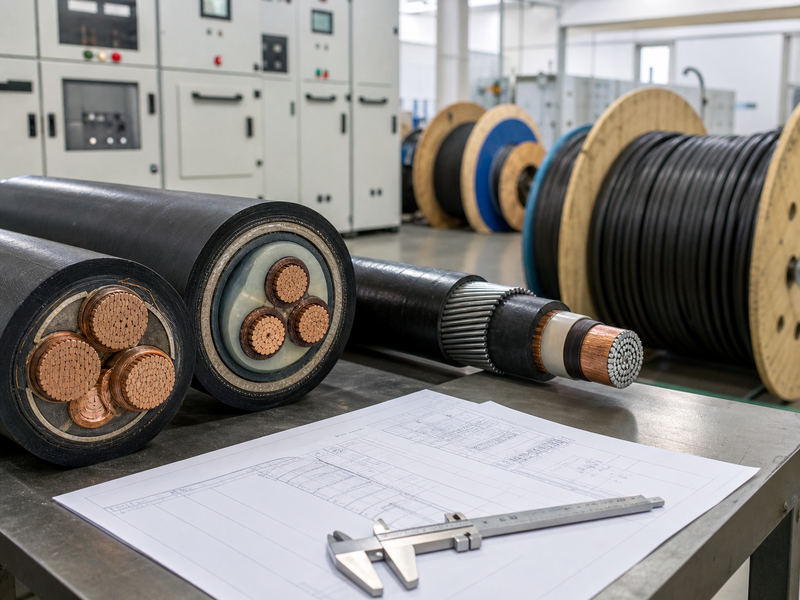
Zgjedhja e kabllove të tensionit të mesëm për projekte industriale: Specifikimi, Instalimi, dhe Kufijtë e Testimit
Medium voltage cable selection for an industrial project is not only a voltage choice. The cable design must match the system voltage, niveli i defektit, route environment, mënyra e instalimit, kërkesa e ekranit metalik, sheath and armor protection, aksesorë, and test plan. A medium voltage cable that looks correct by nominal voltage can still create problems if the cable route cannot meet bend radius limits, if pulling tension is not controlled, if the screen bonding method is unclear, or if terminations are installed in poor site conditions.
XWA reviews MV cable requirements from the factory and engineering side. The project specification must define the electrical duty first, pastaj rrugën dhe kushtet e instalimit. Vetëm pasi këto detaje të jenë të qarta, mund të konfirmohet ndërtimi, duke përfshirë madhësinë e përcjellësit, sistemi izolues, ekran metalik, forca të blinduara, mbështjellës i jashtëm, gjatësia e daulles, dhe dokumentacionin. Kjo faqe përditëson artikullin e vjetër të përzgjedhjes së TM në një referencë praktike inxhinierike për shpërndarjen e energjisë industriale, vendet e minierave, shërbimet komunale, impiante të rinovueshme, nënstacionet, dhe objekte të mëdha.
Vendimi i parë është detyra e sistemit, jo emri i katalogut të kabllove
Orari i kabllove të tensionit të mesëm shpesh fillon me terma të tillë si 11 kabllo kV, 15 kabllo kV, 20 kabllo kV, ose 33 kabllo kV. Këta emra janë të dobishëm, por nuk e përcaktojnë kabllon e plotë. E njëjta klasë tensioni mund të shfaqet në sisteme të ndryshme të tokëzimit të rrjetit, nivelet e gabimeve, gjatësitë e rrugës, metodat e instalimit, dhe kushtet mjedisore. Një kabllo për një furnizues të nënstacionit të brendshëm përballet me rreziqe të ndryshme nga një kabllo që kalon një vend miniere, një qark grumbullimi i impianteve diellore, or a utility distribution route.
The project electrical design should define the nominal system voltage, maximum operating voltage, niveli i izolimit, frekuenca, rregullimi fazor, rryma e ngarkesës, rryma e qarkut të shkurtër, kohëzgjatja e defektit, and protection philosophy. These values influence conductor size, insulation rating, dizajni i ekranit, dhe aksesorë. XWA connects this review with the Kabllo Fuqie MV product range, but the final cable configuration still depends on the project data.
A common weak specification only states ?MV XLPE cable? ose ?medium voltage power cable.? That wording is not enough. It does not define voltage class, material përcjellës, madhësia e përcjellësit, copper wire screen or tape screen, lloji i armaturës, sheath compound, sjellja e zjarrit, kërkesa për bllokimin e ujit, or applicable standard. It also says nothing about drum length, route bend points, trench condition, përfundimet, and acceptance tests. XWA treats the cable name as the starting point, not the final engineering answer.
Voltage class and insulation level must follow the network design
Medium voltage cable standards separate nominal cable names from insulation levels. A project may use an 11 kV network, but the cable designation may appear as 6/10(12) kV or 8.7/15(17.5) kV depending on the design basis and local practice. A 33 kV circuit may use 18/30(36) kabllo kV. The exact designation must match the system voltage and the selected standard.
| Engineering item | Pse ka rëndësi | What XWA confirms |
|---|---|---|
| Nominal voltage | Defines the network class and product family | 6 kV, 10/11 kV, 15 kV, 20 kV, 33/35 kV or other project class |
| Highest system voltage | Controls insulation level and standard designation | Rated voltage expression such as 6/10(12) kV or 18/30(36) kV |
| Fault level and duration | Affects conductor and screen thermal withstand | Short-circuit current, fault time, and protection setting basis |
| Grounding method | Influences screen current, earth fault behavior, and bonding arrangement | Solid grounding, resistance grounding, isolated system, or project-defined method |
| Load current and route length | Influences conductor size, ampaciteti, dhe rënie të tensionit | Continuous current, mënyra e instalimit, grupimi, temperatura e ambientit, dhe kufiri i rënies së tensionit |
IEC 60502-2 is commonly referenced for extruded-insulation power cables from 6 kV deri në 30 kV rated classes. It gives a standards framework for construction and tests, but it does not replace project engineering. The standard does not decide whether a site needs armor, how many route bends are acceptable, what soil thermal resistivity applies, or how accessories will be installed. Those conditions come from the project design and installation method.
Conductor size is controlled by more than ampacity
Conductor size normally starts with load current, but industrial MV feeders require more checks. Ampacity depends on installation method, temperatura e ambientit, soil condition, grupimi, thellësia e varrimit, rregullimi i kanaleve, rezistenca termike, and conductor operating temperature. A size that works in air may not work in a congested underground duct bank. A size that passes continuous current may still fail short-circuit thermal withstand or voltage-drop requirements.
Voltage drop becomes important when the cable route is long or when large motors start. Motor starting current can cause temporary voltage depression. Renewable collection systems can have long routes between inverter stations and substations. Mining and industrial plants may have routes with many bends, transitions, and parallel feeders. XWA can provide cable construction and resistance data, while the project designer checks the final load-flow and voltage-drop calculation.
The conductor material also changes the design. Copper offers higher conductivity for the same cross-section and often supports smaller cable diameter. Aluminum reduces weight and material cost, but it usually needs a larger conductor size for the same current and voltage-drop target. The termination system must match the conductor material. Lug selection, compression method, oxide control, and joint quality all affect field reliability.

Screen, këllëf, and armor are project-risk decisions
MV cable construction usually includes conductor screen, Izolimi XLPE, ekran izolues, ekran metalik, filler or binder where applicable, armor for mechanical protection when specified, dhe këllëf i jashtëm. Each layer has a function. Removing or changing a layer without understanding the route risk can create failure points.
The metallic screen provides an earth path and helps control the electric field around the insulation system. Its design may use copper wire screen, ekran me shirit bakri, or other project-defined metallic layer. The required screen cross-section depends on earth-fault current and duration. Vazhdimësia e ekranit, lidhja e ekranit, and termination workmanship are critical in MV systems.
Armor is not automatically required for every MV cable. It is useful for direct burial, mechanical impact, rodent risk, oborre industriale, rrugët e minierave, and places where excavation or external pressure may occur. It can also increase cable weight, diametri, ngurtësi e përkuljes, and pulling complexity. For tray, kanal, or well-protected indoor routes, unarmored construction may be acceptable if the project specification allows it. The safer decision depends on route exposure, not on a universal rule.
| Gjendja e rrugës | Common construction direction | Engineering caution |
|---|---|---|
| Indoor substation or switchgear room | Unarmored or lightly protected MV cable may be acceptable | Termination space, kërkesa për zjarr, and bending route remain important |
| Underground trench or direct burial | Armored MV cable or additional mechanical protection is often specified | Soil thermal condition and sheath protection must be checked |
| Industrial yard with vehicle or excavation risk | Forca të blinduara, shirit paralajmërues, kanal, or protective route design may be required | Mechanical protection does not remove the need for correct burial and route marking |
| Long duct bank | Unarmored or armored design depends on duct protection and pulling limits | Tension tërheqës, presioni i murit anësor, and heat dissipation become key limits |
| Humid or water-exposed route | Water-blocking layer or sheath requirement may be specified | Sealed ends and drum storage are part of moisture control |
Për projektet që krahasojnë nivelet e mbrojtjes mekanike, artikullin përkatës XWA mbi kabllo të blinduara kundër të paarmatosura jep kontekst shtesë të rrezikut të rrugës. Në një sistem TM, ky krahasim duhet të marrë parasysh edhe ngurtësinë e përkuljes, përshtatje aksesor, dhe pajisjet e instalimit.
Kufijtë e instalimit mund të refuzojnë një kabllo teknikisht të saktë
Zgjedhja e kabllove TM duhet të përfshijë konstruktivitetin. IEEE dhe specifikimet e projektit publik theksojnë në mënyrë të përsëritur planifikimin e rrugës, kushtet e tërheqjes, rrezja e përkuljes, mbështetje kabllore, lubrifikimi, skajet e kabllove të mbyllura, dhe inspektimi para aktivizimit. Këto artikuj kanë rëndësi sepse sistemet e izolimit të TM janë të ndjeshme ndaj dëmtimeve mekanike. Një kabllo mund të kalojë testet e fabrikës dhe ende të dështojë herët nëse instalimi përkulet, tërheq, gërvishtjet, ose kontaminon sistemin e izolimit.
Rrezja minimale e përkuljes varet nga dizajni i kabllit, diametri, forca të blinduara, klasa e dirigjentit, dhe të dhëna standarde ose prodhuese. A larger armored cable needs more space at trench corners, ngritësit, switchgear entrances, and termination points. Pulling tension and sidewall pressure must also remain within the allowed limit. Long routes with several bends can become unsuitable unless the route uses pulling points, rollers, kanalet, or revised drum planning.
End sealing deserves specific attention. Moisture can enter cable ends during storage, transporti, or site waiting time. MV cable drums should be stored and handled so the cable ends remain sealed and protected. If ends are damaged, wet, or contaminated, the termination process becomes riskier. XWA checks packing, drum marks, and cable-end protection before shipment, but site handling continues the same responsibility.
Accessories are part of the cable system
A medium voltage cable does not operate alone. Përfundimet, nyjet, thumba, stress-control components, screen bonding parts, gland plates, and switchgear interfaces form the complete cable system. Many MV failures occur at accessories rather than in the factory cable length. This makes accessory compatibility a selection issue, not a late installation detail.
The cable outside diameter, diametri i izolimit, ndërtimi i ekranit, dizajni i armaturës, and conductor material must match the selected termination and joint kits. The termination environment should be clean, dry, and controlled. Dust, lagështia, poor stripping, uneven screen removal, sharp edges, and incorrect crimping can create partial discharge points. Për këtë arsye, a cable datasheet should be reviewed together with accessory data and installation method.
When XWA reviews an MV cable requirement, the factory can confirm cable construction and dimensions. The project team or accessory supplier must confirm that the termination kit range fits those dimensions. This division of responsibility prevents a common problem: the cable arrives correctly made, but the accessory kit does not fit the insulation or sheath dimensions at site.
Factory tests and site tests answer different questions
MV cable testing should be separated into factory routine tests, type or sample test evidence, and site acceptance or commissioning tests. These groups do not replace each other. A factory routine test verifies the produced cable length before shipment. Type-test evidence supports the design basis. Site tests check handling, instalimi, aksesorë, and readiness before energization.
Factory checks commonly include conductor resistance, inspektimi dimensional, testi i tensionit, partial discharge test where required by the standard and voltage class, insulation and sheath measurements, sheath integrity, marking inspection, dhe inspektimi i daulleve. The exact test set depends on the agreed standard and contract specification. XWA also aligns test report wording with the cable designation, klasa e tensionit, and order data.
Site testing may include visual inspection, continuity checks, rezistenca e izolimit, sheath testing, VLF përballojnë, pra delta, and partial discharge diagnostics depending on project practice and cable system voltage. Diagnostic tests need careful interpretation. A single test does not describe every risk. Aksesorë, noise conditions, gjatësia e kabllit, prior service condition, and test setup can influence results. Artikulli XWA mbi Testimi i kabllove MV përpara dërgesës explains the factory side; commissioning teams still define the final site test program.
What XWA confirms before MV cable production
XWA organizes MV cable configuration around a technical data set. This approach reduces ambiguity and keeps the cable, fletë të dhënash, shënjimi, raport testimi, paketim, and quotation aligned.
| Data required for configuration | Typical detail | Why it affects the cable |
|---|---|---|
| Emërtimi i tensionit | 6/10(12) kV, 8.7/15(17.5) kV, 12/20(24) kV, 18/30(36) kV | Defines insulation level and test basis |
| Standard | IEC 60502-2 or project-defined standard | Defines construction and test framework |
| Dirigjent | Bakri ose alumini, madhësia, klasës, single-core or three-core | Controls ampacity, rezistencës, rënia e tensionit, diametri, dhe mënyra e përfundimit |
| Screen | Ekran me tela bakri, ekran me shirit bakri, or specified metallic screen area | Controls earth-fault path and accessory compatibility |
| Forca të blinduara | Steel wire, steel tape, aluminum wire, or unarmored | Controls mechanical protection, peshë, rrezja e përkuljes, and pulling behavior |
| Mbulesa e jashtme | PVC, PE, LSZH, or special compound where specified | Controls route exposure, sjellja e flakës, gërryerje, and environmental suitability |
| Rruga e instalimit | Tabaka, llogore, kanal, varrimi i drejtpërdrejtë, tuneli, or industrial yard | Controls protection, thermal condition, and constructability |
| Drum plan | Length per drum, total quantity, destinacion, packing requirement | Controls logistics, pulling section, joint count, and site handling |
The configuration data also supports product links inside the XWA site. A project using 11 kV feeders can refer to the 11Kabllo kV page for voltage-specific product context. Higher distribution feeders can connect with the 33Kabllo kV faqe. The blog explains selection logic; the product pages define the supply range.
Selection mistakes that create industrial project risk
The most common mistake is treating rated voltage as the whole specification. Voltage matters, but it does not define the conductor, ekran, forca të blinduara, këllëf, instalimi, aksesorë, or tests. The second mistake is selecting armor without checking bend radius and pulling method. Armor can protect the cable, but it also makes installation more demanding. The third mistake is ignoring screen design and bonding. Poor screen selection can affect fault performance and accessory fit.
The fourth mistake is separating cable and termination decisions. MV cable dimensions must match terminations and joints. The fifth mistake is ignoring route heat conditions. Duct banks, grouped circuits, buried sections, and high ambient temperature can reduce current capacity. The sixth mistake is relying on one test result as proof of the whole cable system. Factory tests and site tests answer different questions, and both matter.
The best MV cable selection is therefore a controlled engineering decision. It starts with system duty, checks installation limits, confirms construction details, matches accessories, and defines the test documentation. This method is slower than selecting a catalogue name, por prodhon një specifikim që mund të prodhohet, instaluar, testuar, dhe mbahet me më pak surpriza.
FAQ
Çfarë informacioni përcakton një specifikim të kabllove të tensionit të mesëm?
Një specifikim i dobishëm i kabllit TM përcakton përcaktimin e tensionit, materiali dhe madhësia e përcjellësit, sistemi izolues, ekran metalik, forca të blinduara, mbështjellës i jashtëm, rruga e instalimit, standardi i aplikueshëm, niveli i defektit, gjatësia e daulles, dhe dokumentet e testimit. Një përshkrim i shkurtër si p.sh ?MV XLPE cable? nuk mjafton për planifikimin e prodhimit ose instalimit.
Kablloja MV e blinduar është gjithmonë më e mirë se kablloja MV e paarmatosur?
Nr. Armatura përmirëson mbrojtjen mekanike aty ku rruga ka varrim, ndikimi, gërmimi, brejtës, ose rreziku i oborrit industrial. Gjithashtu rrit peshën e kabllit, diametri, ngurtësi e përkuljes, dhe vështirësi në tërheqje. Rrugët e brendshme të mbrojtura, tabaka, ose kanalet mund të përdorin kabllo të paarmatosur nëse e lejojnë specifikimet e projektit dhe dizajni i mbrojtjes mekanike.
Pse ka rëndësi rrezja e përkuljes për kabllon e tensionit të mesëm?
Izolimi i kabllove TM dhe ekranet mund të dëmtohen nga përkulja e tepërt. The minimum bend radius depends on cable design, diametri, forca të blinduara, conductor structure, dhe mënyra e instalimit. Route drawings should leave enough space at trench corners, duct exits, switchgear entries, and termination zones.
Which tests matter before energizing an MV cable system?
Factory tests verify the produced cable before shipment. Site acceptance tests check the installed cable system, including handling condition, aksesorë, vazhdimësi, insulation condition, sheath integrity, and dielectric performance. The final test program depends on the project standard, klasa e tensionit, gjendja e instalimit, and commissioning practice.
Can one MV cable design be used for all industrial projects?
Nr. Industrial projects differ in voltage, ngarkesës, niveli i defektit, gjatësia e rrugës, mënyra e instalimit, heat environment, ekspozimi mekanik, and accessory system. A cable design that fits an indoor feeder may not fit a buried mining route or a renewable-energy collection circuit. The project specification must define the actual duty.
Konkluzioni inxhinierik
Medium voltage cable selection works only when electrical design, route constructability, ndërtim kabllor, aksesorë, and testing are reviewed together. IEC 60502-2 and other technical references provide the standards framework, but the project conditions define the final cable. XWA confirms MV cable configuration from voltage, dirigjent, ekran, forca të blinduara, këllëf, standarde, rrugës, drum plan, and test-document requirements. Contact XWA with the project cable schedule, klasa e tensionit, madhësia e përcjellësit, gjendja e rrugës, sasia, gjatësia e daulles, and destination port for a technical quotation.