
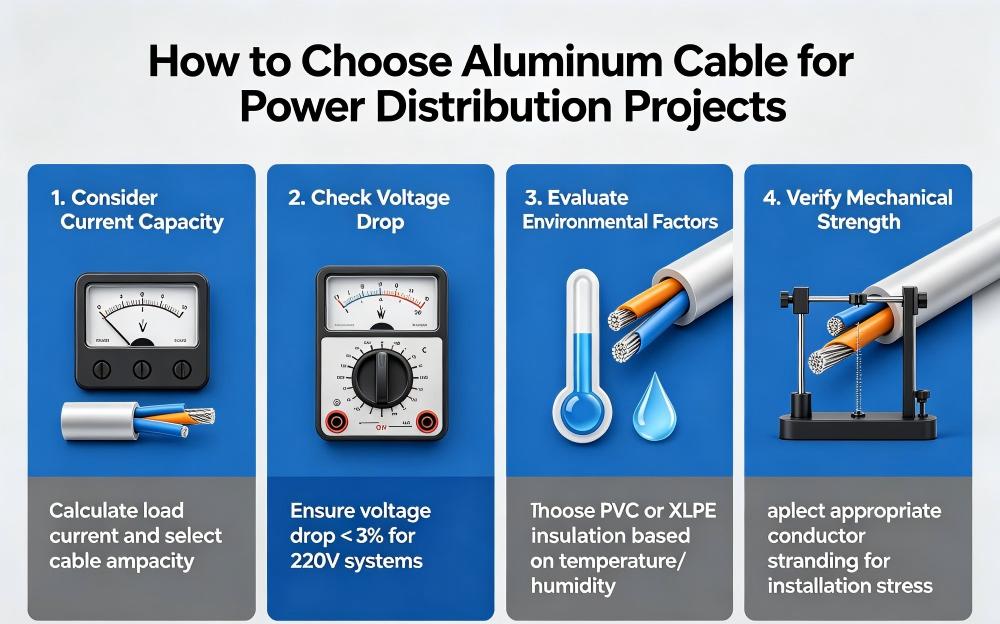
Aluminum cable selection for power distribution projects depends on load current, rënia e tensionit, detyrë e qarkut të shkurtër, mënyra e instalimit, madhësia e përcjellësit, material izolues, route environment, and the applicable cable standard. Aluminum conductors can reduce weight and material cost in many distribution routes, but the final cable design must still match electrical performance, termination practice, mbrojtje mekanike, and delivery conditions.
From XWA Cable’s engineering and factory view, aluminum cable is not a single product category. It can refer to low-voltage aluminum power cable, medium-voltage aluminum cable, overhead AAC, AAAC, ACSR, or insulated ABC cable. The correct construction comes from the project file. XWA reviews conductor material, klasa e dirigjentit, përcaktimi i tensionit, izolim, këllëf, forca të blinduara, ekran, standarde, gjatësia e daulles, and packing before production.

Start With The Distribution Duty
The first selection step is to define the role of the cable in the power distribution system. A building feeder, industrial sub-main, underground MV route, rural overhead line, and service drop all use different construction logic. The same conductor material can appear in very different cable designs.
Aluminum works well where conductor weight, gjatësia e rrugës, trajtimi i instalimit, and project economics matter. It does not remove the need for proper sizing. A cable that has enough insulation rating can still fail the design if voltage drop, thermal loading, rryma e defektit, termination compatibility, or mechanical protection receives weak attention.
| Aplikimi | Common Aluminum Option | Main Selection Driver |
|---|---|---|
| Low-voltage feeder | Aluminum XLPE or PVC power cable | Current, rënia e tensionit, mënyra e instalimit, këllëf |
| Medium-voltage distribution | Aluminum conductor MV cable | Klasa e tensionit, ekran, sistemi izolues, fushëveprimi i testit |
| Overhead rural line | AAC, AAAC, ACSR, or ABC cable | Span, ulet, tensile strength, korrozioni, service plan |
| Rruga e fabrikës industriale | Armored or unarmored aluminum cable | Mechanical protection and termination space |
| Export distribution project | Custom aluminum cable to standard | Standard, gjatësia e daulles, shënjimi, paketim, dokumentet |
Current Capacity Is Only One Boundary
The cable size must carry the design current under the specified installation condition. Ampacity depends on conductor area, insulation temperature rating, temperatura e ambientit, grupimi, soil or air conditions, duct or tray arrangement, and permissible conductor temperature. A size that works in open air may not work in a buried duct bank.
XWA can provide conductor size, material izolues, ndërtim kabllor, and datasheet values for review. The system designer still defines current, mënyra e instalimit, derating assumptions, and protection settings. This distinction matters because factory data supports the calculation, while the project design defines the operating condition.
Voltage Drop Often Pushes The Conductor Size Up
Voltage drop is a frequent reason aluminum cable needs a larger cross section than an initial current check suggests. Aluminum has lower conductivity than copper, so the equivalent design may require a larger conductor area to reach the same voltage-drop target. This is part of the engineering tradeoff between material, peshë, diametri, and installed cost.
Long feeders, rural distribution lines, pump loads, motor-starting circuits, and low-voltage service routes need voltage-drop review. Rezistenca, reaktancë, aktuale, faktor fuqie, gjatësia e rrugës, and conductor temperature all affect the result. XWA treats conductor resistance and route length as key project data for aluminum cable configuration.
| Voltage-Drop Factor | Effect On Aluminum Cable | Engineering Response |
|---|---|---|
| Long cable route | More total impedance | Increase size or review transformer layout |
| High load current | Higher voltage loss | Check load forecast and phase balance |
| Motor starting | Temporary voltage depression | Review starting current and permissible drop |
| High conductor temperature | Higher resistance | Use realistic thermal assumptions |
| Parallel runs | Can reduce current per cable | Confirm equal length, përfundimin, and protection |
Short-Circuit Duty And Protection Coordination Matter
Distribution cables must withstand fault current until the protection device clears the fault. Aluminum conductor size, sistemi izolues, ekran metalik, forca të blinduara, and earthing arrangement may all relate to fault performance. For MV aluminum cable, screen area and short-circuit duty are especially important.
A project specification that lists only voltage and conductor size can miss this requirement. XWA reviews rated voltage, përçuesi i zonës, izolim, ekran metalik, forca të blinduara, këllëf, and standard. The protection engineer should confirm fault level and clearing time. Cable construction and system protection must work together.
Copper And Aluminum Are Not Interchangeable By Name
Copper and aluminum cable can serve similar distribution functions, but they are not direct one-for-one replacements by nominal size. Aluminum usually needs a larger cross section for the same resistance target. It also needs compatible lugs, lidhësit, jointing methods, and termination practice. Surface preparation and connector selection affect long-term reliability.
The correct comparison uses current, rënia e tensionit, diametri i kabllit, peshë, rrezja e përkuljes, hapësira e përfundimit, connector system, installation labor, and total installed cost. XWA keeps the comparison tied to project conditions rather than material preference.
| Faktori | Aluminum Cable Impact | Design Note |
|---|---|---|
| Conductivity | Lower than copper | Larger section may be required |
| Weight | Lower for many comparable duties | Useful for overhead and handling |
| Diametri | Can increase with larger section | Check ducts, tabaka, gjëndrat, and bending |
| Termination | Needs aluminum-compatible accessories | Connector and preparation method matter |
| Project cost | Material saving may be significant | Review total installed cost, not cable price alone |
Low-Voltage And Medium-Voltage Aluminum Cable Need Different Documents
Low-voltage aluminum power cable usually focuses on conductor size, numri bazë, izolim, këllëf, forca të blinduara, mënyra e instalimit, and voltage-drop performance. Medium-voltage aluminum cable adds conductor screen, XLPE insulation system, ekran izolues, ekran metalik, water blocking where specified, teste rutinë, and stricter document control.
This difference affects quotation and production review. A 0.6/1 kV aluminum feeder can often be specified through a construction table and standard. A 12/20 kV or 18/30 kV aluminum cable needs a more detailed technical file because screen area, testimi i shkarkimit të pjesshëm, testimi i tensionit, sheath test, aksesorë, and commissioning method can affect project acceptance.
Insulation And Sheath Define The Environment
Aluminum cable can use XLPE, PVC, PE, LSZH, or other insulation and sheath systems depending on voltage and application. XLPE is common for power distribution where higher conductor temperature and good dielectric performance are needed. PVC remains common in many low-voltage applications. PE can support moisture and outdoor exposure in certain constructions. LSZH can fit enclosed public areas where smoke and halogen emission matter.
The sheath must match the route. Indoor tray installation, underground duct, varrimi i drejtpërdrejtë, ekspozimi në natyrë, chemical area, tuneli, and industrial plant routes create different risks. Aluminum conductor selection does not replace sheath selection. The cable still needs correct mechanical, mjedisore, and fire-performance details.
Armored And Unarmored Aluminum Cable Need Different Route Logic
Armoring adds mechanical protection, especially in direct burial, industrial areas, and routes with impact risk. It also increases weight, diametri, rrezja e përkuljes, dhe puna e përfundimit. Unarmored cable may fit protected ducts, tabaka, or routes with separate mechanical protection. The installation method should define the armor decision.
For single-core AC cables, armor material needs special attention because magnetic armor can create heating. Aluminum wire armor or non-magnetic alternatives may be required depending on cable design and project standard. XWA reviews core count, AC system condition, armor material, këllëf, and installation route before confirming the construction.
Overhead Aluminum Conductors Have Their Own Selection Logic
Overhead distribution uses aluminum in several forms. AAC uses all aluminum conductors and fits short-span or lower mechanical-load routes. Shofer AAAC uses aluminum alloy and provides better strength and corrosion behavior in many routes. ACSR cable uses aluminum around a steel core and fits long-span or higher-tension routes. Kabllo ABC uses insulated bundled construction for low-voltage overhead distribution and service routes.
These products should not be grouped only as aluminum cable. Each has a different purpose. Span, ulet, era, akull, corrosion exposure, tensile strength, pole hardware, and service connection plan decide the correct overhead construction.
Standards And Drawings Prevent Specification Drift
Aluminum cable specifications should identify the applicable standard, përcaktimi i tensionit, material përcjellës, klasa e dirigjentit, madhësia, izolim, screen or armor where applicable, këllëf, testet, shënjimi, dhe paketim. IEC, BS, ASTM, NË, UL, or local utility standards may apply depending on cable type and market.
A size such as 4×240 mm2 or 3×70+54.6 mm2 is not a complete factory instruction. The same visible size can differ by conductor class, trashësia e izolimit, material këllëf, forca të blinduara, standarde, dhe shënimi. XWA uses the approved drawing and datasheet as the production reference.
Factory Tests And Traceability Support Project Acceptance
Factory testing should match the cable type and standard. Low-voltage cable review can include conductor resistance, testi i tensionit, insulation resistance where specified, inspektimi i këllëfës, dimension checks, shënjimi, and drum length. Medium-voltage aluminum cable review can add partial discharge, testimi i tensionit, kontrollet e ekranit, testet e këllëfës, and stricter traceability records.
Traceability matters because project acceptance needs a link between the approved datasheet, produced cable, lista e daulleve, and test report. XWA records the cable code, madhësia, tensionit, standarde, loti i prodhimit, numri i daulles, and inspection result. This reduces confusion during shipment review and site receiving.
Export Packing And Drum Length Affect Delivery Quality
Aluminum cable can have large diameter and long delivery length. Drum design, gjatësia e daulles, cable end sealing, shënjimi, ngarkimi i kontejnerëve, and moisture protection affect delivery quality. Long drums reduce joints but increase weight and handling requirements. Short drums may simplify unloading but create more joint points and installation planning work.
XWA reviews drum length together with cable size and route plan. Export packing can use wooden drums or steel-wood drums depending on cable weight, destinacion, and handling condition. Drum marking should match cable code, gjatësia, tensionit, standarde, project reference, and destination requirement.
Common Specification Gaps XWA Reviews Early
| Gap | Possible Result | XWA Review Point |
|---|---|---|
| Only conductor material and size are listed | Izolimi, këllëf, forca të blinduara, and standard remain unclear | Build a complete datasheet before production |
| No voltage-drop condition is provided | Conductor may be undersized for long routes | Use route length, aktuale, and allowable drop |
| Termination method is not defined | Accessory mismatch may occur on site | Confirm aluminum-compatible lugs and jointing practice |
| Armor material is unclear | Single-core AC cable may face heating risk | Review core count and armor material |
| Drum length is missing | Delivery and installation planning become weak | Define practical length per drum |
Project Data XWA Needs For Aluminum Cable Configuration
| Të dhënat e projektit | Why It Matters | Shembull Detaje |
|---|---|---|
| Emërtimi i tensionit | Defines insulation level and test basis | 0.6/1 kV, 6/10 kV, 8.7/15 kV, ose standardi i projektit |
| Materiali dhe madhësia e përcjellësit | Defines electrical and production data | Aluminum 120 mm2, 240 mm2, 500 mm2 |
| Mënyra e instalimit | Controls ampacity and protection | Tabaka, kanal, varrimi i drejtpërdrejtë, overhead, indoor, të jashtme |
| Route length and load | Controls voltage drop | Design current, gjatësia, faktor fuqie, voltage-drop limit |
| Mbrojtje mekanike | Defines armor or route protection | SWA, AWA, unarmored, duct protection |
| Sheath environment | Controls fire, UV, lagështia, and chemical resistance | PVC, PE, LSZH, rezistente ndaj UV, rezistent ndaj flakës |
| Standardi dhe testet | Controls acceptance and documents | IEC, BS, ASTM, UL, NË, or utility specification |
| Drum and packing | Controls shipment and installation handling | Length per drum, shënjimi, wooden or steel-wood drum |
FAQ
Is aluminum cable suitable for power distribution?
po, aluminum cable can fit many power distribution routes when conductor size, rënia e tensionit, termination accessories, and installation method are correctly defined. The project should compare total installed performance, not only conductor material.
Does aluminum cable need a larger size than copper cable?
Often yes for the same resistance or voltage-drop target. Aluminum has lower conductivity than copper, so the equivalent design may use a larger cross section. The final size depends on current, gjatësia, gjendja e instalimit, dhe kufiri i rënies së tensionit.
Can aluminum cable be used underground?
po, if the cable construction matches the route. Underground use may require suitable sheath, armor or duct protection, mbrojtje nga lagështia, and installation planning. Direct burial and duct installation create different mechanical and thermal conditions.
What makes overhead aluminum conductor different from aluminum power cable?
Overhead conductors such as AAC, AAAC, and ACSR focus on span, ulet, tensile strength, korrozioni, and line hardware. Aluminum power cable focuses on insulation, këllëf, vlerësimi i tensionit, mjedisi i instalimit, and protection coordination.
Konkluzioni inxhinierik
Aluminum cable selection for power distribution should balance current capacity, rënia e tensionit, detyrë e qarkut të shkurtër, mënyra e instalimit, termination compatibility, mbrojtje mekanike, and export delivery. Aluminum can be a strong engineering choice when the conductor size, ndërtim kabllor, aksesorë, and route condition are coordinated.
XWA Cable reviews the project specification before confirming aluminum cable construction. Clear voltage, ngarkesës, rrugës, standarde, këllëf, forca të blinduara, gjatësia e daulles, and packing data help the factory prepare a cable that matches the actual distribution project.