
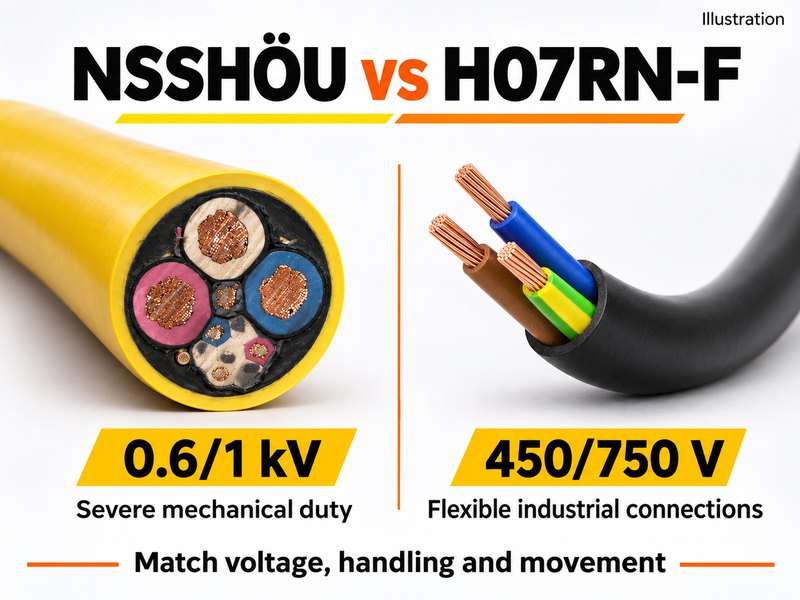
NSSHÖU vs H07RN-F is a comparison of connection duty, not simply flexibility. H07RN-F is a 450/750 V heavy-duty flexible rubber cable widely used for industrial equipment and temporary power. NSSHÖU, also written NSSHOEU, is a 0.6/1 kV rubber cable family associated with more severe mechanical service, including quarry, mining and tunnelling equipment. Start with the circuit voltage, then the actual handling conditions. For equipment that winds a cable repeatedly, evaluate the reeling duty separately.

Two rubber cables can solve different connection problems
A workshop machine and a mobile quarry machine may both need a flexible supply, but the cable experiences different stresses. A supported workshop connection mainly needs suitable routing, environmental resistance and a secure equipment entry. A connection repeatedly handled across rough ground adds abrasion, local impact and much more demanding sheath service.
H07RN-F already belongs to a heavy-duty flexible cable family. It is a practical starting point for many outdoor power connections, generators and construction-site distribution arrangements. NSSHÖU becomes particularly relevant when the equipment specification calls for its construction family or when the mechanical environment drives the selection towards a more substantial rubber connection.
Our preference is to resolve those two questions separately: what electrical duty must the cable carry, and what physical treatment must it survive? That gives a more useful specification than choosing whichever product has the higher voltage printed on it.
| Selection point | H07RN-F | NSSHÖU |
|---|---|---|
| Voltan terkadar, U0/U | 450/750 V AC | 0.6/1 kV AC, equivalent to 600/1,000 V |
| Construction reference | DALAM 50525-2-21 | DIN VDE 0250-812 |
| Typical selection context | Flexible industrial and outdoor equipment connections | Demanding industrial, quarry and mining connections |
| Susunan teras | Single-core and multicore designs; G identifies a protective conductor in the stated total | O/J and screened 3E configurations, with auxiliary-core options according to design |
| Connection review | Match routing, compound properties and equipment entry to service | Pay particular attention to handling loads, overall diameter, support and the specified core arrangement |
| Continuous movement | Use the declared movement conditions | Use the declared movement conditions; specify powered reeling as a separate duty |
The XWA product pages provide the corresponding construction and reference-size information for H07RN-F industrial rubber cable dan NSSHÖU heavy-duty rubber cable.
Read the voltage rating before comparing the sheath
U0 is the rated voltage between a conductor and earth; U is the rated voltage between conductors. The two figures need to be read together with the supply arrangement and applicable installation requirements.
On a 400 V three-phase circuit, the line-to-line voltage alone does not distinguish these two families: it is below both stated U ratings. The mechanical environment can therefore become the more important differentiator, after the electrical requirements have been checked. At 690 V, the line-to-line figure is still below 750 V, but that comparison is only one part of the assessment: the conductor-to-earth voltage, earthing arrangement and installation rules remain relevant.
A specification calling for a 0.6/1 kV cable is more specific than a statement that the load operates below 750 V. Preserve that specified rating when evaluating the cable schedule. Conversely, a 1 kV voltage class does not determine how much current a particular conductor can carry. Current rating also follows conductor area, loaded-core count, suhu, grouping and heat dissipation.
Describe the movement, rather than calling everything “flexible”
Three installations can use flexible copper conductors while placing very different demands on the complete cable:
- A supported connection: the cable is positioned during installation and then remains largely stationary. Routing clearance, support and the equipment entry are the main mechanical interfaces.
- An intermittently moved connection: equipment is repositioned or a supply lead is handled between tasks. The bending conditions and contact surfaces deserve attention alongside oil, moisture and temperature exposure.
- A powered reel or travelling system: the cable bends repeatedly under a defined travel pattern. Reel diameter, ketegangan, speed and torsion become design inputs.
For the third case, specify a cable designed for the actual winding or travel duty. This is where an ordinary model comparison needs to widen into an equipment-duty review. Our related explanation of current rating on wound cable reels addresses the separate thermal effect of leaving cable wound while it carries load.
Our engineering judgment is that the movement description belongs alongside the cable designation in a project schedule. “Periodically repositioned on a supported route” and “continuously wound by a powered reel” are useful descriptions; “flexible cable” alone leaves too much of the operating duty undefined.
A tougher connection still has to fit the equipment
Consider an illustrative replacement enquiry for a four-core 50 mm² connection. The conductor area and number of cores are useful starting points, but an alternative construction can have a different overall diameter, mass and bending requirement. Those differences affect the gland, connector, available space and handling arrangement.
At the equipment entry, select a gland whose sealing and clamping range matches the actual cable diameter. Support the cable so that its weight and handling loads are managed by the intended restraint, rather than transferred to individual conductor terminations. A larger sheath can improve the mechanical package while also requiring more room at the inlet.
The core arrangement needs the same care. A 4G construction includes the green/yellow protective conductor within its four cores. A screened NSSHÖU 3E arrangement introduces a different electrical function. Match the power, protective, screening and auxiliary conductors to the equipment drawing; this keeps a mechanical upgrade aligned with the original circuit design.
What should stay on the same comparison sheet?
Keep the conductor area, core arrangement, length and installation conditions visible when comparing alternatives. Add overall diameter and mass for handling, and the declared fixed or moving bending conditions for routing. Where water or chemical exposure matters, specify the exposure itself: occasional splashing, prolonged immersion and contact with a named fluid are different service conditions.
This also makes the commercial comparison clearer. A price difference may reflect a different sheath system, cable diameter or core configuration rather than a difference in copper area. For a project connection, the useful comparison is the complete installed arrangement, including the termination and handling requirements.
Choose for the service, then keep the connection in good condition
H07RN-F is often the straightforward choice where a 450/750 V flexible industrial connection meets the specification and operating conditions. NSSHÖU deserves closer consideration for its specified 0.6/1 kV construction and severe mechanical service. Repeated reeling adds a further requirement that should be defined in the equipment duty.
Once installed, inspection should reflect the environment and frequency of handling. Look for sheath cuts, crushing, damaged connectors and loss of restraint; arrange competent assessment and repair when damage is found. The HSE’s guidance on equipment inspection and testing explains why inspection intervals depend on the equipment and its working environment.
Planning an industrial rubber-cable connection? Send XWA the existing cable designation or equipment drawing, circuit voltage, core arrangement, conductor size and length. A brief description of movement and ground conditions helps us discuss the relevant construction and prepare a focused quotation. E-mel: info@xwacable.com.