
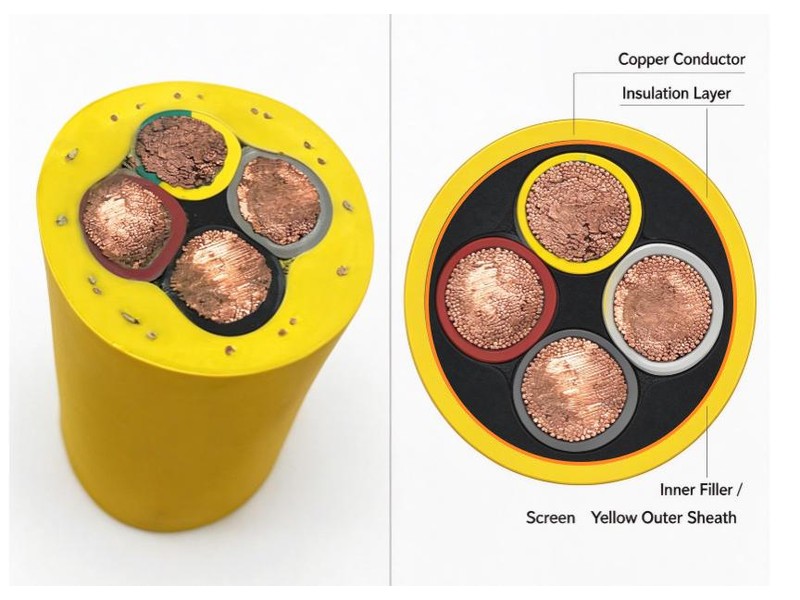
A cable reel needs a current rating for the way the cable is actually wound and operated. Cable left in several layers retains heat differently from cable laid out in air, so an unwound ampacity cannot simply be carried over to a loaded drum. The appropriate derating comes from the reel-and-cable design, winding arrangement, ambient conditions and operating duty. There is no reliable percentage that applies to every reel. For an industrial machine that must remain powered while retrieving cable, the useful specification is the allowable load throughout its travel, including the position with the most cable on the drum.
One cable can have two very different thermal environments
Current produces resistive heating in a conductor. In a simple DC resistance model, the loss in a conductor is I²R: doubling current produces four times the resistive loss if resistance is held constant. This relationship explains the heat source, not the complete current rating. AC losses, conductor temperature and the surrounding assembly also influence the operating result.
On an open route, heat can pass through the insulation and sheath to the surrounding air. On a reel, neighbouring cable turns create additional thermal resistance and contribute their own heat. Inner layers have a different cooling path from the exposed outer layer. A cable can therefore be electrically overloaded in its wound condition even when the same current would be acceptable in a stated unwound arrangement.
The calculation starts with the whole thermal environment. Průměr navijáku, winding width, layer count, větrání, enclosure and ambient temperature all matter. A larger copper area may reduce conductor resistance, but it also changes the cable diameter, drum capacity and bending demand. It is a change to the assembly rather than an isolated cure.

Portable extension reels and powered machine reels need different decisions
For a portable extension reel, follow its marked wound and unwound limits and operating instructions. Where the instruction requires full unwinding for the intended load, unreeling is part of its safe use. Extra cable must still be routed without creating a trip, crushing or entanglement hazard.
A powered crane or material-handling reel is a different engineering problem. Its cable may need to carry current while part of its length remains wound. The equipment design must accommodate that condition rather than assume that an operator can always lay the cable out completely. Travel speed, acceleration, reversal, winding pattern and mechanical tension enter the design alongside thermal loading.
That distinction is important for NSHTÖU reeling cable. Reinforcement and flexible core construction address specified movement demands. Oni ne, by themselves, establish the permissible current for every drum. We would treat the winding arrangement as an early design input, before comparing conductor sizes or overall diameters.
A reel standard has a defined scope
Veřejný rozsah IEC 61316:2021 covers industrial cable reels within specified limits, including rated operating voltage up to 690 V AC or DC and rated current up to 63 A. It should not be extended automatically to a large crane reel, a higher-current feeder or a medium-voltage trailing system outside that scope. The applicable equipment requirements and reel design documentation determine the assessment for those systems.
The specification needs a winding state, not just an ampere figure
| Operating condition | Why it changes the assessment | Useful design information |
|---|---|---|
| Maximum cable wound on the drum | More loaded cable can be enclosed by neighbouring layers. | Winding width, průměr hlavně, cable diameter and maximum live layers. |
| Cable extended along the route | The cooling condition changes, while the complete connected cable length still contributes resistance. | Route arrangement, seskupení, exposed length and remaining wound length. |
| Repeated travel and retrieval | Load and cooling vary with the movement cycle. | Current-versus-time profile aligned with travel and dwell periods. |
| Enclosed or hot installation | Heat rejection differs from an open, ventilated reference arrangement. | Ambient design temperature, enclosure and ventilation conditions. |
| Changed replacement cable | Průměr, materials and construction can change thermal and mechanical behaviour. | Actual replacement datasheet, connector fit and reel compatibility. |
A reference current value becomes useful only when its conditions are known. Free-air, grouped, wound and intermittently loaded values describe different situations. A reduction factor published for a particular reel is not a generic property of rubber insulation, nor is it transferable merely because two cables have the same cross-section.
A simple loss example, without pretending to calculate ampacity
Consider an illustrative circuit with a total loaded-path resistance of 0.020 ohm at the temperature being assessed. Na 100 A, its resistive loss is 100² × 0.020 = 200 W. Na 150 A, the same simplified calculation gives 450 W. These are assumed values chosen to show the square-law effect; they are not ratings for an XWA cable, and the example does not model a reel.
Whether either heat output is acceptable depends on how that heat is rejected and on the permissible temperatures of the cable and assembly. A voltage-drop result also cannot answer this thermal question: an acceptable drop does not establish safe conductor temperature on a drum.
Single-core portable feeders add a circuit-arrangement question
Separate single-core leads require attention to the complete circuit, including routing, seskupení, connectors and the protective grounding arrangement. A rating taken from one installation condition cannot be assumed to apply when the leads are gathered, enclosed or wound differently.
Type W portable power cable is a relevant family for these feeder discussions, but its model designation does not establish a reel rating. A large single-core feeder and a multicore reeling cable also differ in mechanical handling. Keeping the electrical circuit and the travel arrangement together avoids comparing unlike cable schedules.
The printed voltage rating answers another question entirely. It identifies the cable’s electrical rating, not its current capacity or its tolerance of repeated winding. Our explanation of cable markings and voltage notation separates those identification fields from installation-dependent performance.
When the reel runs hot, investigate the condition before changing the cable
A protection trip, unusual smell, softening or discolouration calls for isolation and competent inspection. Cooling and restarting repeatedly can conceal the underlying condition. A warm outer surface is also not a measurement of the hottest conductor or inner cable layer.
The initial investigation distinguishes a broadly heated wound section from a local hot connection. Sustained load, winding layers and cooling are relevant to the first pattern; contact condition, termination and damage deserve attention in the second. These observations guide inspection rather than proving a single cause.
Protection devices have different duties. An RCD responds to residual current; it is not a substitute for thermal assessment. A circuit overcurrent device, reel thermal protection and equipment operating limits must be coordinated with the assembly. The HSE equipment safety guidance provides a practical basis for inspecting visible damage and referring unsafe equipment for competent checks.
Can a higher-temperature sheath solve overheating?
A higher material temperature capability does not remove heat from a wound cable. Dirigent, izolace, pochva, connectors and the reel each have relevant limits. A material change becomes a useful improvement when it is assessed within the complete assembly and its operating conditions.
Is a 50% reel derating a safe default?
No universal 50% rule is established here. A percentage needs a stated starting rating and a matching winding configuration, load profile and thermal basis. Without those conditions, the percentage can give a false sense of precision.
Define the duty before finalising the cable schedule
For a project discussion with XWA Power & Kabel, a useful starting point is the cable voltage and core arrangement together with the load profile, rozměry bubnu, live layers and movement cycle. This lets the cable construction and the reel requirement be discussed together. The resulting schedule should distinguish conductor size, mechanical reeling duty and the allowable electrical load in service; none of those fields replaces the others.