
XWA POWER & CABLE | CONSTRUCTION DIRECTORY
Explore cable structures by armour, electrical screens, insulation, sheath, conductor and protective layers. These construction choices span voltage classes: one cable can combine several of them.
A useful starting point is the job each layer needs to do: armour for mechanical protection, screens for electrical duty, and sheath materials for the route environment. We recommend comparing those functions together, because an extra protective layer also affects cable diameter, mass and installation. The combinations below connect these choices to relevant XWA cable ranges.
Discuss a cable constructionFind cables by construction
Browse armoured, screened, unarmoured, halogen-free and water-blocked constructions. A project cable can combine several features to meet its electrical duty and route conditions.
Armoured cable constructions
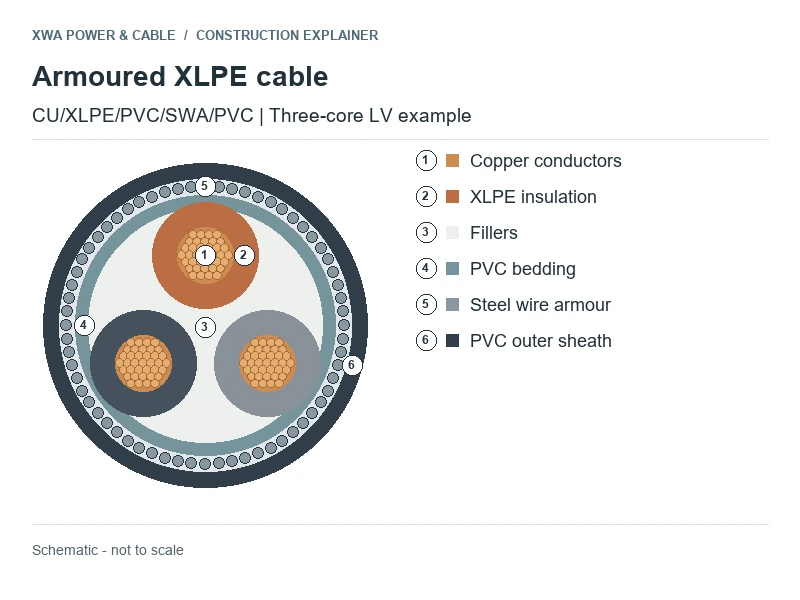
XLPE/SWA/PVC
XLPE insulation, steel wire armour and PVC sheath for fixed power routes. Conductor, core count and electrical screens are selected for the voltage and application.
Armour detailsCU/XLPE/PVC/SWA/PVC
Copper conductor, XLPE insulation, PVC bedding, steel wire armour and PVC sheath: a common LV armoured construction.
Request this constructionAL/XLPE/PVC/SWA/PVC
Aluminium conductor, XLPE insulation, PVC bedding, steel wire armour and PVC sheath, with core arrangement and section selected for the circuit.
Request this constructionCU/XLPE/CTS/PVC/SWA/PVC
A screened, steel-wire-armoured multicore power construction. CTS identifies copper tape screens; MV designs also require conductor and insulation semiconductive screens.
Screened armour detailsCU/XLPE/CTS/PVC/AWA/PVC
Screened single-core AC cable with aluminium wire armour, used where integral mechanical protection and non-magnetic armour are required.
Single-core armour detailsScreened cable constructions
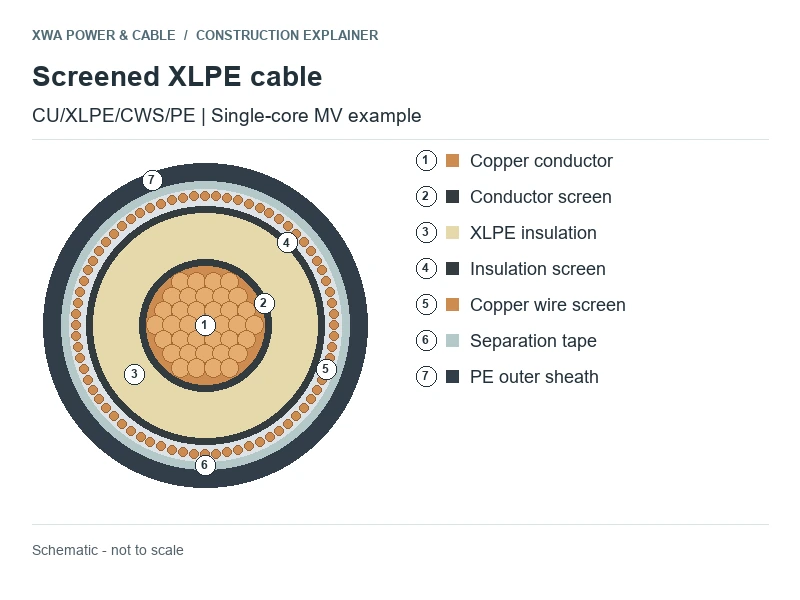
CU/XLPE/CWS/PVC
Copper conductor, XLPE insulation, copper wire screen and PVC sheath. The N2XSY range on this site uses this screened construction.
N2XSY cableAL/XLPE/CWS/PVC
Aluminium conductor, XLPE insulation, copper wire screen and PVC sheath. The metallic screen is separate from the aluminium phase conductor.
NA2XSY cableCU/XLPE/CWS/PE
Copper conductor, XLPE insulation, copper wire screen and PE sheath. Screen area, sheath properties and voltage remain separate specification items.
N2XS2Y cableAL/XLPE/CWS/PE
Aluminium phase conductor with a separate copper wire screen, XLPE insulation and PE sheath.
NA2XS2Y cableCU/XLPE/CTS/PVC
Copper conductor with XLPE insulation, copper tape screens and PVC sheath. The N2XSEY example is a three-core screened construction without SWA.
N2XSEY cableCU/PVC/TCWB/PVC
Copper conductors, PVC insulation, an overall tinned copper wire braid and PVC sheath. Braid coverage and core arrangement are selected for the control or signal duty.
Control and signal screen detailsUnarmoured insulated constructions
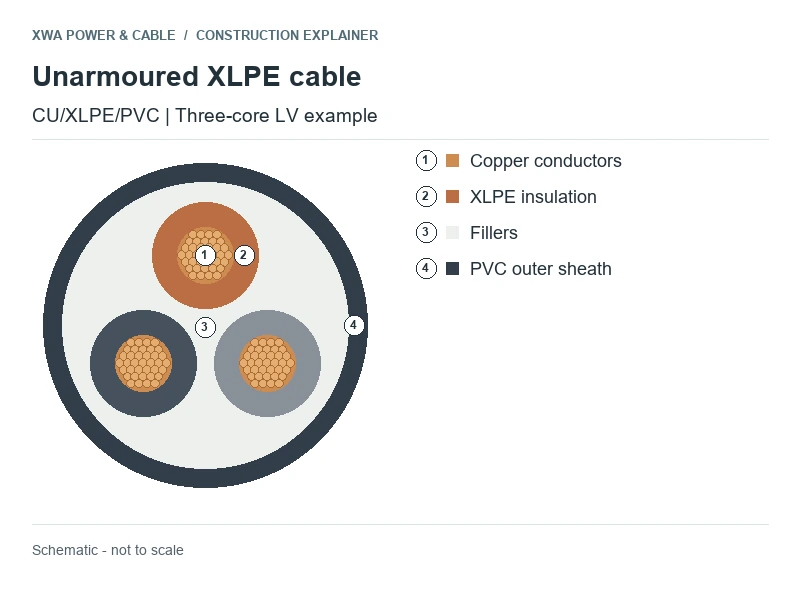
CU/PVC/PVC
Copper conductor, PVC insulation and PVC sheath. The NYY-J example includes a protective conductor; the suffix and full datasheet define the core identification.
NYY-J cableCU/XLPE/PVC
Copper conductor, XLPE insulation and PVC sheath, as used in the unarmoured N2XY construction.
N2XY cableHalogen-free sheath constructions
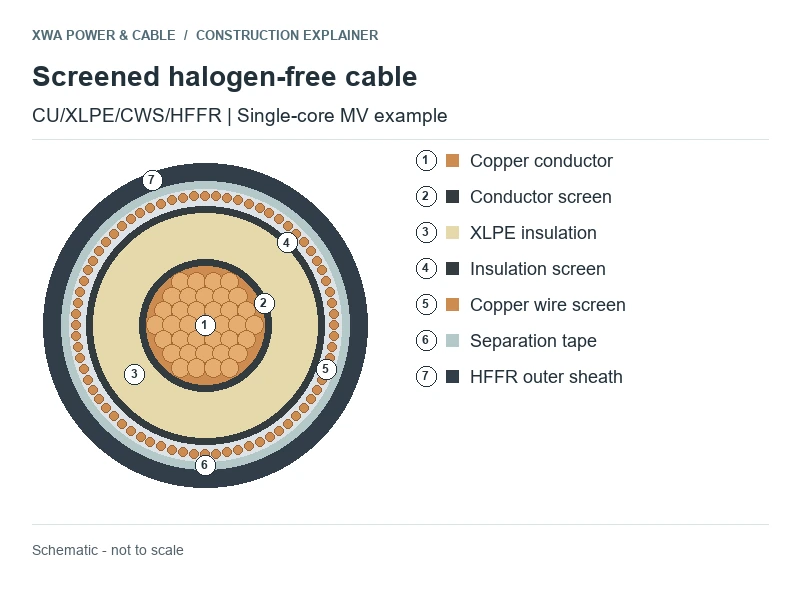
CU/XLPE/HFFR
Copper conductor, XLPE insulation and halogen-free flame-retardant sheath, as represented by N2XH. Project fire requirements define the applicable smoke, gas and flame tests.
N2XH cableCU/XLPE/CWS/HFFR
Copper conductor, screened XLPE insulation, copper wire screen and halogen-free sheath, as represented by N2XSH.
N2XSH cableWater-blocked screened constructions
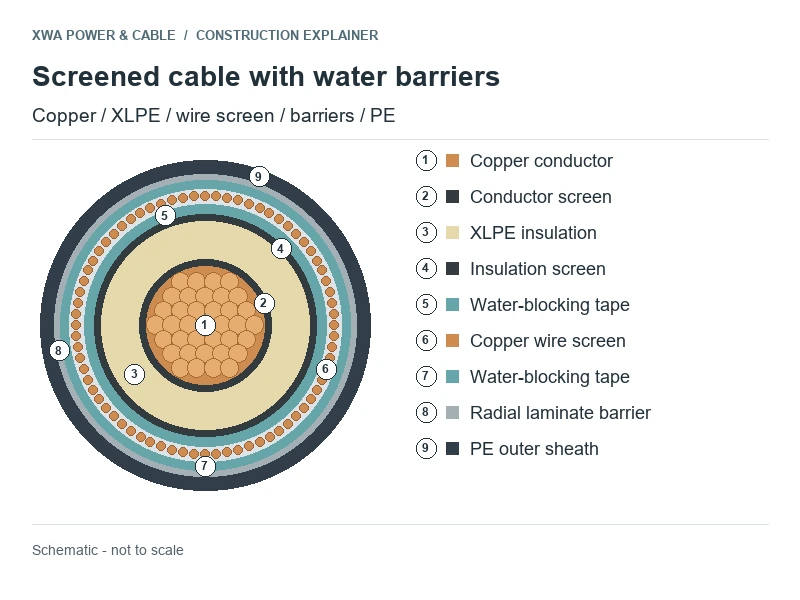
CU/XLPE/CWS/PE + longitudinal blocking
Screened PE-sheathed cable with longitudinal water-blocking components in the screen region. Conductor water blocking can be specified separately.
N2XS(F)2Y cableAL/XLPE/CWS/PE + longitudinal blocking
Aluminium-conductor screened cable with PE sheath and longitudinal water blocking in the specified region.
NA2XS(F)2Y cableCU/XLPE/CWS/PE + longitudinal and radial barriers
A screened construction combining longitudinal blocking with a radial laminate barrier. This is a different barrier arrangement from a longitudinal-only construction.
N2XS(FL)2Y cableMaterials and layer reference
Armour, screens, insulation, conductors and protective layers
Materials and layer reference
Armour, screens, insulation, conductors and protective layersRead the layers from the conductor outwards: CU = copper; AL = aluminium; CWS = copper wire screen; CTS = copper tape screen; TCWB = tinned copper wire braid; SWA = steel wire armour; AWA = aluminium wire armour; HFFR = halogen-free flame-retardant material.
Materials, layers and construction details
The following reference explains the individual layers behind these combinations. Armour, screens, insulation, sheaths, conductors, core arrangement, water barriers and fire performance can be combined within one project specification.
One Cable, Several Structural Choices
Armour protects mechanically; insulation separates electrically; screens perform electrical duties; the sheath protects the assembly. These layers work together in the finished cable design.
For example, a three-core distribution cable can have copper conductors, XLPE insulation, semiconductive layers, copper tape screens, an inner sheath, steel wire armour and a PVC outer sheath. It belongs to several structure groups at once.
This directory complements Cable Types and Models. The complete cable specification defines rated voltage, dimensions, tests and installation conditions. Available configurations depend on the agreed electrical and mechanical design.

01Armoured Cables
6 construction distinctions
Armoured Cables
6 construction distinctionsArmour is a mechanical-protection layer, independent of the insulation material and voltage class. Its material and geometry also affect mass, bending, terminations and electrical losses.
- Steel wire armour (SWA)Round steel wires around the cable assembly
- Common around multicore power and control cables; screened MV constructions can also include SWA.
- Aluminium wire armour (AWA)Non-magnetic aluminium wires
- Often used for single-core AC power cables to avoid the magnetic-loss issue of ordinary steel around one phase.
- Steel tape armour (STA / DSTA)One or more specified layers of steel tape
- A different protective geometry from wires; tensile duty and installation limits require the declared design.
- Wire braid protectionInterwoven metallic wires
- Mechanical braid and an electrical screening braid are not automatically the same component or duty.
- Special tensile armourOne or more designed armour layers
- Submarine and other special-service cables need dedicated load, fatigue, corrosion and system qualification.
- Unarmoured constructionNo integral mechanical armour
- Ducts, trays or other external protection may suit the route; electrical screens may still be present.
Single-core AC circuits commonly use non-magnetic armour to limit magnetic losses and heating. Armour earthing and any protective-conductor function are designed for the circuit fault duty.
02Screened and Shielded Cables
6 construction distinctions
Screened and Shielded Cables
6 construction distinctionsElectrical screens perform different jobs in power and signal cables. In MV/HV insulation systems, semiconductive screens control the electric field; the metallic screen is a separate layer. Control and instrumentation screens address electromagnetic interference.
- Semiconductive conductor / insulation screensSmooth the electrical interfaces around power-cable insulation
- Not a substitute for a metallic screen, armour or an insulating layer.
- Copper wire screen (CWS)Metallic wires around a screened power core
- Screen area, fault duty, bonding and accessories form part of the electrical specification.
- Copper tape screen (CTS)Metallic tapes around the insulated power core
- Tape layout and electrical duty differ from a copper wire screen; substitution needs a design check.
- Braid screenInterwoven conductive wires around a core group or assembly
- Coverage, termination and frequency-dependent performance matter; a braid is not automatically armour.
- Foil screen and drain wireConductive foil with a defined connection path
- Used in many signal constructions; continuity and termination govern the completed screen.
- Individual and overall screensScreens around pairs/triads, around the complete assembly, or both
- Individual screens separate groups; an overall screen surrounds the laid-up groups.
A cable can combine electrical screens and mechanical armour. The screen arrangement follows the electrical duty, while the armour follows the route-protection requirement.
03Insulation Materials
5 construction distinctions
Insulation Materials
5 construction distinctionsInsulation surrounds the conductor and provides the required electrical separation. The same material name can appear in different voltage designs; compound, thickness, screens and testing define the complete insulation system.
- XLPE insulationCross-linked polyethylene
- Used across power-cable voltage classes; XLPE alone does not establish current rating or the outer-sheath material.
- PVC insulationPolyvinyl chloride compound around the conductor
- Used in specified LV and control constructions; distinguish PVC insulation from a PVC outer sheath.
- EPR / HEPR insulationEthylene-propylene rubber-based insulation
- Used in selected power and flexible-duty designs; operating and mechanical limits follow the declared compound.
- PE insulationPolyethylene insulation
- Common in selected signal and other cable designs; an external PE jacket is a different layer.
- Cross-linked halogen-free compoundsA defined halogen-free polymer system
- Used in relevant PV and other constructions; compound and cable fire tests still need the declared scope.
Temperature limits and current ratings follow the product datasheet and installation conditions for the complete cable.
04Outer Sheaths and Environmental Protection
5 construction distinctions
Outer Sheaths and Environmental Protection
5 construction distinctionsThe outer sheath protects the cable from its environment. Compound selection addresses the moisture, weathering and mechanical exposure of the route.
- PVC sheathPolyvinyl chloride outer protection
- Flame, oil, UV and chemical performance depend on the specified compound and test evidence.
- PE sheathPolyethylene outer protection
- Used in many buried power designs; ordinary PE is not automatically flame-retardant or a complete water barrier.
- LSZH / LSOH sheathLow-smoke, halogen-free compound system
- Smoke and halogen properties require defined tests; LSZH does not itself mean circuit integrity during fire.
- Rubber / elastomer sheathDeclared elastomeric protective compound
- Flexing, oil, weather, abrasion and immersion suitability follow the actual cable duty and compound.
- Metallic sheath or laminateA continuous metal layer or bonded laminate
- May provide moisture protection and electrical functions; corrosion, bonding and joints require system design.
UV, oil, termite and immersion requirements are specified with the corresponding compound and test requirements.
Back to structure categories05Conductor Materials and Stranding
6 construction distinctions
Conductor Materials and Stranding
6 construction distinctionsThe phase conductor carries load current. Conductor material, stranding and shape are separate from screen and armour material: an aluminium-conductor cable can have a copper screen, and a copper-conductor cable can have aluminium armour.
- Copper conductorsPlain or tinned copper, as specified
- Area, resistance, stranding and terminal compatibility define the required conductor.
- Aluminium / aluminium-alloy conductorsAluminium or a specified alloy
- Alloy, electrical resistance, connections and mechanical duty distinguish the construction.
- Solid and stranded conductorsClass 1 solid and Class 2 stranded conductors for insulated cables
- Conductor class describes the construction; it is not a blanket installation-flexibility approval.
- Flexible fine-stranded conductorsClass 5 or Class 6 flexible copper conductors, where specified
- Repeated movement, torsion, trailing service or drag-chain use require the complete cable to be rated for that duty.
- Round, compacted and sector-shaped conductorsDifferent conductor geometries
- Shape changes assembly dimensions and accessory fit; equal nominal area does not mean equal cable diameter.
- Steel-reinforced bare conductorsAluminium strands around a steel strength member
- The steel core in ACSR is reinforcement within the conductor, not cable armour outside insulation.
AAC, AAAC and ACSR are bare conductors for overhead lines; sheathed power cables serve underground and other insulated routes.
Back to structure categories06Core Count and Cable Arrangement
6 construction distinctions
Core Count and Cable Arrangement
6 construction distinctionsA three-core cable places the phase cores inside a common sheath. Three separate single-core cables allow a selected flat or trefoil layout, with different handling, bonding and support arrangements.
- Single-core cableOne principal insulated power conductor per cable
- Power circuits use the specified arrangement of separate cables; armour and bonding need the corresponding design.
- Multicore power cableSeveral insulated power cores under a common sheath
- Core count, neutral and protective-conductor arrangements must be explicit.
- Three-core screened cableThree screened phase cores in one assembly
- Screen layout, fillers and common outer layers distinguish it from three individual single-core cables.
- Multicore control cableMultiple identified control conductors
- Numbering, colour identification, protective conductor and screen arrangement follow the stated design.
- Pairs, triads and grouped signalsConductors assembled into defined signal groups
- Group twist, individual/overall screens and electrical characteristics are specified together.
- Aerial bundled assemblyInsulated conductors assembled for overhead duty
- Messenger, neutral and phase arrangements follow the utility design; ABC is not a burial-cable construction.
The notation 3 x 1 x 240 identifies three separate single-core 240 mm2 cables. Metallic-screen area is stated separately from phase-conductor area.
Back to structure categories07Water Blocking and Moisture Barriers
5 construction distinctions
Water Blocking and Moisture Barriers
5 construction distinctionsConductor water blocking, screen-region blocking and radial barriers protect different moisture paths. Marine installations require a dedicated cable and accessory design.
- Longitudinal screen-region blockingSwellable tapes, yarns or other specified components
- Restricts water travel along the screened region after entry; it is not a radial metallic barrier.
- Water-blocked conductorA specified barrier within the conductor assembly
- Addresses a separate longitudinal path from the screen-region construction.
- Radial laminate barrierBonded metal/polymer barrier beneath or within the sheath system
- Addresses radial moisture entry; layer continuity, joints and terminations affect the completed system.
- Metallic moisture sheathA defined continuous metallic sheath
- Material, corrosion protection, electrical duty and accessory seals need the complete system specification.
- Submarine protective systemDedicated barriers, sheath protection and armour
- Water pressure, installation loads, fatigue and route conditions require a separate submarine design.
Longitudinal barriers limit water travel along the specified cable region; radial barriers reduce moisture ingress through the cable circumference. End seals protect cable lengths during storage and installation.
08Fire Barriers and Declared Fire Performance
5 construction distinctions
Fire Barriers and Declared Fire Performance
5 construction distinctionsFire-performance specifications address flame spread, smoke, combustion gases or circuit integrity. Fire-barrier layers are selected to support the required tested performance.
- Flame-retardant constructionLimits flame propagation under the specified test
- Single-cable and bunched-cable tests address different conditions.
- Low-smoke constructionControls smoke under the stated test method
- Low smoke is not equivalent to low halogen emissions or continued electrical operation.
- Halogen-free compound systemMeets the relevant declared halogen / gas test requirements
- An LSZH marking is not a universal product approval or a circuit-integrity classification.
- Circuit-integrity / fire-resistant constructionMaintains the tested electrical function under specified fire conditions
- Voltage, test arrangement, duration and any shock or water exposure belong to the claim.
- Mica or other declared fire barrierAn additional material layer in certain designs
- Its presence alone does not prove that the completed cable passes a circuit-integrity test.
IEC 60332, IEC 61034, IEC 60754 and IEC 60331 address different aspects. Only the applicable part, edition, test conditions and actual evidence establish the declared performance.
Back to structure categoriesRelated models and project ranges
Published cable models and application ranges
Related models and project ranges
Published cable models and application rangesRelated cable models and construction examples
Compare the conductor, insulation, screen and sheath combinations used in the related cable models below.
NYY-J
CU/PVC/PVCCopper, PVC insulation and PVC sheath
N2XY
CU/XLPE/PVCCopper, XLPE insulation and PVC sheath
NA2XSY
AL/XLPE/CWS/PVCAluminium phase conductor, copper wire screen, PVC sheath
N2XS2Y
CU/XLPE/CWS/PECopper phase conductor, copper wire screen, PE sheath
N2XSEY
CU/XLPE/CTS/PVCThree screened copper phase cores in a common PVC sheath
Armoured construction options
XLPE / bedding / SWA / PVCInsulated core assembly, steel wire armour and PVC sheath; electrical screens are added for the specified voltage design
N2XSH
XLPE / metallic screen / halogen-free sheathScreened power cable with a declared halogen-free sheath system
N2XS(F)2Y
Screen-region blocking + PE sheathLongitudinal blocking around the screened core
N2XS(FL)2Y
Longitudinal blocking + radial laminate + PESeparate barriers for longitudinal and radial moisture paths
The construction drawing brings together conductor class, bedding, fillers, screen area, armour dimensions and moisture barriers in one layer sequence.
Product Ranges by Project Duty
Screened Distribution Feeders
Insulation systems, metallic screens, route protection and accessory interfaces for medium-voltage distribution.
Explore the rangeHigh-Voltage Cable Systems
Insulation, metallic sheath or screen, moisture barriers and bonding assessed as one cable system.
Explore the rangeSubmarine Power Routes
Purpose-designed water protection, tensile armour and mechanical duty for the specified marine installation.
Explore the rangeFlexible Industrial Supply
Flexible industrial cables combine suitable conductor stranding, insulation and sheath materials for the specified movement and environment.
Explore the rangeControl and Instrumentation
Core groups, identification and individual/overall shielding configured for the signal function.
Explore the rangeOverhead Conductors and Assemblies
Bare conductor reinforcement and insulated aerial assemblies, distinct from underground armour systems.
Explore the rangeStandards and technical reading
Scope, specifications and further construction guidance
Standards and technical reading
Scope, specifications and further construction guidanceStandards Follow the Finished Construction
IEC 60228 covers conductors, while IEC 60502-1 and IEC 60502-2 address their respective LV and MV power-cable ranges. Higher-voltage systems use the applicable cable-system standard and accessory requirements.
The official publication scope describes the MV standard coverage for fixed distribution installations.
Current rating, diameter, mass, bending limits and drum requirements are provided for the selected finished construction.
Further Construction Guidance
For electrical and mechanical differences, read steel wire armour in MV cable. For route protection and installation trade-offs, see armoured versus unarmoured MV cable.
Cable Structure Questions
Can an armoured cable also be screened?
Yes. A metallic screen and mechanical armour are separate components. A screened MV cable can also have steel wire armour; the screen duty, armour arrangement and bonding must each match the design.
Does a structure name determine the voltage class?
XLPE, SWA, PVC and PE identify materials or layers. The rated voltage, insulation dimensions, screens and test requirements define the electrical design.
Is LSZH the same as fire-resistant cable?
LSZH describes smoke and halogen-related properties. Fire-resistant cable is designed and tested to maintain circuit operation under specified fire conditions.
How is a project construction selected?
The voltage, conductor size, core arrangement and route conditions define the construction. XWA works from the project specification or cable schedule to establish the manufacturing and test requirements.
Discuss a Cable Construction with XWA
Discuss your cable construction with XWA. Email a cable schedule or tell us the voltage, size and required length to start a project quotation.
Explore our factory · info@xwacable.com · WhatsApp