
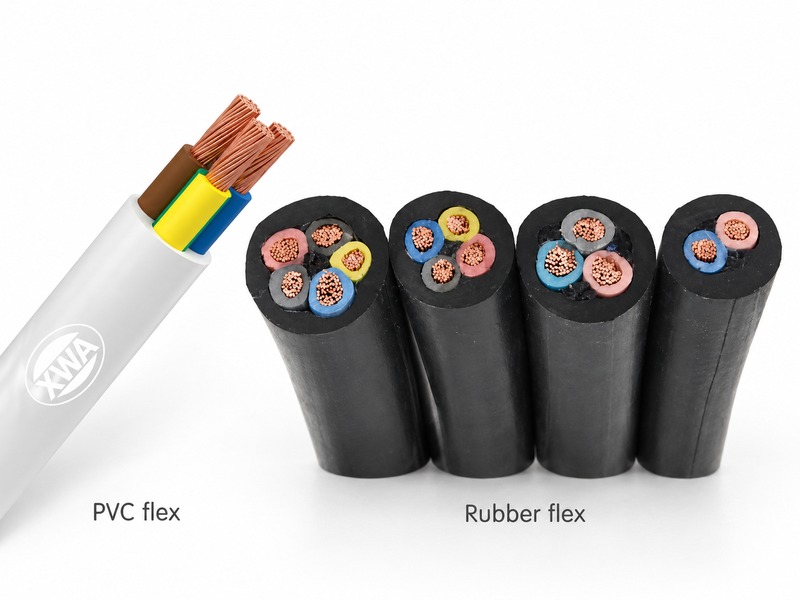
For ordinary indoor appliance and equipment connections, H05VV-F is the usual PVC-flex option; H07RN-F is the heavy-duty rubber-flex option for more demanding handling and suitable outdoor duties. H05VV-F is rated 300/500 В, while H07RN-F is rated 450/750 В. In an H05VV-F vs H07RN-F comparison, the decisive difference is often the work the lead must survive, not simply the supply voltage. Дождь, истирание, repeated handling and the equipment connection matter. The heavier construction is useful when the duty requires it, but the designation alone does not establish continuous-flex life, unrestricted immersion or compatibility with every connector.
Start with what happens to the lead during a working day
A lead lying behind a protected indoor appliance and a lead moved across a workshop floor may supply similar equipment. They experience different mechanical duties. The second lead can be dragged, stepped on, caught at edges or repeatedly bent at the equipment entry.
That difference explains why comparing only copper area and voltage misses the main purpose of the two cable families. Cross-section addresses the electrical load and voltage drop. Insulation and sheath construction also have to suit the treatment the cable receives. A higher voltage designation does not make an exposed connection waterproof, and a more robust sheath does not remove the need for damage protection.
Where H05VV-F keeps the connection straightforward
H05VV-F гибкий кабель ПВХ combines flexible copper conductors with PVC insulation and a PVC outer sheath. Its normal role is an ordinary-duty connection for appliances, office equipment and suitable indoor extension leads, subject to the equipment instructions and electrical requirements.
A protected indoor connection does not automatically benefit from changing to a heavier rubber cable. Connector capacity, routing space and the actual handling duty still matter. A cable that is unnecessarily bulky can be awkward to fit into an appliance entry without creating any useful improvement in that application.
H05VV-F is not the default choice for a lead that will remain exposed to outdoor weather or receive heavy site handling. A matching 230 V supply does not establish that suitability. Nor does a white or black sheath identify a particular performance class: the product designation and specification are more informative than colour.
What makes H07RN-F relevant to harsher service
H07RN-F heavy-duty rubber cable uses crosslinked elastomeric insulation and a PCP, или эквивалент, sheath system. It is commonly associated with portable industrial equipment, temporary power and demanding outdoor use where the specified product is suitable for the exposure.
The benefit is a construction intended for a tougher service category, not a blanket claim that the cable cannot be damaged. Масло, погода, temperature and water conditions still need a defined product rating. A splash-prone temporary connection is not the same duty as a pump lead continuously submerged in water.
The HAR type listing distinguishes ordinary H07RN-F from water-resistant H07RN8-F constructions. That distinction is a reason not to treat every rubber-sheathed lead as an interchangeable submersible cable. The actual immersion conditions and equipment requirements govern any such use.
Например, an indoor bench tool and a mobile tool used in a wet, abrasive work area may both operate from the same nominal supply. The environmental and handling changes can make the rubber cable family relevant, but the plug, socket, equipment and protective measures must also suit that work area. Cable selection alone does not approve the complete assembly.
Read the code without turning it into an amp rating
The designations separate several different characteristics. They do not encode every installation limit.
| Code element | Х05ВВ-Ф | Х07РН-Ф |
|---|---|---|
| ЧАС | Harmonised designation | Harmonised designation |
| 05 / 07 | 300/500 V rated voltage | 450/750 V rated voltage |
| Insulation and sheath | В / В: PVC insulation and PVC sheath | Р / Н: crosslinked elastomeric insulation and PCP or equivalent sheath |
| Ф | Flexible conductor construction | Flexible conductor construction |
| Relevant EN product family | В 50525-2-11 | В 50525-2-21 |
The HAR conversion document maps the two cable types to these different EN 50525 parts. The PVC part is not the correct part merely because both products are flexible cables. The letter H is also not, сам по себе, evidence that a particular manufacturer or product holds a current HAR licence.
Consider the same illustrative size marking, 3G1.5, on either family: three cores, including a green/yellow protective conductor, with a nominal area of 1.5 мм² per core. That matching marking does not establish an identical current rating, outer diameter or finished-lead rating.
The load, длина кабеля, installation conditions and connected components still determine the electrical design. No universal H05VV-F-to-H07RN-F ampacity multiplier follows from the 05/07 voltage distinction. A rubber sheath cannot compensate for an undersized conductor on a long run.

Flexible does not mean continuous-flex
Both families use flexible conductors, but occasional repositioning and repeated machine cycles are different duties. The difference between solid and stranded conductor construction explains the basic geometry; it does not establish a cycle-life rating for a finished cable.
Repeated bending can eventually damage conductor strands and crack the sheath, particularly near an equipment entry. A cable for a drag chain, high-frequency reciprocating movement or continuous reeling needs evidence for that motion, bending geometry and service. An F suffix alone is not that evidence.
This also prevents a misleading comparison: a heavy-duty portable lead is not automatically a better cable-chain product than an ordinary PVC lead. For a specialised motion system, the correct answer may be a different cable design altogether.
The connection has to fit the cable too
Changing the cable family can change the outside diameter and handling characteristics even when the conductor size stays the same. The gland or cord grip must accommodate the actual cable and restrain its outer sheath; the electrical terminations should not carry the pulling load.
A fitting suitable for the previous lead may have the wrong grip range for the replacement. The protective conductor, terminal arrangement, connector rating and specified sealing method also remain part of the assembly. The drawing illustrates only the gripping principle, not a certified component or a set of installation instructions.
HSE’s general electrical safety guidance treats equipment use and working conditions together. That is the useful final distinction here: H05VV-F suits an ordinary protected connection; H07RN-F addresses a heavier-duty cable requirement, while the complete connection still has to match the environment.
XWA supplies both cable families. For an application-specific comparison, contact XWA with the equipment duty, основная договоренность, conductor size and exposure conditions. Those details make the distinction between indoor PVC flex and heavy-duty rubber flex meaningful without assuming that the more rugged option is always necessary.