
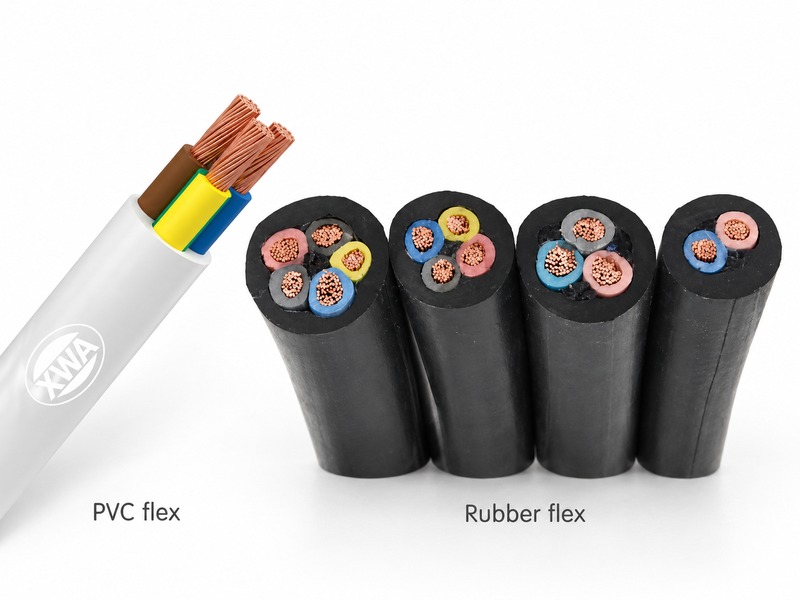
H05VV-F vs H07RN-F is primarily a comparison of service duty: H05VV-F is the ordinary-duty PVC flex for protected indoor connections, while H07RN-F is the heavy-duty rubber flex for more demanding handling and suitable outdoor use. Their voltage ratings are 300/500 V and 450/750 V respectively. Rain, abrasion, repeated handling and the equipment connection determine which construction fits the job; continuous machine movement or immersion requires a cable specifically rated for that service.
Start with what happens to the lead during a working day
A lead lying behind a protected indoor appliance and a lead moved across a workshop floor may supply similar equipment. They experience different mechanical duties. The second lead can be dragged, stepped on, caught at edges or repeatedly bent at the equipment entry.
Conductor area addresses electrical load and voltage drop; insulation and sheath construction address the treatment the lead receives. Together, these determine the suitable cable and connection arrangement.
Where H05VV-F keeps the connection straightforward
H05VV-F flexible PVC cable combines flexible copper conductors with PVC insulation and a PVC outer sheath. Its normal role is an ordinary-duty connection for appliances, office equipment and suitable indoor extension leads, subject to the equipment instructions and electrical requirements.
For a protected indoor connection, ordinary-duty PVC flex can be the practical choice. Its dimensions should fit the connector, appliance entry and available routing space.
Outdoor weather and heavy site handling call for a cable rated for those conditions. Select by the stated construction and service requirements, alongside the supply voltage.
What makes H07RN-F relevant to harsher service
H07RN-F heavy-duty rubber cable uses crosslinked elastomeric insulation and a PCP, or equivalent, sheath system. It is commonly associated with portable industrial equipment, temporary power and demanding outdoor use where the specified product is suitable for the exposure.
Heavy-duty rubber construction is useful where the lead faces tougher handling. Oil, weather, temperature and water exposure are matched to the product rating; continuous immersion is a distinct service condition.
The HAR type listing identifies H07RN8-F as a water-resistant construction distinct from ordinary H07RN-F. Submersible equipment uses the cable specified for its immersion conditions and connection requirements.
An indoor bench tool and a mobile tool in a wet, abrasive work area may share the same supply voltage. The mobile tool needs a cable, plug, socket and protective measures suited to that more demanding environment.
Reading the voltage and material designations
The codes identify the voltage and material family. The product datasheet supplies the detailed service and installation limits.
| Code element | H05VV-F | H07RN-F |
|---|---|---|
| H | Harmonised designation | Harmonised designation |
| 05 / 07 | 300/500 V rated voltage | 450/750 V rated voltage |
| Insulation and sheath | V / V: PVC insulation and PVC sheath | R / N: crosslinked elastomeric insulation and PCP or equivalent sheath |
| F | Flexible conductor construction | Flexible conductor construction |
| Relevant EN product family | EN 50525-2-11 | EN 50525-2-21 |
The HAR conversion document maps these cable families to their respective EN 50525 parts. A claimed HAR approval is verified against the licensed manufacturer and covered product.
In either family, 3G1.5 identifies three cores, including a green/yellow protective conductor, each with nominal area 1.5 mm². Current rating and finished diameter follow the particular construction and installation conditions.
Electrical design uses load, length, installation conditions and connected-component limits. Conductor sizing and voltage drop are calculated for the circuit, separately from the choice of PVC or rubber sheath.

Flexible conductors and continuous machine movement
Both families use flexible conductors. Occasional handling and repeated machine cycles place different demands on the finished cable; the difference between solid and stranded conductor construction explains the underlying conductor geometry.
Repeated bending stresses conductor strands and the sheath, especially at an equipment entry. Drag chains, high-frequency movement and continuous reeling require a cable rated for the motion, bending geometry and service conditions.
For a dedicated motion system, compare cables designed for that movement rather than selecting solely from ordinary-duty or heavy-duty portable flex.
The connection has to fit the cable too
Changing the cable family can change the outside diameter and handling characteristics even when the conductor size stays the same. The gland or cord grip must accommodate the actual cable and restrain its outer sheath; the electrical terminations should not carry the pulling load.
When the cable family changes, check the fitting grip range, protective conductor, terminals, connector rating and sealing arrangement against the replacement cable dimensions.
HSE’s general electrical safety guidance treats equipment use and working conditions together. That is the useful final distinction here: H05VV-F suits an ordinary protected connection; H07RN-F addresses a heavier-duty cable requirement, while the complete connection still has to match the environment.
XWA supplies both cable families. Tell us the equipment duty, core arrangement, size and exposure conditions for an application-specific quotation.