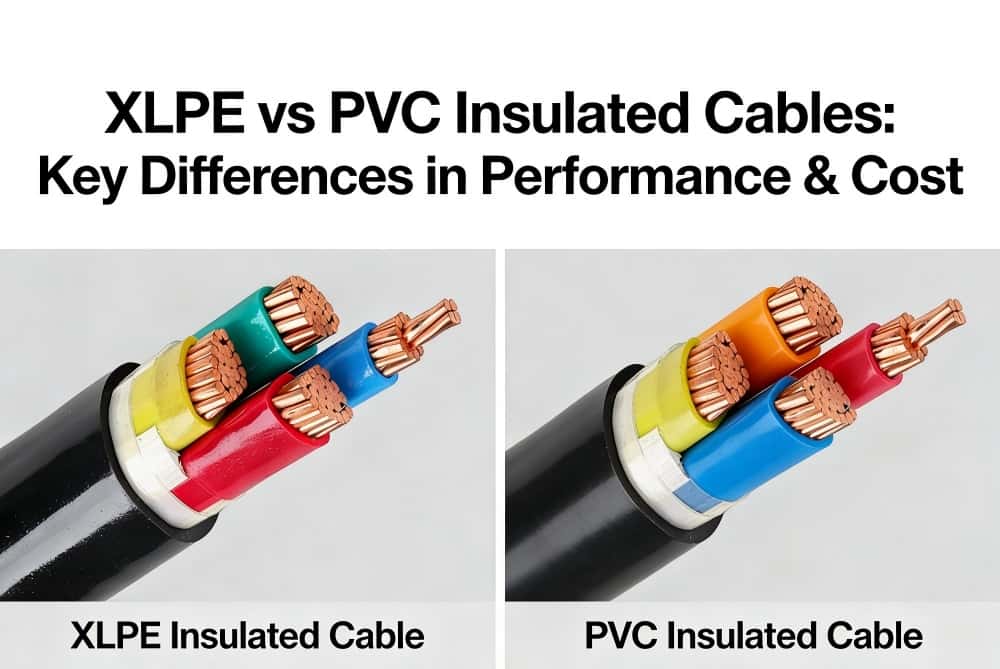
When choosing electrical cables for industrial, коммерческий, or residential applications, the insulation material plays a critical role in performance, safety, and cost-efficiency. Two of the most common options are XLPE insulated cables и PVC insulated cables. While both are widely used, they differ significantly in their properties, applications, and long-term value. This guide breaks down the key differences between XLPE vs PVC cable types to help you make an informed decision.
What is XLPE Insulation?
СПЭ (cross-linked polyethylene) is a thermoset insulation material created by cross-linking polyethylene molecules under high pressure and temperature. This process enhances the material’s thermal, mechanical, and chemical properties, making XLPE cables suitable for demanding environments.
Advantages of XLPE Cables:
- Higher Temperature Resistance: XLPE can withstand temperatures up to 90°C continuously and up to 250°C during short-circuit conditions.
- Superior Moisture and Chemical Resistance: Ideal for underground, открытый, or humid installations.
- Better Electrical Properties: Lower dielectric losses and higher current-carrying capacity compared to PVC.
- Longer Lifespan: More resistant to aging, cracking, and environmental stress.
What is PVC Insulation?
ПВХ (polyvinyl chloride) is a thermoplastic polymer commonly used as insulation for low-to-medium voltage PVC cables. It is cost-effective, flexible, and easy to manufacture, making it a popular choice for general-purpose wiring.
Advantages of PVC Cables:
- Cost-Effective: Generally cheaper than XLPE insulated cables in terms of material and production.
- Flexibility: Easier to handle and install in tight spaces.
- Adequate for Standard Applications: Suitable for indoor use, low-voltage systems, and non-demanding environments.
- Flame Retardant: Many PVC cable formulations include flame-retardant additives.
Key Differences: XLPE vs PVC Cable Performance
1. Thermal Performance
- XLPE Cable: Operates efficiently at higher temperatures, reducing the risk of overheating. Ideal for high-load applications.
- PVC Cable: Maximum operating temperature is typically 70°C, limiting use in high-temperature environments.
2. Durability and Environmental Resistance
- XLPE Insulated Cable: Resists moisture, UV radiation, oils, and chemicals. Perfect for direct burial, открытый, and industrial settings.
- PVC Insulated Cable: More prone to degradation when exposed to sunlight, влага, or harsh chemicals over time.
3. Electrical Efficiency
- СПЭ: Offers lower dielectric constant and dissipation factor, resulting in better insulation resistance and reduced power loss.
- ПВХ: Higher dielectric losses may affect efficiency in long-distance or high-voltage applications.
4. Mechanical Strength
- XLPE Cable: Superior tensile strength and resistance to abrasion, cracking, and stress.
- PVC Cable: Softer and more flexible but may crack or deform under mechanical stress or extreme temperatures.
5. Cost Comparison
- PVC Cable: Lower upfront cost, making it attractive for budget-conscious projects with standard requirements.
- XLPE Cable: Higher initial investment but offers lower lifetime costs due to durability, reduced maintenance, and energy savings.
Which Cable Should You Choose?
Choose XLPE Insulated Cables If:
- You need cables for outdoor, underground, or industrial installations.
- High temperature resistance and long-term reliability are priorities.
- The application involves high voltage or frequent overloads.
- You want to minimize long-term maintenance and replacement costs.
Choose PVC Insulated Cables If:
- You are working on indoor, low-voltage, or temporary installations.
- Budget constraints are a primary concern.
- Flexibility and ease of installation are important.
- Environmental exposure is minimal.
Conclusion
Both XLPE and PVC cables have their place in electrical systems, but the choice depends on your specific needs. XLPE insulated cables excel in performance, durability, and efficiency for demanding applications, while PVC insulated cables offer a cost-effective solution for standard, low-risk environments. By understanding the differences in thermal resistance, environmental adaptability, and lifetime costs, you can select the right XLPE vs PVC cable type for your project, ensuring safety, reliability, and value.
FAQ
Q1: Can I use PVC cables outdoors? A1: PVC cables are not recommended for prolonged outdoor use as they degrade under UV exposure and moisture. For outdoor applications, XLPE insulated cables are a better choice due to their superior environmental resistance.
Q2: Are XLPE cables more expensive than PVC cables? A2: Yes, XLPE cables generally have a higher upfront cost than PVC cables. However, their longer lifespan and lower maintenance needs often make them more cost-effective in the long run.
Q3: Which cable type is better for high-temperature environments? A3: XLPE cables are designed to withstand higher temperatures (up to 90°C) compared to PVC cables (typically 70°C), making them ideal for high-temperature settings.
Q4: Can XLPE and PVC cables be used together in the same installation? A4: While possible, it is not recommended to mix insulation types in the same circuit due to differences in thermal and electrical properties. Consistency in cable selection ensures optimal performance and safety.
Q5: How do I determine whether to choose XLPE or PVC for my project? A5: Consider factors such as operating temperature, environmental conditions, voltage requirements, and budget. For harsh or high-demand settings, choose XLPE insulated cables. For indoor, low-voltage, and cost-sensitive projects, PVC insulated cables may suffice.